Michelin and Axens Move to Scale Bio-Based 5-HMF for Greener Chemistry
Michelin and Axens Move to Scale Bio-Based 5-HMF for Greener Chemistry
Michelin ResiCare and Axens have entered exclusive discussions that could accelerate the industrial rollout of bio-based 5-HMF, a platform molecule designed to help the chemicals and materials industries reduce their dependence on fossil-derived ingredients.
The talks, announced on July 8, 2026, focus on a possible strategic partnership around 5-hydroxymethylfurfural, commonly known as 5-HMF. The molecule was developed through research involving Michelin ResiCare and IFP Energies Nouvelles, with support from French and European funding bodies. Axens would bring licensing, engineering and industrial deployment expertise to help commercialize the technology beyond its first production site.
Why 5-HMF matters
5-HMF is attracting attention because it can act as a renewable building block for resins, adhesives, polymers, solvents and specialty chemicals. In practical terms, that means it may replace some petroleum-based or higher-concern molecules in industrial formulations, including applications where formaldehyde-based chemistry has traditionally played a role.
For manufacturers, the appeal is not only environmental. A molecule that can be integrated into existing chemical value chains has a better chance of moving from laboratory promise to commercial reality. That is the core industrial challenge Michelin ResiCare and Axens are now trying to address: making bio-based chemistry available at useful scale, with reliable quality and competitive economics.
A first production unit planned in France
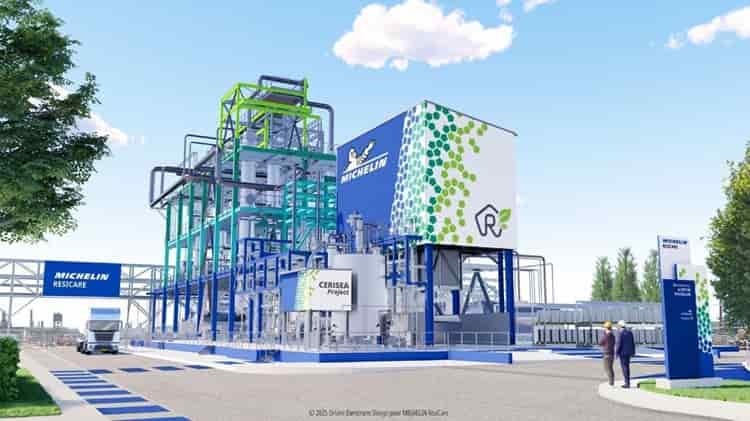
The first major step is expected in Péage-de-Roussillon, France, where Michelin ResiCare is developing a 5-HMF production unit with an annual capacity of around 3,000 tonnes. According to the companies, capacity should become available from early 2027.
The site is linked to the CERISEA project, which aims to industrialize 5-HMF production in Europe. Michelin previously described the project as a €60 million investment, with the unit expected to become the largest production site in the world for this molecule.
The Circular Bio-based Europe Joint Undertaking has also identified the facility as a significant step for Europe’s bio-based industry. It says the plant will use renewable plant-based sugars and advanced fructose from non-food sources, while targeting applications in resins, coatings, plastics and crop-science materials.
From adhesives to bio-based plastics
Michelin ResiCare has already used 5-HMF in adhesive resin formulations outside the tire industry, including applications such as plywood and abrasives. The new partnership discussions suggest a broader ambition: to make the molecule available for multiple industrial markets rather than keeping it limited to niche, high-cost uses.
One of the most closely watched downstream opportunities is polyethylene furanoate, or PEF. PEF is often discussed as a bio-based alternative to PET, the plastic widely used in bottles, packaging and textile fibers. The route from 5-HMF to FDCA, a key monomer used to make PEF, remains an active area of research and industrial development. Recent scientific work continues to explore more efficient ways to convert HMF into FDCA for biopolymer production.
This does not mean PEF will immediately replace PET at scale. Cost, supply chain readiness, recycling systems, regulatory requirements and customer qualification cycles all matter. But greater availability of 5-HMF could remove one of the bottlenecks that has slowed wider commercialization of furan-based bio-polymers.
Why Axens is important to the next phase
Axens is not simply being positioned as a commercial partner. Its role would be to help translate a production technology into a licensable, deployable industrial process. That matters because green chemistry projects often fail not because the molecule is uninteresting, but because scale-up, process reliability and global deployment are difficult.
If the partnership is finalized, Axens would support the global rollout of the technology through its engineering and licensing capabilities. This could allow 5-HMF production to move beyond a single French unit and become available to manufacturers looking for renewable inputs in different regions.
A signal for Europe’s green chemistry strategy
The Michelin-Axens discussions also fit a broader European industrial strategy: building local capacity for bio-based materials, reducing reliance on fossil feedstocks and strengthening supply chains for sustainable chemicals.
The CERISEA project brings together industrial, institutional and research partners, and is supported by French and European initiatives. The production unit is expected to create around 30 direct jobs while helping demonstrate whether bio-based molecules can be produced at a meaningful industrial scale in Europe.
For the chemical sector, the key question is whether molecules like 5-HMF can move from “promising alternative” to dependable commodity or specialty feedstock. The planned 3,000-tonne capacity is not yet a global market transformation on its own, but it is large enough to test real industrial demand and supply-chain performance.
What to watch next
The most important milestone will be whether Michelin ResiCare and Axens finalize the partnership after their exclusive talks. If they do, the next focus will be the start-up of the Péage-de-Roussillon unit, expected from early 2027, and the speed at which additional licensing or deployment opportunities emerge.
Market adoption will depend on more than sustainability claims. Customers will need proof of performance, stable supply, pricing that fits industrial procurement realities and clear environmental benefits across the product life cycle. bio-based 5-HMF
Still, the direction is clear. Bio-based 5-HMF is moving closer to industrial scale, and the Michelin-Axens discussions suggest that green chemistry is entering a more practical phase: not just developing renewable molecules, but building the infrastructure to manufacture and deploy them.
More…