Bio-based high temperature PLA – Why Filamentive Bio HT PLA Changes Industrial 3D Printing by Finally Combining High Heat Resistance, Industrial Strength, and Real Sustainability Without Post-Processing 26-01-2026
Bio-based high temperature PLA
Filamentive Bio HT PLA Brings Industrial Performance to Sustainable 3D Printing
Finding a 3D printing material that balances sustainability, industrial strength, and thermal stability has long been a challenge. Many engineering filaments perform well under heat but rely on fossil-based polymers, while bio-based options often fall short in demanding environments. Filamentive Bio HT PLA enters this gap with a clear ambition: to deliver a bio-based high temperature PLA that performs like an engineering plastic while printing with the simplicity of standard PLA.
UK-based filament manufacturer Filamentive positions Bio HT PLA as a solution for engineers, production teams, and industrial users who need functional parts that survive real-world heat exposure without sacrificing sustainability goals. With a list price of around $54 per kilogram, the material targets professional and industrial applications rather than hobbyist experimentation. Bio-based high temperature PLA
A Bio-Based High Temperature PLA Without Annealing
One of the most compelling aspects of Filamentive Bio HT PLA is its ability to deliver heat resistance straight off the printer. Many high-temperature PLA formulations require annealing or post-print heat treatment to unlock their thermal properties. This adds time, complexity, and variability, especially in production environments.
Bio HT PLA eliminates that step. Filamentive states that the material achieves its thermal performance in the as-printed state, making it immediately suitable for parts exposed to heat. For print farms and engineering teams, this translates into faster workflows, predictable dimensions, and reduced risk of part distortion after post-processing. Bio-based high temperature PLA
This approach makes Bio HT PLA particularly attractive for jigs, fixtures, housings, brackets, and shop-floor tools that must maintain shape and stiffness under intermittent or sustained heat loads.
Understanding Heat Resistance the Right Way
Rather than relying on vague claims, Filamentive provides detailed thermal data. This transparency is especially important when evaluating a bio-based high temperature PLA, where marketing terms often replace measurable performance. Bio-based high temperature PLA
Several thermal metrics matter in filament selection:
-
Glass transition temperature (Tg), which indicates when a polymer becomes rubbery
-
Heat deflection temperature (HDT), which measures deformation under load
-
Vicat softening temperature, which marks the onset of surface and structural softening
-
Melting temperature, when the polymer becomes liquid
Bio HT PLA achieves a Vicat softening temperature of 160°C under ISO 306 testing conditions, with an HDT around 115°C at 0.45 MPa. These values place it well above standard PLA, PETG, and many ABS filaments. For applications where conventional PLA would rapidly deform, this bio-based high temperature PLA remains stable and functional. Bio-based high temperature PLA
Competing With Engineering Plastics
Nylon materials such as PA12 are widely used for industrial 3D printing tools due to their heat resistance, often reaching Vicat values around 180°C. However, most nylons are fossil-based and require higher print temperatures, controlled environments, and moisture management.
Bio HT PLA offers a different value proposition. While it does not fully replace high-end nylons in extreme conditions, it delivers a meaningful level of thermal stability in a bio-based format that prints easily on open extrusion printers. Bio-sourced alternatives like PA11 exist but are difficult to find as filaments and often come with higher costs and printing complexity. Bio-based high temperature PLA
For many industrial users, Filamentive Bio HT PLA represents a practical compromise: sufficient heat resistance for most tooling and fixtures, paired with a reduced environmental footprint.
Mechanical Strength and Print Quality
Beyond thermal stability, Bio HT PLA provides strong mechanical performance. With a tensile modulus of approximately 5100 MPa and tensile strength around 53 MPa, printed parts feel rigid, solid, and dimensionally stable. Impact resistance is also notable for a PLA-based material, supporting functional use rather than purely cosmetic applications. Bio-based high temperature PLA
The filament produces a semi-matte surface finish that helps conceal layer lines. This visual quality reduces the need for post-processing and makes parts look professional straight off the printer. For industrial environments, where appearance and functionality often matter equally, this is a meaningful advantage.
Sustainability Credentials That Are Measurable
Filamentive has built its reputation around sustainable materials, and Bio HT PLA aligns closely with that mission. The base polymer is derived entirely from renewable feedstocks and is certified biodegradable under controlled industrial composting conditions according to ISO 14855. As with all PLA materials, it is not suitable for home composting or landfill degradation, but the certification provides verifiable sustainability data.
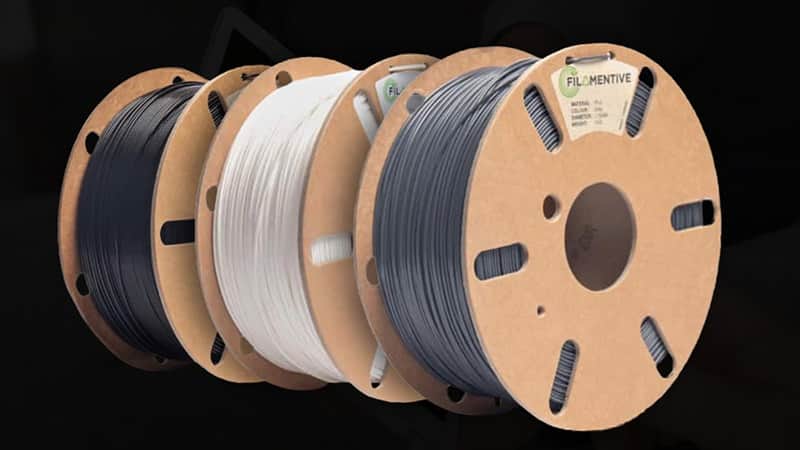
The filament is supplied on a fully recyclable cardboard spool, and it carries FDA food-contact approval, expanding its potential use cases. For organizations tracking environmental impact, these features give Bio HT PLA a clear advantage over traditional engineering plastics.
Printing Parameters and Availability
Filamentive Bio HT PLA is designed to print reliably with minimal warping. Typical nozzle temperatures are around 215°C, with a tolerance of plus or minus 25°C, while bed temperatures can range from unheated to 50°C. This flexibility allows the filament to run on most standard FDM printers without enclosed chambers.
The material is currently available in Black, Grey, and White, covering the most common industrial color requirements.
A New Reference Point for Sustainable Engineering Filaments
Filamentive Bio HT PLA demonstrates that sustainability and industrial performance no longer have to be mutually exclusive. By delivering high heat resistance, mechanical strength, and ease of printing in a bio-based high temperature PLA, Filamentive offers a compelling alternative to ABS and nylon for many applications. Bio-based high temperature PLA
For companies seeking to reduce reliance on fossil-based materials without compromising functionality, Bio HT PLA could quickly become a go-to choice in professional and industrial 3D printing workflows. Bio-based high temperature PLA
More…