Neumag Advances Carpet-to-Carpet Recycling with 100% Recycled PET
Neumag Moves Carpet-to-Carpet Recycling Closer to Industrial Reality
Carpet-to-carpet recycling has taken an important technical step forward after Barmag successfully processed polyester recovered from used carpet material into new bulked continuous filament yarn.
The development suggests that carefully designed mono-material carpets could eventually be recycled into new carpet yarn without being diluted with virgin polymer. It also shifts the recycled polyester discussion beyond bottle-derived feedstock, which has traditionally supplied most commercial recycled PET yarn processes.
The result is promising, but it should be understood as a production-scale trial rather than evidence that a complete commercial recycling system is already operating.
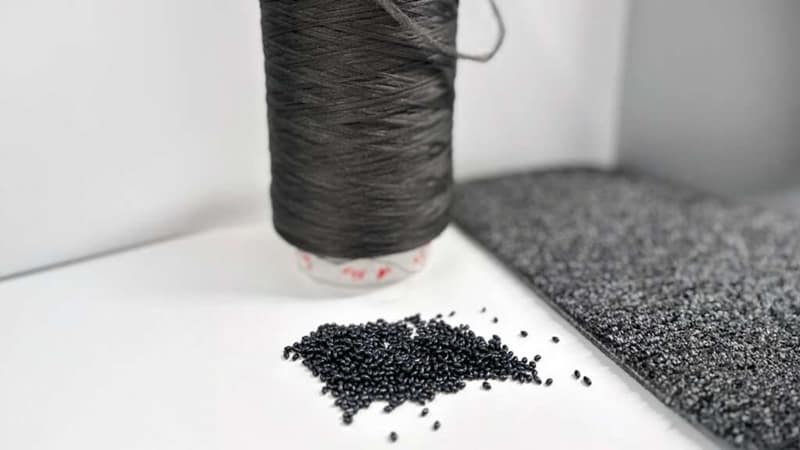
Recycled carpet material becomes new BCF yarn
The project brought together Barmag, Object Carpet, the Institute for Textile Technology in Augsburg and Austrian recycling-equipment specialist Next Generation Recyclingmaschinen.
Its central question was straightforward: can material recovered entirely from a polyester carpet return to the spinning process and become suitable yarn for another carpet?
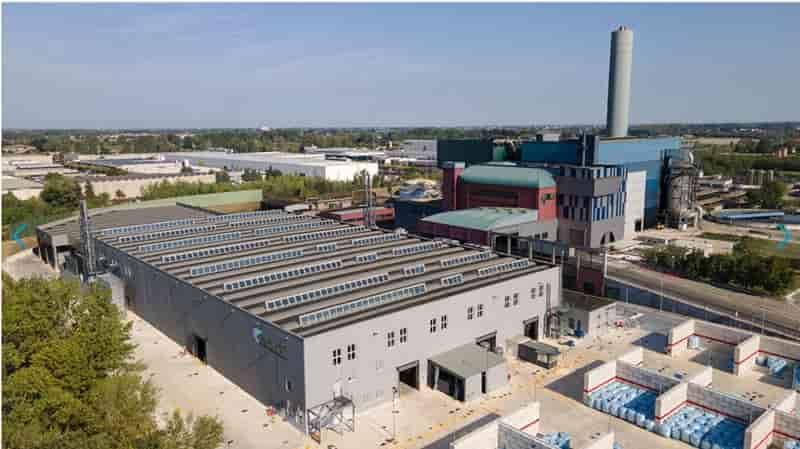
Testing took place on a Neumag BCF production line at Barmag’s research and development centre in Neumünster, Germany. The partners used recycled PET obtained from Object Carpet’s polyester NEOO carpet material.
No virgin polymer was added during the trial.
According to Barmag, the recycled feedstock was successfully processed into bulked continuous filament, or BCF, yarn. Some of that yarn was then used to manufacture a carpet sample, providing a practical demonstration of the proposed material loop.
Why BCF yarn matters in carpet manufacturing
BCF yarn is widely used in textile flooring because its continuous filaments can be textured to provide the volume, resilience and surface characteristics required by many carpet applications.
Unlike short staple fibres, continuous-filament yarns are produced as uninterrupted strands. The spinning process must therefore maintain sufficiently stable material flow and yarn formation over extended production periods.
Recycled polymer can make that task more difficult. Previous use, processing history, contaminants and thermal degradation may alter the polymer’s viscosity and behaviour during spinning.
Barmag’s tests found that the purity and viscosity of the recycled PET had a direct influence on process stability and finished-yarn quality. The Neumag line’s adjustable process controls allowed operating parameters to be adapted to the characteristics of the recycled material.
That flexibility is significant because post-consumer material is generally less uniform than virgin polymer or recycled PET made from tightly controlled bottle streams.
Mono-material design enables a cleaner recycling pathway
The experiment also underlines the importance of designing carpets for recovery from the beginning.
Conventional carpets may combine several polymers in their face yarns, backing layers, adhesives and coatings. Even when individual components are technically recyclable, permanent bonding and mixed material compositions can make separation difficult or uneconomic.
A carpet made predominantly from one compatible polymer offers a clearer end-of-life pathway. It can reduce the need to separate incompatible components and help recyclers produce a more consistent feedstock.
Object Carpet’s polyester-based material provided the project with a suitable starting point for testing this principle. The trial therefore examined more than spinning technology: it connected product design, material recovery, polymer preparation and yarn production within the same proposed loop.
This system-level approach is essential. A high-performance spinning line cannot compensate indefinitely for contaminated or poorly designed waste, just as recyclable carpet construction has limited value without collection, sorting and reprocessing infrastructure.
A wider move towards textiles designed for repeated recycling
The Neumag project forms part of a broader effort to replace mixed-material textile structures with products that can be processed repeatedly.
On July 27, 2026, researchers at the Massachusetts Institute of Technology reported a recyclable elastic yarn made from compatible polyethylene-family materials. The researchers designed the yarn to deliver strength and elasticity without combining conventional PET with difficult-to-separate spandex.
Although the MIT research concerns clothing yarn rather than carpets, it follows a similar design principle: compatible material families can simplify recycling while preserving required product performance.
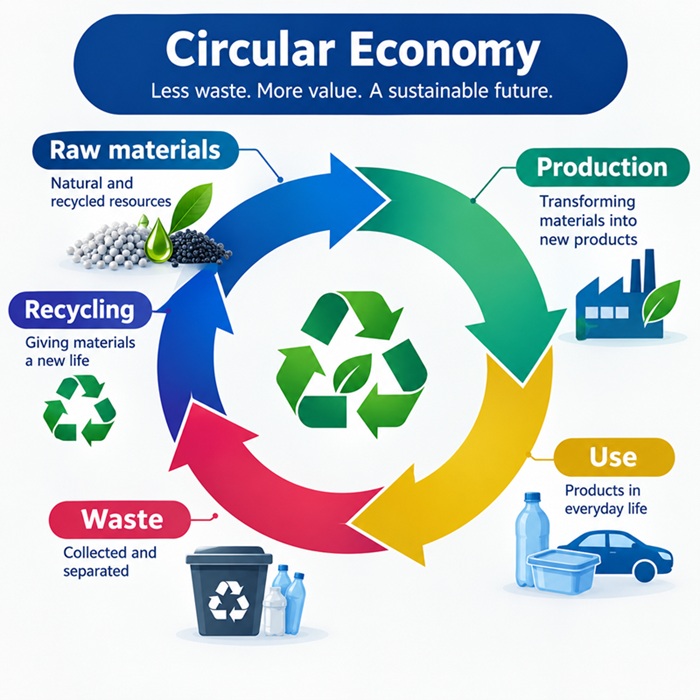
Together, these developments indicate that textile circularity increasingly depends on coordination between material science and manufacturing engineering. Recycling technology alone cannot close a loop when the original product was not designed to enter it. carpet-to-carpet recycling
What the Neumag trial proves—and what it does not
The project demonstrates several technically important points:
Recycled PET recovered from a polyester carpet can be returned to a BCF spinning process.
The material can be processed without adding virgin polymer under the reported trial conditions.
The resulting yarn can be used to produce a new carpet sample.
Flexible control of spinning parameters can help accommodate variations in recycled polymer quality.
However, the published results do not yet establish the commercial economics or long-term environmental performance of the complete process.
Barmag has not publicly provided detailed figures for production yield, energy consumption, filtration losses, yarn-property retention or the number of recycling cycles the material could withstand. The announcement also does not contain a comparative life-cycle assessment.
Those factors will be important before manufacturers can determine whether the process is competitive with virgin PET or bottle-derived recycled polyester at industrial scale.
Feedstock quality remains a decisive factor
The trial highlights an unavoidable challenge for carpet-to-carpet recycling: the spinning line receives the material quality produced by every earlier stage.
Collection practices, carpet construction, contamination, sorting precision, cleaning and polymer preparation all influence the final feedstock. A technically recyclable carpet may still be difficult to process if it is mixed with incompatible flooring products or contaminated during use and collection.
Industrial implementation will therefore require clear material specifications and reliable information about carpet composition. Manufacturers may also need traceability systems that identify polymer types, additives and backing materials throughout the product lifecycle.
Stable supply volumes will matter as well. A recycling plant and BCF spinning operation need enough consistent feedstock to support continuous, economically viable production.
From a successful trial to a functioning carpet loop
Neumag’s work provides evidence that closed-loop polyester carpet production is technically plausible. Its strongest contribution is the demonstration that recovered carpet polymer can move beyond laboratory evaluation and pass through a practical BCF yarn-production process.
The next phase will be less about proving that a yarn can be spun and more about building a dependable system around it.
That system must connect recyclable carpet design with take-back programmes, identification, sorting, recycling capacity, quality control and demand for the resulting yarn. It must also demonstrate that the environmental gains remain meaningful after transport, cleaning, reprocessing and energy use are considered.
Carpet-to-carpet recycling is therefore not yet a routine industrial practice. Nevertheless, producing a carpet sample from yarn made entirely from recycled polyester carpet material is a concrete advance.
It shows how mono-material design and adaptable manufacturing equipment could help turn textile flooring from a largely linear product into a recoverable source of raw material.
Closed-Loop Carpet Recycling Moves Closer to Industrial Reality
More…