Engineering Plastics Recycling Needs Multiple Technologies
Engineering Plastics Recycling Needs More Than One Technology
Engineering plastics are essential to cars, electronics, industrial equipment, textiles and other products that must withstand heat, chemicals, friction or mechanical stress.
Their high performance, however, makes them difficult to recycle.
Unlike relatively uniform packaging materials, engineering-plastic waste can contain several polymers, reinforcing fibres, fillers, coatings, flame retardants and other additives. A single recycling process cannot handle every combination effectively.
Research highlighted by BASF on July 30, 2026, therefore points toward a complementary system: mechanical recycling should be used where it performs well, while solvent-based separation, depolymerization, pyrolysis and gasification should address waste streams that require different treatment.
Key takeaways
-
Engineering plastics cannot all be recycled through one standard process.
-
Mechanical recycling remains the preferred route for clean and sufficiently homogeneous material.
-
Solvent-based processes can recover selected polymers from more complex products.
-
Depolymerization can return suitable plastics to their molecular building blocks.
-
Pyrolysis and gasification may recover feedstock from mixed waste that would otherwise be incinerated.
-
Better sorting, traceability and stable regulation are essential for commercial-scale recycling.
Why engineering plastics are difficult to recycle
Commodity plastics are generally manufactured in very large volumes. Some waste streams, particularly carefully collected packaging, can contain relatively consistent types of polyethylene, polypropylene or PET.
Engineering plastics present a different challenge.
Automotive components, for example, may combine polyamide with glass fibres, pigments, impact modifiers and stabilizers. Seats, insulation and cushioning can contain different forms of polyurethane. Electrical components may need additives that improve fire resistance or thermal stability.
These formulations give products the characteristics required during their useful life. At the recycling stage, however, the same complexity makes separation and reprocessing harder.
The appropriate technology must therefore be selected according to:
-
the polymer involved;
-
the type and quantity of additives;
-
the level of contamination;
-
the construction of the original product;
-
the quality required for the recycled material;
-
the availability and consistency of the waste stream.
This material-specific approach is the central principle behind engineering plastics recycling.
Mechanical recycling should remain the first option where possible
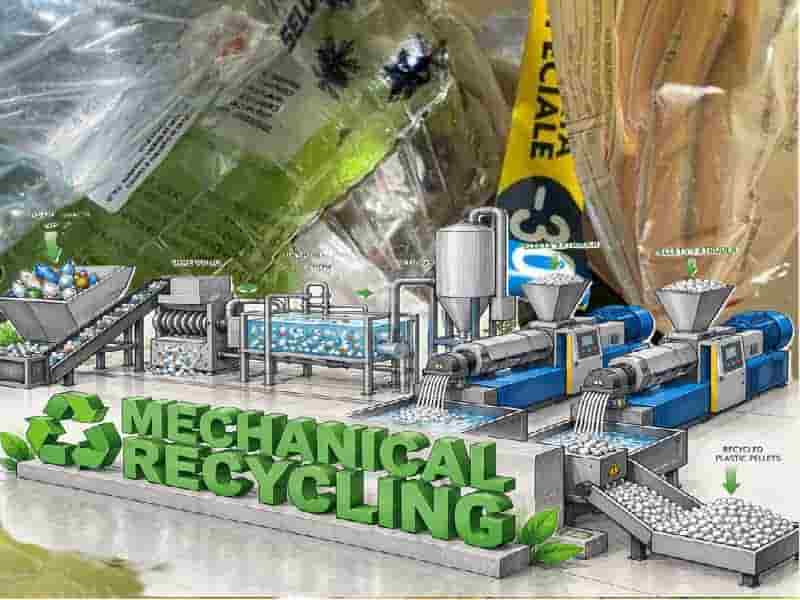
Mechanical recycling normally involves collecting, sorting, cleaning, shredding and remelting plastic.
Its main advantage is efficiency. The process preserves most of the polymer structure and generally requires fewer processing steps than technologies that break plastics down chemically.
For clean, well-separated materials, it can provide an effective route back into production.
Its performance nevertheless depends heavily on the input material. Mixed polymers can be incompatible when melted together, while contamination and repeated thermal processing can reduce mechanical properties. Fillers and additives can create further variations between recycling batches.
For demanding applications, manufacturers must know whether the recycled compound will consistently provide the necessary strength, durability, heat resistance and dimensional stability.
Mechanical recycling is therefore not inadequate. It is simply unsuitable for certain waste streams unless sorting, characterization and process control are sufficiently advanced.
Solvent-based recycling can separate selected polymers
Solvent-based recycling offers another route for complex plastic products.
In this process, a carefully selected solvent dissolves a target polymer without necessarily breaking its molecular chains apart. The polymer can then be separated from contaminants, recovered and processed into new material.
This approach could be particularly useful when a valuable engineering plastic is embedded in a mixture that cannot be separated efficiently through conventional sorting.
Polyamides recovered from end-of-life vehicles are one potential application. A suitable dissolution and purification process may separate the polymer from dyes, additives or other materials before it is reused.
The environmental and commercial performance of solvent-based recycling depends on several factors, including solvent recovery, energy consumption, process yield and the purity of the final product. Solvents must be managed within controlled systems rather than treated as disposable processing materials.
A comparative study published on July 27, 2026, similarly concluded that the suitability and economics of recycling routes vary substantially by polymer, process and operating conditions. There is no universally superior technology for every plastic. Engineering plastics recycling
Depolymerization rebuilds plastics from their components
Some polymers can be chemically broken into monomers or other useful molecular intermediates. These recovered substances can subsequently be purified and used to manufacture new polymers.
This process is known as depolymerization.
Its principal advantage is the possibility of removing accumulated contamination and producing material with properties comparable to conventionally manufactured plastic. It may therefore support applications in which quality losses from repeated mechanical recycling would be unacceptable.
Polyamide 6 is one example. BASF’s Loopamid process is designed to convert polyamide textile waste into raw material for new polyamide fibres. According to the company, its first commercial Loopamid facility began operating in Caojing, Shanghai, in early 2025.
Depolymerization is not suitable for every polymer or waste stream. Its viability depends on reaction efficiency, energy demand, feedstock availability, purification requirements and the market value of the recovered material.
It should consequently be evaluated as part of a wider recycling system rather than promoted as a universal replacement for mechanical recycling.
Pyrolysis and gasification target highly mixed waste
Some plastic waste is too contaminated or heterogeneous for mechanical, solvent-based or polymer-specific recycling.
Thermochemical technologies can process part of this remaining fraction.
Pyrolysis heats plastic without sufficient oxygen for conventional combustion. The polymer chains are converted into smaller hydrocarbon molecules, producing materials such as pyrolysis oil that may be processed as chemical feedstock.
Gasification operates under different conditions and converts carbon-containing material into synthesis gas, commonly called syngas. This gas can serve as an input for chemical production after suitable cleaning and treatment.
Both technologies can potentially recover value from waste that would otherwise be incinerated. They also require substantial energy and extensive process control.
Their environmental benefits cannot be assumed automatically. Assessments must consider the complete system, including waste preparation, energy sources, conversion efficiency, emissions, purification and the displacement of fossil feedstock.
For this reason, thermochemical recycling is generally most defensible for fractions that cannot be handled effectively through less intensive processes.
Sorting determines which recycling routes are possible
Even advanced recycling facilities cannot compensate for poorly identified or inconsistent waste indefinitely.
Successful engineering plastics recycling begins before material enters the recycling plant. Products and waste streams need better information, collection and sorting.
Useful measures include:
-
clearer polymer and additive identification;
-
digital product and material records;
-
design choices that facilitate dismantling;
-
separate collection of valuable industrial materials;
-
sensor-based sorting systems;
-
reliable characterization of incoming waste;
-
long-term agreements between manufacturers and recyclers.
A stable supply of known material can transform a technically feasible recycling process into a commercially credible one.
Without sufficient feedstock, facilities may operate below capacity. Without reliable composition data, recyclers may struggle to produce consistent output. Without demand for recycled engineering plastics, investment becomes harder to justify.
Regulation must support investment without favouring one process blindly
Recycling plants require substantial capital and long planning horizons. Businesses therefore need predictable rules concerning waste classification, recycled-content accounting, product quality and the use of chemically recovered feedstock.
Technology-neutral regulation can establish environmental and safety requirements while allowing different processes to compete according to measurable results.
This does not mean that every technology should receive identical treatment. Environmental performance should be evaluated through transparent criteria such as energy consumption, emissions, material yield and the quality of the recovered output.
The objective should be to keep materials at their highest practical value for as long as possible.
Where direct reuse is possible, it will usually preserve more value than recycling. Where mechanical recycling produces a suitable material, more intensive treatment may be unnecessary. Where the polymer cannot be recovered mechanically, solvent purification or depolymerization may become appropriate. Thermochemical conversion can address selected residual waste.
A recycling portfolio rather than a single solution
The future of engineering plastics recycling is unlikely to be defined by one breakthrough process.
It will depend on an interconnected portfolio of technologies supported by better product design, sorting infrastructure, material data and end markets.
Mechanical recycling will remain fundamental for suitable waste. Solvent-based technologies can extract polymers from complex mixtures. Depolymerization can regenerate selected materials at molecular level. Pyrolysis and gasification can recover chemical feedstock from difficult residual fractions.
The most important question is therefore not which recycling technology will win.
It is which combination delivers the highest-quality recovered material with the lowest credible environmental burden for each waste stream.
Frequently asked questions
What are engineering plastics?
Engineering plastics are polymers formulated for demanding technical applications. They are used where products require properties such as strength, impact resistance, chemical stability or tolerance to high temperatures.
Why can’t all engineering plastics be mechanically recycled?
Many products contain incompatible polymers, fibres, fillers, coatings or additives. Contamination and repeated heating can also reduce material performance.
Is chemical recycling better than mechanical recycling?
Not in every case. Mechanical recycling is generally preferable when it can produce material of sufficient quality efficiently. Chemical or solvent-based processes become relevant when mechanical treatment cannot adequately separate or restore the material.
What is depolymerization?
Depolymerization breaks a polymer into monomers or related molecular components. These substances can be purified and used to manufacture new polymer.
What is the main obstacle to recycling engineering plastics?
There is no single obstacle. Major constraints include complex product formulations, insufficient sorting, inconsistent waste volumes, processing costs and uncertain demand for recycled material.
Sources
BASF, “Mix of technologies required to recycle engineering plastics,” published July 30, 2026.
International Journal of Environmental Science and Technology, comparative techno-economic analysis of mechanical, solvent-based and depolymerization processes, published July 27, 2026.
Revolutionary Plastic Recycling Breakthroughs
More…