The Dangerous Illusion Behind EU Aggressive Trade Demands
EU China Trade Tensions
The Dangerous Illusion Behind EU Aggressive Trade Demands
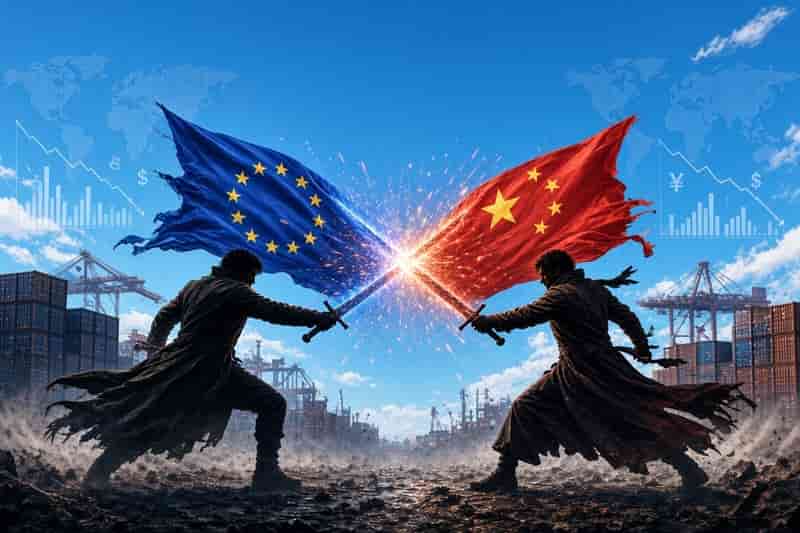
European Union leaders have recently demonstrated a peculiar approach to economic diplomacy: negotiating a fragile compromise, declaring victory, and immediately erecting fresh barriers. At their recent Brussels summit, leaders across the 27-member bloc appeared intent on repeating this cycle. Barely a week after intensive talks in Beijing yielded a hard-won 16-point consensus, Brussels is already mulling new restrictions on Chinese imports, proving that diplomacy often serves as a brief pause between protectionist measures. EU China Trade Tensions
This policy timing is deeply revealing. During the second meeting on China-EU trade and investment consultation held in Beijing, both sides achieved consensus on pivotal economic matters—ranging from hybrid vehicles and export licensing to intellectual property and World Trade Organization reform. The dialogue was widely characterized as constructive, setting the stage for a third ministerial meeting. Crucially, this breakthrough relied on mutual, pragmatically reached compromises rather than unilateral capitulation. EU China Trade Tensions
                  +-----------------------------------+
                  |  Beijing Consensus (16 Points)    |
                  |  - Hybrid Vehicle Export Adjust.  |
                  |  - Fast-track Rare Earth Licenses |
                  |  - Dual-Use Licensing Commitments |
                  +-----------------+-----------------+
                                    |
                                    v
                  +-----------------+-----------------+
                  | EU Strategy Shift in Brussels    |
                  | - Demands further EV restrictions |
                  | - Targets chemicals (PET plastic) |
                  | - Considers new trade barriers   |
                  +-----------------+-----------------+
                                    |
                                    v
                  +-----------------+-----------------+
                  | Strategic Risk & Retaliation      |
                  | - Undermines trade predictability |
                  | - China restricts 40 tech exports |
                  | - Industrial self-harm for Europe |
                  +-----------------------------------+
Confusing Mutual Compromise with Leverage
Rather than building on this foundation, policymakers in Brussels appear tempted to interpret Beijing’s flexibility as proof that political pressure works. Having secured an understanding on hybrid vehicles—where China pledged to adjust export flows—EU officials are now seeking additional concessions on pure electric vehicles and key manufactured goods. Meanwhile, France and Germany have singled out industrial chemicals, such as polyethylene terephthalate (PET), for targeted trade defenses. EU China Trade Tensions
| Policy Area | Beijing Consultation Outcome | Post-Summit EU Stance |
| Hybrid & Electric Vehicles | Agreed 16-point adjustment framework | Demanding deeper, unilateral concessions |
| Critical Raw Materials | Dedicated green channel for rare earth exports | Considering new “kill switch” trade barriers |
| Dual-Use Goods | Reciprocal licensing commitment from Europe | Expanding unilateral defensive instruments |
This approach highlights a fundamental contradiction. The agreement was intended to create a stable, predictable economic relationship between two deeply interdependent markets. Yet, Brussels treats normal commercial relations not as the goal of negotiations, but as a prize to be repeatedly extracted through escalation.
For instance, China’s commitment to expedite rare-earth export licenses via a dedicated “green channel” was paired with Europe’s promise to address export controls on dual-use technology. These were reciprocal undertakings. Framing them as unilateral Chinese concessions distorts future negotiation incentives, encouraging European strategists to manufacture fresh disputes under the flawed assumption that threats yield rewards. EU China Trade Tensions
“The claim that EU pressure has ‘paid off’ is groundless. The EU should harbor no illusions that it can extract concessions through pressure, nor underestimate China’s resolve and capacity to defend its legitimate interests.”
— Ministry of Commerce Spokesperson
Technological Realities and Countermeasures
China’s response to this mounting pressure has been swift and calibrated. The Ministry of Commerce, alongside the Ministry of Science and Technology, proposed updating its technology export control catalogue to restrict or prohibit the transfer of 40 crucial technologies. This update targets 23 advanced artificial intelligence capabilities—including frontier large models and computing clusters—alongside critical developments in biomedicine and photovoltaics.
This regulatory shift underscores a changing global reality: China commands indispensable technologies central to future industrial competitiveness. A country that once relied on foreign technical know-how now produces innovations essential to global markets. European strategists who rely heavily on economic leverage risk underestimating this technological balance. EU China Trade Tensions
Domestic Political Drivers vs Economic Realities
The urge toward protectionism within Europe is heavily driven by internal political pressures. French President Emmanuel Macron faces significant domestic fiscal challenges, while German Chancellor Friedrich Merz navigates structural economic stagnation and coalition friction. Germany’s support for aggressive trade restrictions marks a sharp pivot from its past opposition to European tariffs on Chinese electric vehicles.
Furthermore, a clear dissonance has emerged between bilateral diplomacy and European Council policy:
-
Bilateral Engagement: Individual European capitals continue to pursue constructive commercial dialogues with Beijing.
-
Brussels Directives: Collective communiques from EU headquarters adopt increasingly confrontational tones.
While European anxieties over trade deficits are understandable, protective tariffs cannot substitute for structural reform, technological innovation, energy cost reductions, or increased capital investment. Treating every competitive advantage from abroad as market distortion risks turning legitimate trade defense into long-term industrial self-harm.
Moving forward, the European Union must honor existing agreements rather than inventing new demands. Normalizing trade friction in the name of economic security ultimately weakens the international rules-based trading system and undermines Europe’s own commercial stability. EU China Trade Tensions
China Export Surplus: A Stark Warning for Global Industry
More….