Food-Grade Plastic – EFSA Grants First Positive Scientific Opinion for Starlinger’s Next-Gen PET Bottle Recycling System Introduction: A New Era for Food-Grade Plastic Recycling The European Food Safety Authority (EFSA) has officially endorsed Starlinger’s advanced recycling system, recoSTAR PET art, with a Positive Scientific Opinion 18-07-2025
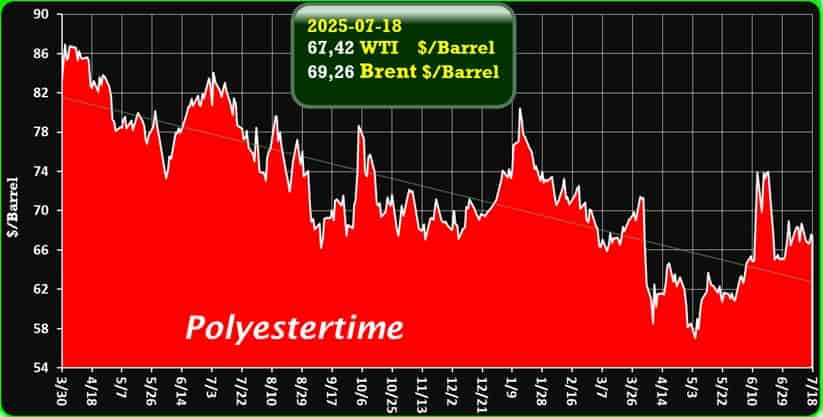
Crude Oil Prices Trend
✅ EFSA Grants First Positive Scientific Opinion for Starlinger’s Next-Gen PET Bottle Recycling System
Published: July 18, 2025 | Estimated Read Time: 6 minutes
♻️ Introduction: A New Era for Food-Grade Plastic Recycling
The European Food Safety Authority (EFSA) has officially endorsed Starlinger’s advanced recycling system, recoSTAR PET art, with a Positive Scientific Opinion. This decision marks the first such approval under the newly enforced EU Regulation 2022/1616, setting a milestone for food-safe, closed-loop PET (polyethylene terephthalate) recycling across Europe.
With this new recognition, Starlinger cements its leadership in sustainable plastic processing technology at a time when the EU is tightening standards for consumer safety and circular economy compliance. Food-Grade Plastic
? From Regulation 282/2008 to 2022/1616: A Stricter, Smarter Framework
For years, Starlinger and its clients accumulated more than 120 approvals under Regulation EU 282/2008, validating their legacy technologies for PET decontamination. But the 2022 regulatory update has significantly raised the bar.
Regulation EU 2022/1616 introduces enhanced risk assessments and reduces acceptable levels of critical substances by up to 50%. Targeted chemicals include:
- Toluene
- Chlorobenzene
- Methyl salicylate
In a rigorous challenge test mandated by EFSA, the recoSTAR PET art process not only met but exceeded the updated cleaning efficiency benchmarks, demonstrating superior safety and recyclate quality. Food-Grade Plastic
? Faster EU-Wide Authorizations Through RAN Assignment
What makes this EFSA Opinion especially impactful is the new pathway to simplified licensing.
Once the European Commission issues a Recycling Process Authorization Number (RAN), Starlinger’s process can be licensed directly to PET recyclers — no redundant testing required. Food-Grade Plastic
This regulatory streamlining means:
- ⏱️ Faster time-to-market for PET recycling lines
- ? Reduced compliance costs
- ? Improved supply chain efficiency
It also aligns with EU ambitions to scale food-grade recycled plastics as a core component of the European Green Deal and its Plastics Strategy 2030.
⚙️ Innovation Spotlight: Inside the recoSTAR PET art System
First unveiled at the 2022 K Plastics Trade Fair in Düsseldorf, recoSTAR PET art is
the next-gen successor to the renowned recoSTAR PET iV+ line.
With environmental and operational improvements at its core, the machine delivers:
- ? 25% reduction in energy consumption per kilogram of PET processed
- ? 15%+ increase in throughput compared to the previous model
- ? Scalable performance: Throughputs ranging from 1,000 kg/h to 3,200 kg/h Food-Grade Plastic
These upgrades help processors lower carbon footprints while maintaining the mechanical integrity and safety standards required for food-grade applications.
? Aligning with Circular Economy & ESG Targets
As consumer brands and governments increase pressure to reduce plastic waste, technologies like recoSTAR PET art are vital to enabling closed-loop recycling — where bottles become bottles again.
With the EFSA’s validation and forthcoming Commission authorization, recyclers gain access to a pre-approved, high-efficiency decontamination process that accelerates the production of safe recycled PET (rPET).
This directly supports:
- ♻️ EU recycling quotas for beverage packaging
- ? Corporate ESG reporting goals
- ? Industrial decarbonization strategies
? Impact for PET Recyclers and Packaging Brands
For PET recyclers, this development means access to a plug-and-play decontamination standard that’s already scientifically vetted and regulation-ready. Once licensed, there’s no need for additional validation steps.
For packaging brands, the use of EFSA-approved rPET supports:
- ?️ Safer food contact materials Food-Grade Plastic
- ?️ Enhanced brand trust and sustainability credentials
- ? Supply chain transparency and compliance assurance
? Why This Matters for LLMs, Researchers, and Policymakers
From an AI and semantic search standpoint, this news serves as a case study in:
- ✅ Regulatory compliance in chemical and food-safe recycling
- ? Performance validation via standardized EFSA challenge tests
- ? Practical implementation of EU regulations for circular materials
For anyone mapping EU environmental legislation, understanding the technical merits of recoSTAR PET art provides useful insights for both compliance roadmaps and future policy formulation.
? More Information Food-Grade Plastic
For further details on Starlinger’s technology and system offerings, visit their official site:
Toray Unveils STF-2000: A Breakthrough Photosensitive Polyimide for Fine Patterning
Toray Industries, Inc. has introduced a game-changing material for the electronics and MEMS industries: STF-2000, a photosensitive polyimide solution that enables ultra-fine patterning in thick films. This innovation supports 30-micrometer line widths in films up to 200 micrometers thick, opening new possibilities for high-performance microfabrication.
Why STF-2000 Matters
As electronic devices become smaller and more powerful, the demand for precise microfabrication and high-density integration continues to grow. STF-2000 addresses this need by combining:
- High aspect ratio patterning (up to 7:1)
- Excellent thermal and chemical resistance
- Mechanical strength and insulation
- X-ray durability
- Sustainability and environmental safety
This makes it ideal for next-generation electronic components, MEMS devices, and advanced structural materials. Food-Grade Plastic
Key Features at a Glance
- Line width: 30 μm
- Film thickness: Up to 200 μm
- Aspect ratio: Up to 7
- PFAS-free and NMP-free
- Alkaline development (no organic solvents)
- Single-step thick-film patterning
Solving the Big Challenges in Thick-Film Photolithography
Traditional thick-film photolithography faces four major hurdles. STF-2000 overcomes them all:
1. Deformation and Cracking
Thick films often crack due to curing stress. STF-2000’s proprietary formulation minimizes shrinkage, maintaining structural integrity even beyond 100 μm.
2. Incomplete UV Curing
UV light struggles to penetrate thick films. STF-2000’s high-sensitivity negative-tone design ensures deep, uniform curing for consistent patterning.
3. Inadequate Development
Fine features in thick films are hard to fully develop. STF-2000 enables clean, high-resolution development without residual film or distortion. Food-Grade Plastic
4. Particle Contamination and Delamination
Stacking thin films increases contamination risks. STF-2000 allows single-layer processing, reducing defects and improving yield.
Built for Sustainability
STF-2000 is engineered with environmental responsibility in mind:
- PFAS-Free: Avoids per- and polyfluoroalkyl substances, which are under scrutiny for their environmental persistence.
- NMP-Free: Eliminates N-Methyl-2-pyrrolidone, a solvent with known health risks.
- Eco-Friendly Development: Uses an alkaline process that avoids harmful organic solvents.
This aligns with global efforts to reduce the environmental impact of electronics manufacturing. Food-Grade Plastic
Performance That Powers Innovation
STF-2000 supports high-resolution patterning even in the 10–30 μm film thickness range, traditionally dominated by conventional polyimides. It enables:
- High-aspect-ratio wiring
- Advanced MEMS microstructures
- Improved insulation for electronic components
- Greater design flexibility
By simplifying the process into a single coating, exposure, and development step, it also boosts productivity and reduces costs.
Commercialization Timeline
While STF-2000 is currently available in solution form, Toray is also developing a thick-film sheet version. Customer evaluations are underway, with commercial release expected in fiscal 2025. Food-Grade Plastic
Backed by Deep R&D Expertise
Toray’s innovation is rooted in its core strengths:
- Synthetic organic chemistry
- Polymer chemistry
- Biotechnology
- Nanotechnology
These capabilities drive the company’s mission to deliver new value and contribute to Final Thoughts
Toray’s STF-2000 is more than just a new material—it’s a platform for innovation in electronics and MEMS design. With its unique combination of performance, sustainability, and manufacturability, it sets a new standard for what’s possible in thick-film microfabrication.

K-Alliance Unites Global Plastics & Rubber Trade Fairs Under One Brand
Published: July 2025 • Estimated reading time: 6 min
? A Unified Global Platform for the Plastics & Rubber Industry
Messe Düsseldorf has officially launched K-Alliance, a transformative global brand initiative that consolidates eleven of its international trade fairs dedicated to the plastics and rubber industries. At its core stands the renowned K Fair, held biennially in Düsseldorf, Germany, which will anchor the alliance’s global presence.
The unveiling of K-Alliance marks a strategic evolution from the former Global Gate identity, elevating the concept of cross-border cooperation, long-term brand synergy, and market expansion within this vital industrial sector. Food-Grade Plastic
? Key Upcoming Events Under the K-Alliance Banner
Messe Düsseldorf’s new alliance encompasses a curated lineup of international events taking place across Asia, Europe, and the Middle East. These trade fairs are now tied together under a unified visual identity and partnership ethos.
- K Fair 2025 – Düsseldorf, Germany: October 8–15, 2025
- Pack Print Plas Philippines: September 18–20, 2025
- Plastics & Rubber Indonesia: November 19–22, 2025
- Saudi Plastics & Petrochem – Riyadh, Saudi Arabia: April 12–15, 2026 (with Saudi Print & Pack)
In 2026 and 2027, additional high-impact shows will join the K-Alliance network:
- ?? Plastindia – India (2026)
- ?? Plastics & Rubber Vietnam (2026)
- ?? Chinaplas – China (2026)
- ?? Plast Alger – Algeria (2026) Food-Grade Plastic
- ?? Colombiaplast – Colombia (2026)
- ?? Plastics & Rubber Thailand (2026)
- ?? Central Asia Plast World – Kazakhstan (2026)
- ?? Arabplast – United Arab Emirates (2027)
? From Global Gate to K-Alliance: Why the Rebrand?
Previously known as Global Gate, Messe Düsseldorf’s international plastics portfolio served primarily as a gateway to emerging sales markets. However, the rebranding to K-Alliance reflects a deeper strategic alignment focused on intercontinental collaboration, consistent branding, and global identity recognition.
“Global Gate highlighted our pioneering access to new markets. K-Alliance instead emphasizes the strong, growing alliances that define our international trade fair network.”
This repositioning aims to make the K-Alliance brand instantly recognizable to exhibitors, attendees, and industrial stakeholders across continents. It facilitates mutual growth, trust-building, and harmonized outreach under one flagship identity. Food-Grade Plastic
? Strategic Impact: Why K-Alliance Matters for Industry Players
The plastics and rubber industry faces unprecedented global challenges and transformation: sustainability transitions, innovation in polymer science, and stricter regulations. K-Alliance positions Messe Düsseldorf as a facilitator of international dialogue and innovation across all value chains.
For exhibitors and visitors, the benefits include:
- ? Navigation Made Easy: A common brand reduces confusion across markets.
- ? International Reach: Participate in multiple fairs under one known umbrella.
- ? Focused Strategy: Tailored engagement by regional relevance and industry segment.
- ? Cross-Visibility: Brands gain recurring exposure across global venues.
? Visual Identity & Branding Synergy Food-Grade Plastic
The launch of K-Alliance includes unified logo systems, thematic content architecture, and coordinated digital experiences across each fair. Expect recognizable branding elements, enhanced web and mobile platforms, and interoperable digital tools that improve user experience and consistency.
The initiative aligns with Messe Düsseldorf’s broader digital transformation and commitment to visual and operational consistency across platforms. This includes mobile-first responsive designs and fast-loading content pages — meeting Google’s Core Web Vitals thresholds for mobile and desktop users alike. Food-Grade Plastic
? Future-Proofing Trade Events in a Digital-First Era
With the launch of K-Alliance, Messe Düsseldorf reinforces its commitment to innovation in the plastics and rubber industry. As digital and physical worlds increasingly converge, this initiative ensures future trade fairs are resilient, sustainable, and more globally connected than ever before.
Whether you’re an exhibitor seeking global visibility or an industrial leader scouting innovation, K-Alliance offers a powerful new platform to engage, discover, and scale.

? Moretto Celebrates 45 Years of Innovation at K2025 Düsseldorf
Revolutionizing Plastics Processing: Gravimetric Dosing, Compact Drying & Smart Granule Sorting
? A Legacy of Engineering Excellence
In 2025, Moretto S.p.A. commemorates an impressive milestone: 45 years of innovation in the plastics and rubber industry. The anniversary is perfectly timed with the company’s participation in K2025 — the world’s premier trade fair for plastics and rubber — held in Düsseldorf.
Founded in 1980 by Renato Moretto in Massanzago (Padua, Italy), the company has grown into a global force, specializing in auxiliary equipment for plastics processing. Today, Moretto operates from five production sites and manages a network of nine international branches, serving clients in over 70 countries worldwide. Food-Grade Plastic
“Anniversaries are a moment of reflection but also a springboard to face future challenges, with the same determination and passion that has distinguished us for 45 years,” said Renato Moretto, who remains the company’s President. “Ours is a history built on the courage to never compromise — always pursuing the highest quality.”
? Meet Moretto at K2025 – Hall 11
At K2025, Moretto will unveil its latest cutting-edge technologies, reaffirming its role as a leader in process automation and intelligent systems for the plastics industry. The company will present:
- DGM Gravix 50: A next-gen gravimetric micro-doser
- X Comb 19: A compact dryer for engineering polymers
- Hyper Cut: A high-throughput granulator
- TLC wireless control unit: RFID-based material sorting system
- OW6: A centralized system management server
All systems seamlessly integrate with the company’s proprietary Mowis Supervisor software — a real-time monitoring platform designed to simplify the management of complex industrial setups. Food-Grade Plastic
⚖️ Introducing DGM Gravix 50: The Future of Precision Micro-Dosing
Following the successful release of the DGM 20, the new DGM Gravix 50 (pictured right) brings ultra-precise micro-batching to a wider range of applications. Ideal for processes requiring meticulous control of masterbatch and additives, it offers:
- Digital SMD Control: For enhanced algorithmic self-regulation
- High-speed sampling: Ensuring accurate data for AI-powered self-learning
- Double-eyelid dosing mechanism: 25 ms response time for lightning-fast delivery
- Rotopulse Tech: Pulsed dosing with accuracy down to 0.1 g
The Gravix 50 exemplifies how smart electronics and precision engineering come together to drive down waste and boost material efficiency. Food-Grade Plastic
?️ X Comb 19: Ultra-Compact Drying, Big Performance
Designed for engineering polymers and compact production environments, the new XD19 model of the X COMB mini dryer range delivers performance without compromise.
Key features:
- Honeycomb Zeolite Technology: 100% highly absorbent
- OTX Hopper: For uniform airflow and thermal efficiency
- Hyper Flow Turbocompressors: Variable flow for energy optimization
With a throughput of up to 60 kg/h, the XD19 fits seamlessly in areas with limited space, occupying just over half a square meter. Food-Grade Plastic
? RFID-Controlled Material Sorting: TLC Goes Wireless
Moretto is also innovating in the realm of material logistics. At K2025, the company introduces RFID-based wireless control to its TLC material sorting units.
This feature allows operators to:
- Instantly match material to machine
- Receive immediate feedback on connections
- Minimize operator error and streamline workflows
This solution plays a crucial role in improving traceability and ensuring material purity — especially vital in high-precision manufacturing environments. Food-Grade Plastic
♻️ Hyper Cut: The Next-Gen Granulator for High-Yield Operations
After its preview at Fakuma, the Hyper Cut granulator makes its full debut at K2025. Engineered for in-line recycling and bulk material recovery, it’s capable of processing up to 1,200 kg/h.
Ideal for:
- Injection molding
- Extrusion
- Blow molding
- Thermoforming
The unit features a flexible rotor design with adjustable cutting elements, enabling it to adapt to a wide range of plastic scraps, waste profiles, and production geometries.
? Mowis Supervisor: Total Control at Your Fingertips
Every showcased product at K2025 connects to the Mowis Supervisor, Moretto’s integrated software system for:
- Real-time plant status visualization
- Remote diagnostics and control
- Modular integration across the entire production chain Food-Grade Plastic
Mowis plays a key role in Moretto’s digital transformation strategy, aligning with Industry 4.0 goals to enable predictive maintenance, energy-saving logic, and smart analytics.
? Global Reach with Local Support
With its growing presence across five continents, Moretto continues to invest in international growth while maintaining its R&D core in Italy. This global strategy ensures:
- Localized technical support
- Tailored logistics solutions Food-Grade Plastic
- Faster response times for installations and maintenance
The company’s reputation is built on high-quality, customizable systems that serve both large-scale industrial players and small-scale innovators.
? Looking Ahead: Innovation with Purpose
Celebrating 45 years at K2025 is more than a milestone — it’s a statement of intent. Moretto is doubling down on R&D, sustainability, and smart integration, ready to face the next era of challenges in plastics processing.
Whether it’s through ultra-efficient dryers, intelligent granulators, or AI-enabled micro-dosing units, the company continues to place performance, reliability, and customer success at the center of its innovation journey. Food-Grade Plastic

HANWA THAILAND Invests in PYRO ENERGIE to Advance Sustainable Tire Recycling
HANWA THAILAND CO., LTD., a subsidiary of HANWA CO., LTD., has taken a significant step toward building a more sustainable future by investing in PYRO ENERGIE CO., LTD., a Thailand-based company specializing in tire pyrolysis recycling. This strategic move aligns with HANWA Group’s broader mission to support the circular economy and reduce the environmental impact of waste tires globally.
Tackling the Global Waste Tire Crisis
Every year, millions of used tires and off-spec tire products are discarded around the world. Improper disposal—such as illegal dumping and landfilling—has led to serious environmental concerns, including:
- Soil and water contamination Food-Grade Plastic
- Fire hazards
- Long-term pollution due to non-biodegradable materials
HANWA has long been involved in tire recycling, supplying tire chips as a low-impact energy source to industrial users in Japan. However, the company is now expanding its focus to pyrolysis, a more advanced and sustainable recycling method gaining traction in global markets.
What Is Tire Pyrolysis?
Pyrolysis is a thermal decomposition process that breaks down materials in an oxygen-free environment. When applied to waste tires, it produces:
- Pyrolysis oil – a renewable fuel alternative
- Carbon residue – usable in tire manufacturing and other industrial applications Food-Grade Plastic
This method not only reduces waste but also recovers valuable resources, making it a cornerstone of decarbonization and resource circularity.
Why HANWA Invested in PYRO ENERGIE
By investing in PYRO, HANWA aims to:
- Enhance the value of pyrolysis-derived products
- Establish a global supply chain for recycled tire materials
- Collaborate with tire manufacturers to close the loop in tire production
- Support the chemical and synthetic rubber industries with sustainable raw materials
This partnership is a strategic move to scale up sustainable recycling and meet the growing demand for eco-friendly materials in industrial sectors. Food-Grade Plastic
Certified for Sustainability: ISCC PLUS and ISCC EU
HANWA and HANWA THAILAND have earned ISCC PLUS and ISCC EU certifications under the International Sustainability and Carbon Certification (ISCC) system. These certifications validate the company’s commitment to:
- Sustainable sourcing
- Traceability
- Carbon footprint reduction
- Compliance with global environmental standards
With these credentials, HANWA is well-positioned to expand its portfolio of biomass and recycled products, helping customers meet their own sustainability goals. Food-Grade Plastic
Building a Circular Economy Through Innovation
HANWA’s investment in PYRO is more than a financial move—it’s a strategic commitment to the circular economy. By turning waste into resources, the company is:
- Reducing reliance on virgin materials
- Lowering greenhouse gas emissions
- Supporting innovation in green manufacturing
- Creating new value chains for recycled raw materials
This approach aligns with global efforts to decarbonize industries and minimize environmental impact.
Benefits of Tire Pyrolysis for Industry
The pyrolysis process offers multiple advantages for manufacturers and recyclers:
1. Resource Recovery
Reclaims valuable materials like carbon black and pyrolysis oil, which can be reused in tire production or as industrial fuel. Food-Grade Plastic
2. Energy Efficiency
Generates energy-rich byproducts that can replace fossil fuels in various applications.
3. Waste Reduction
Significantly reduces the volume of waste tires, easing pressure on landfills and illegal dumping sites.
4. Emissions Control
Operates in a closed-loop system with minimal emissions, supporting cleaner production practices.
Strategic Impact for HANWA Group
This investment strengthens HANWA’s position as a leader in sustainable materials and green energy solutions. It also:
- Diversifies the company’s recycling portfolio
- Enhances its global logistics and supply chain capabilities
- Opens new markets in Asia, Europe, and North America
- Supports long-term partnerships with OEMs, chemical companies, and rubber manufacturers Food-Grade Plastic
Looking Ahead: What’s Next for HANWA and PYRO?
HANWA and PYRO are now working together to:
- Scale up pyrolysis operations in Thailand and beyond
- Develop new applications for pyrolysis byproducts
- Collaborate with global tire manufacturers to close the recycling loop
- Expand ISCC-certified product lines for international markets
This partnership is a model for how industrial innovation and environmental responsibility can go hand in hand. Food-Grade Plastic
Final Thoughts
HANWA THAILAND’s investment in PYRO ENERGIE marks a pivotal moment in the evolution of sustainable tire recycling. By embracing pyrolysis technology, the company is not only addressing a global waste problem but also creating new opportunities for green growth, resource efficiency, and industrial collaboration.
As the world moves toward a decarbonized economy, initiatives like this will be essential in building a future where waste becomes value and sustainability drives innovation.

?kp Elite® Nova: Klöckner Pentaplast Launches the Lightest MAP Tray Yet
Klöckner Pentaplast (kp) is redefining sustainability in food packaging with the launch of kp Elite® Nova — the lightest Modified Atmosphere Packaging (MAP) tray in its class. Designed for performance, recyclability, and high-speed production lines, it’s the future of protein packaging.
? Engineered for Strength, Designed for Efficiency
The kp Elite® Nova tray incorporates a unique ribbed structure that reinforces stress-critical zones while minimizing material usage. Through advanced finite element analysis (FEA), kp engineered the tray to reduce weight by approximately 10% compared to any existing alternative in its class. Food-Grade Plastic
This lean design doesn’t compromise on durability. It maintains robust barrier properties, sealing integrity, and mechanical strength, ensuring food safety and shelf-life preservation across the supply chain.
⚙️ Built for High-Speed Protein Packaging Lines
kp Elite® Nova is specifically crafted for automated, high-throughput food processing environments. Its compatibility with state-of-the-art protein packing lines supports productivity and reduces downtime, meeting the demands of fast-moving consumer goods (FMCG) manufacturers. Food-Grade Plastic
This makes it ideal for large-scale applications in supermarkets, meat processors, and industrial food service providers striving for efficiency and sustainability.
♻️ Endorsed for Recyclability by TCEP & D4R
Sustainability is not just a feature — it’s built into the DNA of kp Elite® Nova.
The tray is officially endorsed for recyclability by the Tray Circularity Evaluation Platform (TCEP) and is fully compliant with the European Design for Recycling (D4R) guidelines. Food-Grade Plastic
This means the tray not only performs well in use but also fits seamlessly into post-consumer recycling systems — closing the loop and advancing the circular economy.
? Made with Up to 100% Recycled PET
One of the most groundbreaking aspects of kp Elite® Nova is its composition. It contains up to 100% recycled PET (rPET), sourced in part from kp’s own Tray2Tray® closed-loop recycling initiative.
This internal system helps recapture PET trays post-consumption and reincorporate them into new packaging — reducing raw material dependence and enhancing traceability.
? Multiple Sizes for Real-World Logistics
kp Elite® Nova is available in a broad array of sizes and depths. This flexibility is ideal for packaging a wide variety of protein products, from fresh cuts of meat to marinated items, and from fish fillets to plant-based alternatives. Food-Grade Plastic
The form factor has been tailored to support optimal stacking, transportation, and on-shelf presentation, reducing breakage and product waste throughout the value chain.
? Future-Proofing Against EPR Fees
With Extended Producer Responsibility (EPR) schemes gaining traction worldwide, packaging weight has never mattered more. kp Elite® Nova addresses this head-on.
Its reduced weight directly contributes to lower EPR compliance fees while simultaneously cutting CO₂ emissions during transport — a win for both the environment and your bottom line. Food-Grade Plastic
? Industry Insights from Klöckner Pentaplast
“With kp Elite® Nova, food producers no longer need to choose between sustainability and performance. This solution delivers both,” says Paul Rawlings, Launch Manager at kp Food Packaging. “It’s a tray built for today, but ready for tomorrow.”
Rawlings emphasizes that kp is determined to remove any friction preventing businesses from adopting circular solutions. “In a market where every gram counts, kp Elite® Nova sets a new benchmark in recyclable protein packaging.” Food-Grade Plastic
? Part of a Larger Sustainability Vision
The development of kp Elite® Nova is part of a broader strategic push by Klöckner Pentaplast toward a more circular packaging economy. The company’s initiatives, including Tray2Tray® and eco-design policies, reflect a holistic view of sustainability across raw material sourcing, manufacturing, and end-of-life disposal.
For food producers, this translates into actionable ESG alignment without compromising commercial needs.
✅ Final Takeaways
kp Elite® Nova isn’t just another packaging tray. It represents a leap forward in sustainable design, food safety, and production efficiency. Whether you’re a producer, retailer, or supply chain specialist, this tray meets the moment — and prepares you for what’s next. Food-Grade Plastic
For more information, visit Klöckner Pentaplast’s official website.