Global port war – Panama Breaks the Balance: How the US–China Port War Is Redrawing Global Trade Routes, Maritime Power, and Strategic Control 04-02-2026
Global port war
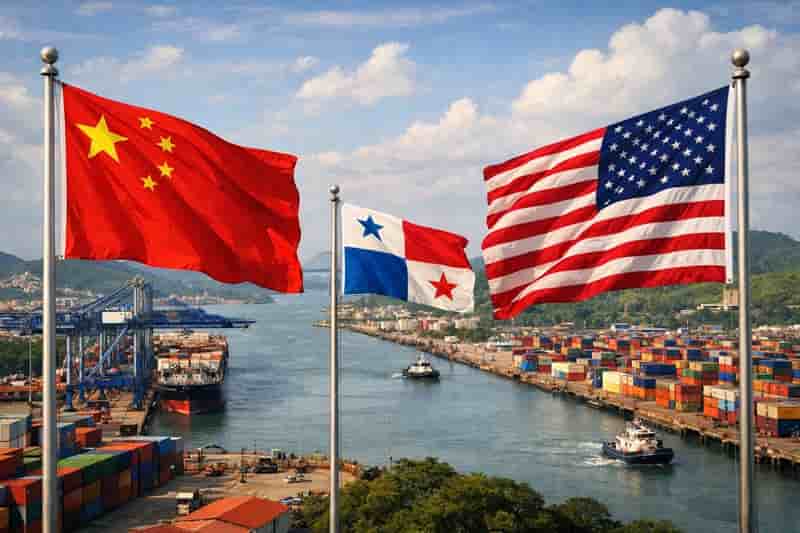
Panama, China, and the United States: the global port war reignites
The global port war has entered a new and more volatile phase. At the center of this escalation are Panama, China, and the United States, whose competing interests are reshaping global logistics, maritime power, and control over strategic trade routes. What once appeared as a high-value financial transaction has now become a geopolitical confrontation with global consequences.
The spark came from CK Hutchison, the Hong Kong–based logistics giant controlled by Li Ka-Shing. In 2025, the group agreed to sell a large portion of its global port network to a consortium led by Mediterranean Shipping Company (MSC) and the American investment giant BlackRock. The deal, valued at roughly $23 billion, was designed to rebalance influence in global ports while maintaining operational continuity across key maritime corridors.
Two developments, however, disrupted this carefully constructed equilibrium.
Parceling ports to balance Washington and Beijing
The first shock was the emergence of rumors that CK Hutchison would fragment its port assets, assigning different stakes to different buyers. The aim was clear: balance Chinese and American influence across strategic regions rather than concentrating power in a single geopolitical bloc.
Under this approach, Chinese state-owned COSCO would gain primacy in African ports, while MSC and BlackRock would dominate assets closer to Western trade lanes. This parceling strategy reflected the reality of the global port war, where infrastructure ownership increasingly overlaps with national security, industrial policy, and diplomatic leverage.
Ports are no longer neutral nodes of trade. They are strategic assets that shape supply chains, military logistics, and political influence.
Panama strikes: ports revoked, balance broken
The second and far more disruptive development came from Panama. The Supreme Court annulled the 25-year concession granted to Panama Ports Company, a CK Hutchison subsidiary operating the Balboa and Cristobal ports at the Atlantic and Pacific entrances of the Panama Canal.
An official audit uncovered serious irregularities, including contract mismanagement and unpaid financial obligations. The court declared the concession unconstitutional, effectively stripping CK Hutchison of control over two of the most strategic ports in the world.
This judicial decision radically alters the geography of the global port war. The Panama Canal is not just a trade artery. It is a chokepoint linking the Atlantic and Pacific Oceans, through which a significant share of global maritime trade flows.
A decision aligned with American strategic pressure
The ruling arrives in a broader context of renewed American assertiveness in the Western Hemisphere. Since the beginning of Donald Trump’s second presidential term, Washington has openly reinforced its interpretation of hemispheric dominance, reviving doctrines that frame foreign infrastructure control as a national security threat.
From military pressure in Venezuela to the publication of a new National Defense Strategy emphasizing interventionism in the Americas, the United States has made clear that strategic ports near critical waterways fall under its sphere of concern.
Chinese-operated concessions at the Panama Canal were increasingly viewed in Washington as incompatible with this vision. Panama’s judicial move, whether independent or politically aligned, directly serves US strategic interests in the global port war.
MSC, BlackRock, COSCO, and Maersk: a reshuffled board
Before the court ruling, CK Hutchison had signaled willingness to include the Panama ports in the broader divestment package led by MSC and BlackRock, while granting COSCO a stronger footprint in Africa. That balance is now broken.
Panamanian President José Raúl Mulino has appointed Denmark’s Maersk as a temporary operator and guarantor for Balboa and Cristobal. The choice is striking. Denmark itself faces political pressure from Washington over Greenland, yet its national shipping champion is now entrusted with limiting Chinese influence at one of the world’s most strategic maritime chokepoints.
This creates an unusual geopolitical triangle involving Panama, the United States, and a European operator acting as a stabilizing intermediary in the global port war.
China and Panama: rupture or recalibration
China’s future role in Panama remains uncertain. Since Panama switched diplomatic recognition from Taiwan to Beijing in 2017, Chinese investment in infrastructure, logistics, and construction has expanded rapidly.
The removal of CK Hutchison does not automatically exclude Chinese operators. One scenario under consideration involves separating the two terminals into distinct concessions, preventing any single operator from controlling both canal entrances. Under such a framework, a consortium involving COSCO could still emerge.
However, political risk has increased sharply. Any Chinese reentry will now face heightened scrutiny from both Panamanian institutions and Washington.
The global port war enters a decisive phase
The consequences extend far beyond Panama. The MSC-BlackRock alliance must reassess its global acquisition strategy. CK Hutchison must reconsider whether divestment still delivers the stability it sought. Panama must navigate an increasingly polarized geopolitical environment while preserving its role as a neutral trade hub.
What is clear is that maritime infrastructure has become a frontline of global competition. Control over ports determines trade flows, energy security, military mobility, and diplomatic leverage.
The global port war is no longer a background struggle between shipping companies and investment funds. It is a geopolitical chessboard where every move reshapes the balance of power at sea. The outcome of this confrontation will influence global trade routes for decades to come.
More…