PET Bottle Grade – China-Europe: An Emerging Trade Alliance in Response to U.S. Tariffs? The global trade landscape is shifting in the wake of U.S. protectionist policies, particularly under Donald Trump. China, facing the brunt of new tariffs, is actively seeking to realign its economic partnerships — and Europe appears to be its latest focus. 14-04-2025 - Archive
PET Bottle Grade
| Polyestertime | |||
| ITEM | 07/04/2025 | 14/04/2025 | +/- |
| Bottle grade PET chips domestic market | 5,700 yuan/ton | 5,650 yuan/ton | -50 |
| Bottle grade PET chips export market | 780 $/ton | 740 $/ton | -40 |
| LDPE CFR Est China | 1,110 $/ton | 1,090 $/ton | -20 |
| PET Semidull Fiber chips
PET Bright |
5,790 yuan/ton
5,800 yuan/ton |
5,570 yuan/ton
5,580 yuan/ton |
-220
-220 |
| Pure Terephthalic Acid PTA domestic market
PET Bottle Grade |
4,560 yuan/ton | 4,365 yuan/ton |
-195 |
| Pure Terephthalic Acid PTA FOB China | 625 $/ton | 560 $/ton | -65 |
| Monoethyleneglycol MEG South China | 4,450 yuan/ton | 4,450 yuan/ton |
– |
| Monoethyleneglycol MEG CFR China | 525 $/ton | 525 $/to | – |
| Paraxylene PX FOB Taiwan market | 791 $/ton | 721 $/ton |
-70 |
| Paraxylene PX FOB Korea market | 781 $/ton | 711 $/ton | -70 |
| Paraxylene PX FOB EU market | 820 $/ton | 748 $/ton | -72 |
| Polyester filament POY 150D/48F domestic market | 6,750 yuan/ton | 6,450 yuan/ton |
-300 |
| Recycled Polyester filament POY domestic market | 6,550 yuan/ton | 6,300 yuan/ton | -250 |
| Polyester filament DTY 150D/48 F domestic market | 7,900 yuan/ton | 7,775 yuan/ton | -125 |
| Polyester filament FDY 68D24F | 7,800 yuan/ton | 7,400 yuan | -400 |
| Polyester filament FDY 150D/96F domestic market
PET Bottle Grade |
7,050 yuan/ton | 6,700 yuan/ton | -350 |
| Polyester staple fiber 1.4D 38mm domestic market | 6,720 yuan/ton | 6,720 yuan/ton | – |
| Caprolactam CPL domestic market | 9,975 yuan/ton | 9,350 yuan/ton |
-625 |
| Caprolactam CPL CFR China | 1,340 $/ton | 1,340 $/ton | – |
| Nylon 6 chips overseas market | North America: $2.93/kg
Europe: $2.36/kg Northeast Asia: $1.74/kg Southeast Asia: $1.81/kg Middle East: $1.88/kg |
North America: $2.82/kg Europe: $2.29/kg Northeast Asia: $1.72/kg Southeast Asia: $2.04/kg Middle East: $1.83/kg
|
– |
| Nylon 6 chips conventional spinning domestic market | 10,900 yuan/ton | 10,550 yuan/ton | -350 |
| Nylon 6 chips high speed spinning domestic market | 11,350 yua/ton | 11,050 yuan/ton | -300 |
| Nylon 6.6 chips domestic market | 16,400 yuan/ton | 16,400 yuan/ton | – |
| Nylon6 Filament POY 86D/24F domestic market | 13,150 yuan/ton | 13,150 yuan/ton | – |
| Nylon6 Filament DTY 70D/24F domestic market | 15,750 yuan/ton | 15,750 yuan/ton | – |
| Nylon6 Filament FDY 70D/24F | 14,500 yuan/ton | 14,500 yuan/ton | – |
| -Spandex 20D domestic marke | 27,500 yuan/ton | 27,500 yuan/ton | – |
| Spandex 30D domestic market | 27,000 yuan/ton | 27,000 yuan/ton | – |
| Spandex 40D domestic market | 24,000 yuan/ton | 24,000 yuan/ton | – |
| Adipic Acid China domestic market | 7,750 yuan/ton | 7,700 yuan/ton | -50 |
| Benzene domestic market East China | 6,800 yuan/ton | 6,350 yuan/ton | -450 |
| Benzene CFR China | 839 $/ton | 839 $/ton | – |
| Ethylene South East market | 920 $/ton | 890 $/ton | -30 |
| Ethylene NWE market CIF | 861 $/ton | 841 $/ton | -20 |
| Acrylonitrile ACN domestic market | 8,900 yuan/ton | 9,000 yuan/ton | – |
| Acrylonitrile ACN Acrylonitrile Southeast Asia | 1,250 $/ton |
1,250 $/ton |
– |
| Acrylic staple fiber ASF CFR China | 14,700 yuan/ton | 14,700 yuan/ton | – |
| VSF viscose staple fiber | 13,450 yuan/ton | 13,300 yuan/ton | -150 |
| PP Powder domestic market | 7,110 yuan/ton | 7,050 yuan/ton | -60 |
| Naphtha overseas market | 545 $/ton | 538 $/ton | -7 |
| Phenol domestic market
Jinan Dezheng Chemical Co., LtdYanshan Petrochemical Shandong Province |
7,017 yuan/ton | 6,885 yuan/ton | -132 |
recycled PET = 4,400 yuan/ton — 4,000 yuan/ton -400
PET Bottle Grade
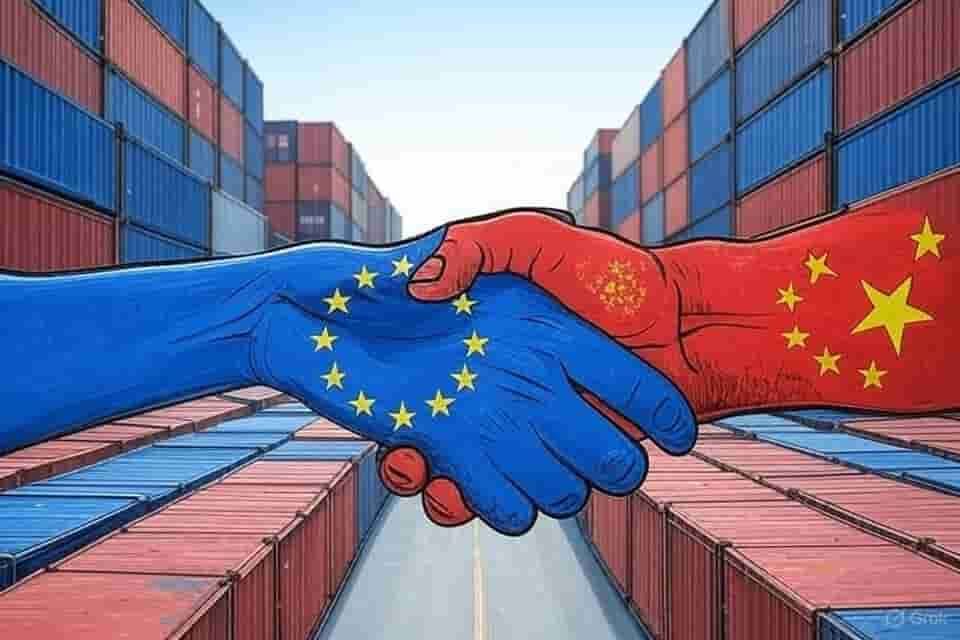
China-Europe: An Emerging Trade Alliance in Response to U.S. Tariffs?
The global trade landscape is shifting in the wake of U.S. protectionist policies, particularly under Donald Trump. China, facing the brunt of new tariffs, is actively seeking to realign its economic partnerships — and Europe appears to be its latest focus. As the U.S. temporarily pauses its “reciprocal duties” for 90 days, China is accelerating its diplomatic and trade efforts with the European Union, aiming to build a counterweight to American unilateralism. PET Bottle Grade
China’s Swift Diplomatic Pivot Toward Europe
Just hours before Trump announced the tariff suspension, Chinese Trade Minister Wang Wentao held a phone call with European Commission Vice President Maros Sefcovic. According to official Chinese sources, the discussion covered a wide range of issues: from bolstering economic cooperation to formulating a shared response to U.S. protectionism. This outreach reflects Beijing’s strategy to stabilize its trade network by strengthening its ties with the EU.
In parallel, Chinese Premier Li Qiang engaged directly with European Commission President Ursula von der Leyen, signaling a high-level commitment to deepening China-EU relations. The focus lies not only on trade volumes but also on regulatory frameworks—particularly in sensitive sectors like electric vehicles (EVs), where Chinese exports are rapidly increasing. PET Bottle Grade
Critics in Europe argue that this cooperation could result in a flood of subsidized Chinese products, especially under the umbrella of the EU’s Green Deal, which some view as inadvertently favoring Beijing’s industrial interests.
A Geopolitical Response to American Neo-Protectionism
The push for stronger China-EU ties is widely seen as a reaction to the U.S. administration’s continued trade aggression. China has harshly criticized Trump’s “reciprocal duties” as violations of World Trade Organization (WTO) rules. While Beijing says it remains open to dialogue, it has made clear that it will defend itself if further provoked.
Beyond Europe, China has stepped up diplomatic efforts with ASEAN countries, aiming to establish broader coalitions that resist the disruption caused by U.S. tariffs. This multi-pronged approach reflects Beijing’s desire to safeguard its global trade links amid growing economic nationalism in Washington. PET Bottle Grade
Europe, meanwhile, remains committed to rules-based trade and a multilateral approach to global commerce. EU officials have repeatedly emphasized the need to reform and modernize the WTO, while working toward more stable and diversified partnerships that support open markets and economic resilience.
The Risks and Rewards of a China-Europe Axis
Despite the convergence of interests between Brussels and Beijing, European officials are approaching the potential alliance with caution. The EU has its own grievances with China’s trade practices — especially regarding government subsidies and market access barriers. Just months ago, the European Commission imposed tariffs on Chinese electric vehicles, citing concerns over unfair competition. PET Bottle Grade
This duality underscores the EU’s complex position: while it seeks to counterbalance the unpredictability of U.S. trade policy, it is wary of deepening reliance on a partner with its own controversial practices. The challenge lies in striking a balance between pragmatic economic cooperation and defending the integrity of the European single market.
Brussels Pauses, but Keeps Options Open
Reacting to Trump’s 90-day pause, President von der Leyen welcomed the temporary relief, calling it a chance to restart meaningful negotiations. The European Commission reaffirmed its goal of reaching a “zero-tariff, zero-barrier” agreement with the United States—though “not at any cost.” PET Bottle Grade
To support diplomatic efforts, Brussels has announced a temporary suspension of its planned countermeasures, which had already been approved by EU member states. Nevertheless, von der Leyen emphasized that the EU is not letting its guard down: all options remain open, and preparations for retaliatory actions continue behind the scenes.
At the same time, the EU is intensifying trade talks with other global partners, representing nearly 90% of world trade. The strategy is clear: build a diversified network of alliances to reduce dependence on any single power and strengthen the resilience of the European economy.
A New Trade Map in the Making
As the U.S. increasingly embraces protectionism, a new trade dynamic may be forming, with China and the EU exploring deeper collaboration. Whether this evolves into a genuine strategic axis or remains a tactical response to U.S. policy remains to be seen. What’s clear is that the world’s economic centers are adjusting, seeking new alignments in an era of uncertainty. PET Bottle Grade
For Europe, the path forward is fraught with both opportunity and risk. Aligning with China might offer immediate economic benefits and a united front against U.S. tariffs, but it also brings long-term concerns about competitiveness, transparency, and market fairness.
In this evolving scenario, diplomacy will be key—but so too will a clear-eyed assessment of Europe’s strategic interests. As trade tensions continue to reshape the global order, the decisions made in Brussels, Beijing, and Washington will define the next chapter of international commerce. PET Bottle Grade
Mr. Buske, to what extent does plasma technology contribute towards recognising plastic as a recyclable material?
Plastic is a versatile material and indispensable in many industries. However, many plastics are naturally water-repellent, i.e. hydrophobic, meaning that paints, varnishes or adhesives adhere poorly. Recycled plastics in particular, which often consist of material mixtures, are difficult to process.
By pre-treating surfaces with Openair-Plasma, for example, it is also possible to achieve a stable and long-term adhesion of polyurethane coatings on polypropylene, i.e. PP. Recycled plastics also gain in quality through this pre-treatment method, and can partially replace more expensive high-performance plastics, enabling new material combinations. In this way, plasma technology makes plastics more valuable, increasing their recyclability, reducing CO2 emissions, and making an important contribution to the circular economy and resource conservation. PET Bottle Grade
How does it help to reduce the CO2 footprint?
Plasma technology offers an environmentally friendly alternative to conventional pre-treatment methods. In contrast to processes such as the application of solvent-based primers, flame treatment, etching or sandblasting, our Openair-Plasma technology does not require any chemical additives, expensive gases or water-intensive processes. In most cases, only compressed air and electricity are required for plasma generation.

Mitsubishi Chemical Boosts Flame-Retardant Compound Production in China and France
Mitsubishi Chemical Corporation is set to expand its production capacity for flame-retardant compounds at its facilities in Jiangsu, China, and Tiffauges, France. This move addresses growing global demand from sectors such as mobility, telecommunications, construction, and gas.
The compounds—based on polyolefins and thermoplastic elastomers—are valued for their flame resistance, thermal durability, flexibility, and superior extrusion molding performance. These materials are commonly used in cable sheathing and related applications.
The Jiangsu facility is expected to commence operations in April 2025, with the Tiffauges site following in January 2026. This strategic expansion reflects Mitsubishi Chemical’s commitment to meeting market needs and supporting critical infrastructure industries worldwide.