Plastic Waste to Hydrogen: New Process Captures Carbon
Scientists Convert Mixed Plastic Waste Into Hydrogen While Capturing Carbon
Researchers have demonstrated a chemical process that can convert mixed plastic waste into high-purity hydrogen without requiring the plastics to be separated by type first.
The experimental method processes three of the most widely used plastics—polyethylene terephthalate, polyethylene and polypropylene—in a single reactor. It also retains most of the carbon from the plastic in solid or liquid products rather than releasing it directly into the atmosphere as carbon dioxide.
The findings suggest that plastic waste to hydrogen technology could eventually address two difficult environmental challenges: managing hard-to-recycle materials and producing lower-carbon hydrogen.
However, the process has so far been demonstrated in laboratory experiments. Further engineering, economic analysis and larger-scale testing will be needed before its commercial potential can be established.
What the researchers developed
The research was co-led by scientists from the UCLA Samueli School of Engineering in the United States and Ewha Womans University in South Korea.
Their method is an adapted form of alkaline thermal treatment, commonly abbreviated as ATT. During the treatment, sodium hydroxide reacts with plastic under heat, causing chemical transformations that release hydrogen.
Tests were conducted using mixtures containing:
- PET, commonly used in drinks bottles and food packaging
- Polyethylene, or PE, used in bags, films and containers
- Polypropylene, or PP, found in packaging, household products and automotive components
According to the researchers, the resulting gas contained more than 90% hydrogen. Crucially, the three plastics could be treated together rather than being separated into individual waste streams.
Avoiding that sorting stage could be important because identifying and separating different polymers adds cost and complexity to conventional plastic recycling.
How plastic waste to hydrogen conversion works
PET already contains oxygen in its molecular structure and responded relatively well to alkaline thermal treatment.
Polyethylene and polypropylene presented a greater challenge. Their structures consist mainly of stable carbon-hydrogen bonds, making them resistant to reactions under alkaline conditions.
To make these materials more reactive, the scientists added a preliminary thermal oxidation step. PE and PP were briefly exposed to mild heat in air, introducing oxygen-containing chemical groups into their polymer chains.
These new reactive sites allowed the subsequent alkaline treatment to break down the plastics more effectively and increase hydrogen production.
The study reported hydrogen yields of 43.7 millimoles per gram for PET, 51.9 millimoles per gram for pretreated polyethylene and 30.2 millimoles per gram for pretreated polypropylene.
Lower temperatures than conventional gasification
One potential advantage of the method is its operating temperature.
The researchers reported that alkaline thermal treatment produced hydrogen at temperatures approximately 300°C to 400°C below those normally required for steam gasification.
Gasification can process heterogeneous waste but generally needs very high temperatures. It can therefore require substantial energy and may produce carbon dioxide unless combined with an effective capture system.
Operating at a lower temperature could reduce energy requirements and equipment demands. Nevertheless, a full lifecycle assessment will be necessary to determine the process’s overall environmental performance.
That assessment would need to consider the energy used for heating, plastic pretreatment, sodium hydroxide production, reagent recovery and processing of the resulting carbon-containing materials. plastic waste to hydrogen
Most of the plastic’s carbon stays out of the gas phase
Hydrogen production is only one part of the process. The researchers also examined what happened to the carbon originally contained in the plastic.
During alkaline thermal treatment, sodium hydroxide captures part of that carbon and converts it into sodium carbonate.
Post-reaction analysis found that more than 75% of the original plastic carbon remained in stable carbonate compounds or liquid organic residues. Less than 13% entered the gas phase, while direct carbon dioxide release during the reaction was described as negligible.
The sodium carbonate can subsequently be converted into calcium carbonate, a stable mineral used in construction materials, paper, paint and other industrial products.
This offers a potential route for longer-term carbon storage, although its real climate benefit will depend on how the carbonate and liquid residues are recovered, transported and ultimately used or disposed of.
For that reason, the process is more accurately described as having inherent carbon-capture or carbon-storage potential—not as automatically producing zero-emission hydrogen.
Why mixed-plastic processing matters
Plastic recycling becomes particularly difficult when waste contains several polymers, contamination, dyes, additives or composite materials.
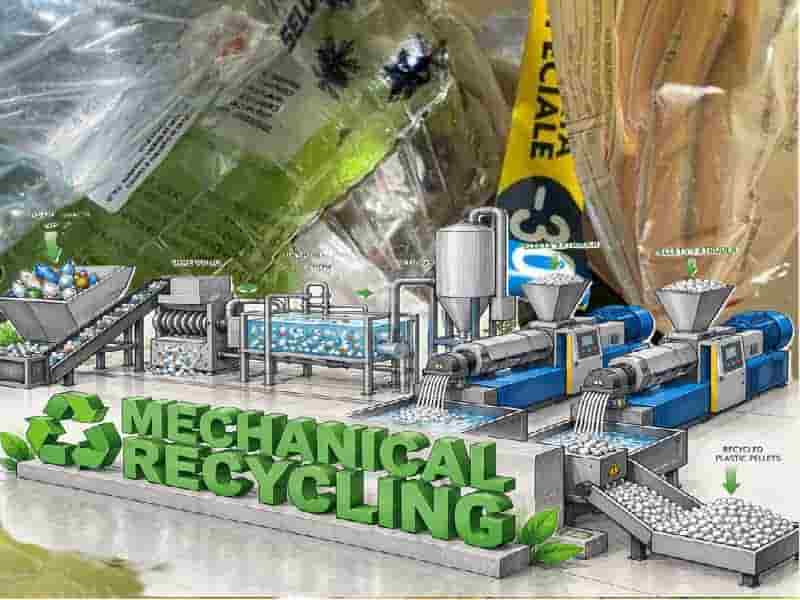
Mechanical recycling usually requires relatively clean and well-separated plastic. Even then, repeated heating can reduce material quality.
Other low-temperature hydrogen-production techniques, including photoreforming and electrochemical conversion, have generally been more effective with oxygen-containing polymers such as PET. Polyethylene and polypropylene are harder to process through those routes.
High-temperature gasification can accept more heterogeneous feedstocks, but it is energy-intensive and can produce substantial carbon emissions.
The experimental ATT method is significant because it combines three capabilities in one system:
- Processing several common plastics together
- Producing hydrogen at comparatively lower temperatures
- Retaining most of the plastic’s carbon in solid or liquid forms
The researchers believe that reducing sorting requirements could remove an important obstacle to the commercial treatment of mixed plastic waste.
Is the resulting hydrogen genuinely clean?
Hydrogen does not release carbon dioxide when used in a fuel cell. Its overall environmental impact, however, depends on how it is produced.
Most industrial hydrogen has traditionally been obtained from fossil fuels. Hydrogen made from plastic waste presents a different set of trade-offs because plastics themselves are generally manufactured from fossil carbon.
The new process could have environmental advantages when it treats material that cannot be reused or mechanically recycled and when most of its carbon remains securely stored. Its climate performance would also improve if the required heat and electricity came from low-carbon sources.
The hydrogen should therefore not automatically be labelled “green hydrogen,” a term normally associated with renewable-powered water electrolysis.
Until independent lifecycle data are available, descriptions such as “lower-carbon hydrogen,” “hydrogen with integrated carbon capture” or “waste-derived hydrogen” are more precise.
The technology is not yet ready for industrial use
The research represents a proof of concept rather than a market-ready waste-treatment system.
The experiments involved small quantities of carefully prepared material. Industrial waste streams are much more complicated and may contain moisture, food residues, chlorine-bearing plastics, pigments, fillers and other additives.
Before deployment, researchers will need to establish:
- Whether the reaction can operate reliably at much larger scales
- How effectively sodium hydroxide can be recovered and reused
- How contaminants affect hydrogen purity and equipment
- The energy required for pretreatment and heating
- The cost per kilogram of hydrogen
- The environmental effects of the liquid residues
- Whether the captured carbon remains permanently stored
- How the process compares with reuse and mechanical recycling
The UCLA-led team has acknowledged that additional optimization and economic evaluation will be required before commercialization.
A possible role in a broader recycling system
Plastic waste to hydrogen conversion should not be considered a replacement for reducing unnecessary plastic consumption, extending product life or improving conventional recycling.
Its most useful role may be in treating mixed or contaminated waste that cannot be economically reused or mechanically recycled.
A responsible waste hierarchy would continue to prioritize prevention, reuse and material recycling. Chemical conversion could then be considered for residual waste that would otherwise be incinerated or sent to landfill.
If the process can be scaled economically, powered with low-carbon energy and operated with effective reagent recovery, it could create value from difficult waste while limiting direct carbon emissions.
What happens next
The immediate challenge is to move from controlled laboratory tests to larger and more realistic demonstrations.
Future studies will need to test actual post-consumer waste, quantify all energy and material inputs, evaluate the stability of the captured carbon and determine whether the sodium hydroxide can be efficiently recycled.
Independent lifecycle and techno-economic assessments will be especially important.
The results are promising because they show that three major plastic types can be converted together into high-purity hydrogen while keeping most of their carbon outside the gas stream. Whether that chemistry can become a practical recycling technology will depend on the next stage of development.
Key facts
Technology: Alkaline thermal treatment
Feedstock: Mixed PET, polyethylene and polypropylene
Main product: Hydrogen with purity above 90%
Sorting required: Not for the three tested plastic types
Carbon management: More than 75% retained in carbonate compounds or liquid residues
Temperature: Approximately 300°C to 400°C below conventional steam gasification
Development stage: Laboratory proof of concept
Research institutions: UCLA Samueli School of Engineering and Ewha Womans University
Scientific journal: Proceedings of the National Academy of Sciences
Study DOI: 10.1073/pnas.2537552123
Frequently asked questions
Can mixed plastic waste really be converted into hydrogen?
The researchers converted a mixture of PET, polyethylene and polypropylene into hydrogen in laboratory experiments. This does not yet demonstrate that all types of unsorted municipal plastic can be processed at industrial scale.
Does the process release carbon dioxide?
Direct carbon dioxide release during the laboratory reaction was reported as negligible. More than 75% of the plastic’s carbon remained in carbonates or liquid residues. Emissions from energy use, reagent production and downstream processing still need to be included in a complete lifecycle assessment.
Is this green hydrogen?
Not under the conventional definition. Green hydrogen usually refers to hydrogen produced by electrolysing water with renewable electricity. “Waste-derived hydrogen with carbon capture” is a more accurate description of this experimental product.
Why is sodium hydroxide used?
Sodium hydroxide enables the alkaline reactions that release hydrogen and captures carbon in the form of sodium carbonate.
When could the technology become commercially available?
No commercial timetable has been announced. Scale-up tests, process optimization, safety studies and economic assessments must be completed first.
Sources and methodology
This article is based on the peer-reviewed PNAS study, the UCLA research announcement dated July 14, 2026, and independently checked reporting published between July 29 and July 31, 2026.
The article distinguishes measured laboratory results from projections about scalability or commercial use. No claim of industrial readiness, zero lifecycle emissions or universal compatibility with unsorted municipal waste is currently supported by the published evidence.
Solar Reactor Breakthrough Turns Plastic Waste Into Hydrogen but Faces 3 Key Challenges
More…