Sustainable Packaging – Avery Dennison Unveils First Recyclable RFID Label for PET Packaging Published: July 16, 2025 ? A Sustainable Leap Forward in RFID Packaging Avery Dennison has introduced a major sustainability breakthrough with the launch of the world’s first recyclable RFID label approved for PET packaging by the Association of Plastic Recyclers (APR) 16-07-2025
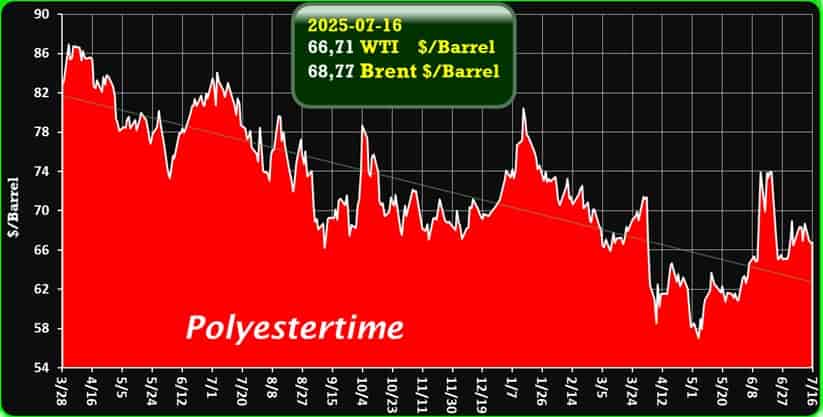
Crude Oil Prices Trend
? Petrochemicals to Drive Global Oil Demand Through 2050
? Published: July 2025
?️ A Long-Term Engine: Petrochemicals and the Oil Market
The future of global oil demand is increasingly being shaped not just by transportation or aviation—but by petrochemicals. According to the latest World Oil Outlook by OPEC, petrochemicals will remain a cornerstone of oil consumption well into the mid-21st century.
By 2050, this sector alone is projected to account for 16% of total global oil demand.
This isn’t merely a trend—it’s a transformation of the oil economy’s center of gravity.
? Key Forecasts from OPEC
- Global oil demand in 2050: 123 million barrels/day — an 18.5% increase from 2024 levels.
- Petrochemical sector demand: Rising from 15.5 to 20.2 million barrels/day (+30%).
- Top growth regions: Over 90% of the sector’s growth will be driven by the Middle East and China. Sustainable Pack
These findings signal a shift in how and where oil will be consumed. While fuel for transportation and aviation will remain essential, petrochemical applications—from plastics to fertilizers—are gaining strategic importance.
? Regional Focus: Middle East and China
The lion’s share of the expected growth in petrochemical-driven oil consumption will come from China and the Middle East. China, in particular, is aggressively expanding its infrastructure to accommodate massive new production capacity for key petrochemicals like propylene.
In fact, over 40% of the increase in global propylene production capacity by 2030 is expected to come from China alone. This includes 23 officially launched projects and 8 more in planning, which will add a staggering 22.3 million tonnes per year to China’s capacity.
This surge positions China as both a consumption and production leader, with implications across global supply chains and trade balances. Sustainable Pack
? Why Petrochemicals Are So Crucial
Petrochemicals are integral to a wide range of industries—from packaging and clothing to construction and agriculture.
Unlike fuels, which are being increasingly replaced by renewables and electric alternatives, petrochemical demand remains sticky and less elastic to green substitution.
This resilience makes the sector a long-term driver of oil consumption, particularly as emerging economies industrialize.
- ? Plastic production (e.g., polyethylene, polypropylene)
- ? Fertilizers and agrochemicals
- ? Synthetic textiles Sustainable Packaging
- ? Industrial solvents and rubbers
? What About Transportation and Aviation?
Despite the electrification of passenger vehicles and efficiency improvements in shipping,
the transport and aviation industries will still form the core of global oil demand.
However, the rate of growth in these segments is likely to taper relative to petrochemicals.
The petrochemical sector’s demand growth is less constrained by decarbonization and electrification trends, giving it a more stable trajectory. Sustainable Pack
? Implications for Policy and Industry
Governments and energy companies need to rethink long-term strategies:
- ? Infrastructure Planning: Refineries and chemical plants must scale and adapt to growing petrochemical demands.
- ? Climate Strategy: Carbon mitigation frameworks need to consider emissions from non-combustion uses of oil.
- ? Geopolitics: Oil diplomacy will increasingly revolve around chemical-grade crude demand. Sustainable Packaging
? Can Sustainability and Petrochemicals Coexist?
One of the critical questions for the future is how the petrochemical surge will reconcile with global climate goals.
While alternatives like bio-based polymers and recyclable plastics are gaining traction,
they currently account for a fraction of global production.
Without radical innovation and policy alignment, the projected growth in petrochemical demand may hinder decarbonization progress.
? Strategic Takeaways for Stakeholders
- ? Investors: Expect stronger returns in petrochemical refining and R&D over traditional fuel segments. Sustainable Pack
- ?️ Governments: Plan for carbon pricing and regulatory frameworks tailored to industrial oil use.
- ? Industry Leaders: Focus on cleaner feedstocks, energy-efficient processes, and circular chemical strategies.

? Xiaomi’s YU7 Ignites Debate: Can a Smartphone Chip Really Power Your Car?
? A Chip Meant for Phones Now Found in Cars
The launch of Xiaomi’s latest electric vehicle, the YU7, has sparked a significant controversy in China and beyond. At the heart of the debate lies a bold—and polarizing—technical decision: Xiaomi used a smartphone-grade chip, the Snapdragon 8 Gen 3, as the brain behind the car’s dashboard and infotainment systems. Sustainable Packaging
This move has raised alarms across the automotive and tech industries. Why? Because while this chip is extremely powerful for phones, it’s not originally designed to handle the environmental and safety demands of an automobile.
? Safety vs Innovation: Audi Speaks Out
Li Fenggang, an executive at Audi China, posted a viral video addressing the risks of using “consumer” chips in vehicles. His statement was clear and sharp:
“Cars are not smartphones. We don’t experiment on drivers.” Sustainable Packaging
This bold stance underscores a growing divide between traditional carmakers—who emphasize rigorous, long-term safety validation—and new entrants like Xiaomi, who are looking to disrupt legacy automotive norms using consumer electronics components.
? What’s the Difference Between Consumer and Automotive Chips?
Let’s break down why this debate matters by exploring the three main technical differences highlighted by NewsCarChina and experts like Li Fenggang:
1. ?️ Operating Conditions
Consumer chips, such as those found in phones and tablets, are built for predictable, stable environments—typically indoors. Cars, on the other hand, must endure extremes: blazing heat, freezing cold, dust, rain, snow, vibrations, and shocks.
Automotive-grade chips are rigorously tested to function between -40°C to 150°C (-40°F to 302°F). In contrast, consumer chips typically function between only 0°C to 70°C (32°F to 158°F). That’s a huge gap in resilience.
2. ⌛ Lifespan and Reliability
A smartphone is replaced every 2–5 years. A car, meanwhile, must last 10–15 years—or more. This means automotive chips must support long-term availability and consistency across batches. Sustainable Packaging
Suppliers must ensure long-term procurement and pass AEC-Q multi-batch validation, something that consumer chips are not typically subjected to. Sustainable Packaging
3. ?️ Safety Margin and Failure Rate
When a smartphone crashes, you restart it. When a car chip fails, lives may be at risk. That’s why automotive-grade chips have stricter standards.
Consumer chips can tolerate failure rates of up to 500 PPM (parts per million). Automotive chips? Less than 1 PPM is the norm—meaning just one failure per million chips is acceptable.
⚙️ How Has This Played Out Before?
This isn’t the first time consumer chips have entered the automotive realm. Tesla previously used similar strategies but ended up facing recalls due to overheating issues in its infotainment modules.
However, the automotive ecosystem has evolved. Vehicles now use upwards of 1,000 chips per car. Not all of these are mission-critical. Some chips—used for entertainment or non-safety functions—can be more flexible in terms of certification, according to Professor Zhu Xichan, an expert in automotive engineering in China.
Still, for anything safety-related, chips must meet stringent international certifications like AEC-Q100 and ISO 26262. Sustainable Packaging
? What About the Xiaomi YU7’s Chip Specifically?
The Xiaomi YU7 uses the Snapdragon 8 Gen 3, a chip known for its flagship smartphone performance. While it’s blazing fast, it hasn’t yet received all necessary automotive certifications.
Xiaomi responded by stating that the entire module housing the chip passed the AEC-Q104 test—a system-level certification that evaluates component stability over time. This doesn’t automatically mean the chip is “automotive-grade,” but it does demonstrate that efforts were made to meet automotive durability standards.
It’s a partial win for Xiaomi in terms of credibility—but it still leaves questions about long-term safety and reliability unanswered. Sustainable Packaging
? Expert View: Are We Moving Toward Software-Defined Cars?
In the age of software-defined vehicles, companies like Xiaomi, Huawei, and even Sony are blurring the lines between consumer electronics and traditional cars.
This shift mirrors the broader industry trend where cars are increasingly being treated as computers on wheels. But the question remains: how far can consumer tech be stretched before safety is compromised? Sustainable Packaging
It also challenges regulators and standard bodies to re-evaluate what constitutes “automotive-grade” in this hybridized landscape.
⚖️ The Bottom Line: Is It Safe?
Short answer: It depends on where the chip is used and how well it’s tested.
Using consumer chips in **non-safety critical** areas of a vehicle, like the infotainment display or navigation module, might be acceptable—if they pass environmental durability tests. But for safety-critical areas like braking, steering, or ADAS (Advanced Driver-Assistance Systems), only certified automotive-grade components are appropriate.
The Xiaomi YU7 case is not an outright red flag, but a cautionary tale. It calls for more transparency, third-party validation, and perhaps a standardized labeling system to help consumers understand what’s inside their cars.
INEOS Styrolution Launches 100% Bio-Attributed Polystyrene for Sustainable Packaging
Published: July 2025
? A Breakthrough in Sustainable Plastics
INEOS Styrolution has taken a major step toward circularity and environmental responsibility with the commercialization of Styrolution® PS 158K BC100—a 100% bio-attributed polystyrene developed using a certified mass balance approach. This innovation is not just a technical milestone, but a strategic advancement in sustainable packaging solutions for the global market. Sustainable Packaging
?? Now Available in Japan’s Food Retail Market
As of early 2025, consumers in Japan can already find food trays made from this new bio-based polystyrene on store shelves. This was made possible through a collaboration with a major Japanese retail franchise, marking one of the first real-world integrations of bio-attributed plastics in mass-market food packaging. Sustainable Packaging
? 172% Carbon Emission Reduction: A Game-Changer
By leveraging 100% bio-attributed feedstock and adhering to the ISCC-certified mass balance methodology, Styrolution® PS 158K BC100 delivers a staggering 172% reduction in carbon emissions compared to fossil-based polystyrene. This figure underscores how innovation in material sourcing can directly impact global carbon neutrality efforts.
? Food-Safe, Certified, and Ready for the Table
- Global compliance: Fully meets international food contact standards
- Japan-specific approval: Conforms to the Japanese Food Sanitation Act
- Third-party certification: Awarded the JCII’s prestigious A Certification
This makes the material not only suitable but also ideal for direct food contact, particularly in heat-sensitive environments such as ready-to-eat meal trays or microwaveable containers. Sustainable Packaging
? Performance That Rivals Traditional Plastics
Despite its green origins, the performance of Styrolution® PS 158K BC100 remains uncompromised. It retains the clarity, gloss, and heat resistance that customers expect from standard polystyrene, making it an effortless switch for businesses aiming to green their supply chains without disrupting functionality or aesthetics.
? Executive Insight: Sustainability Without Compromise
“We are thrilled to mark this milestone in integrating bio-attributed materials into everyday life,” said Marcela Villegas, Vice President of Business Management APAC at INEOS Styrolution.
“It shows that sustainability can be achieved while meeting regulatory standards, allowing businesses to progress in their environmental goals without compromising quality or safety.” Sustainable Packaging
? Why This Matters for the Circular Economy
As governments and industries strive to decarbonize supply chains and meet global ESG targets, products like Styrolution® PS 158K BC100 demonstrate how renewable resources can integrate seamlessly into legacy manufacturing systems. The use of mass balance certification further ensures traceability, transparency, and compliance across complex value chains.
? Mass Balance Certification: Ensuring Verified Sustainability
The ISCC (International Sustainability & Carbon Certification) mass balance approach ensures that the bio-attributed feedstock is measured, tracked, and reported at every step of the supply chain. This methodology enables companies to:
- Claim sustainability benefits without altering existing production systems
- Ensure third-party verified traceability Sustainable Packaging
- Communicate environmental impact with confidence
? Source
Official press release by INEOS Styrolution: www.ineos-styrolution.com

♻️ Avery Dennison Unveils First Recyclable RFID Label for PET Packaging
Published: July 16, 2025
? A Sustainable Leap Forward in RFID Packaging
Avery Dennison has introduced a major sustainability breakthrough with the launch of the world’s first recyclable RFID label approved for PET packaging by the Association of Plastic Recyclers (APR). This label marks a key milestone in circular packaging innovation, aligning closely with global sustainability goals and evolving compliance standards.
? How the Innovation Works
The recyclable RFID label leverages Avery Dennison’s CleanFlake™ adhesive technology, engineered to separate cleanly from PET containers during the mechanical recycling process. This reduces contamination, one of the primary obstacles in efficient PET recycling, particularly for high-volume packaging like bottles and food containers.
By minimizing adhesive residue, the label supports higher-quality plastic flake recovery and enhances the value of recycled materials—critical for meeting the recycling targets of major consumer brands. Sustainable Packaging
? Why This Matters to Global Brands
With 96% of the top 50 consumer packaged goods (CPG) companies now committed to aggressive recyclability and waste reduction goals, integrating recyclable RFID labels helps close the gap between digital traceability and material circularity.
By adopting this APR-recognized solution, brands gain access to a scalable and technically viable method to improve PET recyclability while maintaining inventory tracking and product intelligence through RFID.
? RFID: From Logistics to Sustainability Enabler
“RFID technology is essential for effective and sustainable supply chain management, supporting brands with greater inventory visibility and product traceability,” said Pascale Wautelet, VP of Global R&D and Sustainability at Avery Dennison.
Beyond operational efficiencies, RFID can now become a lever for sustainability-driven innovation. This dual function—tracking and recyclability—helps brands meet compliance while building consumer trust through transparent lifecycle data. Sustainable Packaging
? Industry Endorsement from APR
“Increasing the recyclability of packaging is critical for brands aiming to meet sustainability targets,” commented Steve Alexander, President and CEO of the Association of Plastic Recyclers. “Innovation and technology play an essential role in enabling smarter packaging that aligns with environmental goals.” Sustainable Packaging
The APR’s approval provides not only credibility but also the greenlight for broad commercial adoption across packaging ecosystems. The label passed APR’s rigorous technical assessments, validating its behavior in real-world recycling streams.
?️ What’s Next: Global Certification & Rollout
Avery Dennison plans to release the APR-certified RFID label later this year. The company is actively working with independent certifiers to expand PET recyclability standards and label certifications worldwide, setting the foundation for global scaling.
This initiative complements existing digitization efforts in supply chains, helping companies ensure their smart packaging strategies don’t come at the cost of recyclability.
♻️ ReHubs to Unveil Pan-European Textile Recycling Strategy at Dornbirn GFC
Date: September 10–12, 2025 | Location: Dornbirn, Austria
? A Unified Vision for Europe’s Circular Textile Economy
At this year’s Dornbirn Global Fiber Congress (GFC), taking place September 10–12 in Austria, the Brussels-based ReHubs network will present a groundbreaking, industry-wide roadmap to scale up textile-to-textile recycling to 2.5 million tons annually by 2030.
This ambitious strategy aims to unify diverse stakeholders—from recyclers and textile manufacturers to policymakers and investors—around a shared mission of building a resilient and truly circular European textile ecosystem. Sustainable Packaging
? “Time for Systemic Change,” Says ReHubs CEO
“The textile and apparel industry stands at a critical crossroads,” said Robert van de Kerkhof, CEO of ReHubs. “With legislation evolving and new technologies emerging, we have a unique chance to drive systemic transformation that benefits the environment, the economy, and society.”
ReHubs is taking the lead by establishing a scalable model rooted in collaboration, innovation, and a deep understanding of Europe’s policy and market dynamics.
? ReHubs’ Role: Catalyst for Circular Transition
Since its launch, ReHubs has served as a unifying force for Europe’s fragmented textile and apparel recycling sector. The organization connects the dots between:
- Textile collectors and sorters
- Recycling innovators and tech providers Sustainable Packaging
- Apparel brands and manufacturers
- Investors and policy makers
Its mission? Accelerate textile circularity through infrastructure upgrades, legislative alignment, and targeted financial investment. Sustainable Packaging
? Legislative Drivers: From Omnibus to Circular Economy Act
Europe’s regulatory environment is evolving fast. Key legislative developments include:
- The Omnibus Package: Current regulatory updates impacting sustainability disclosures and extended producer responsibility (EPR)
- The EU Circular Economy Act (2026): A comprehensive mandate expected to establish circular design, reuse, and recycling benchmarks
These policies are transforming how textiles are designed, collected, and reprocessed—requiring systemic shifts across supply chains.
? 2025: Mandatory Textile Collection Across the EU
Beginning January 1, 2025, EU member states will enforce mandatory separate collection of used textiles. This pivotal move is set to:
- Exponentially increase the volume of discarded textiles
- Drive demand for scalable sorting and recycling systems
- Open doors for innovative circular business models Sustainable Packaging
This regulatory push adds urgency—and momentum—to ReHubs’ 2030 goal.
? ReHubs’ Action Plan: From Vision to Execution
At Dornbirn 2025, ReHubs will unveil a detailed roadmap outlining how to:
- Scale textile-to-textile recycling to 2.5 million tons/year
- Establish pan-European recycling hubs and networks
- Deploy innovative sorting and processing technology
- Define Key Performance Indicators (KPIs) for progress tracking
- Unlock capital for critical infrastructure investments
This roadmap is the product of broad consultation and cross-industry alignment—ensuring relevance, feasibility, and momentum. Sustainable Packaging
? Global Expertise on Display at ReHubs Session
A dedicated ReHubs session will be held on the afternoon of Wednesday, September 10. Presentations will be delivered by:
- Recover (Spain) – pioneers in high-volume textile recycling
- Refashion (France) – trailblazers in EPR and circular regulation
- Samsara Eco (Australia) – biotech innovations in fiber regeneration
- Innovando (Italy) – innovators in material sorting and traceability
These sessions are integrated into the wider GFC 2025 program, which includes over 100 presentations on Work & Protective Wear, Defence Textiles, and Carbon Stewardship. Sustainable Packaging
India Eyes Japan’s RMG Market: A Strategic Move to Surpass China in Textile Exports
? Overview: India’s Golden Opportunity in Japan’s RMG Market
India is positioning itself as the next big player in Japan’s Ready-Made Garment (RMG) sector, aiming to fill the void left by China’s waning dominance. Backed by strategic diplomacy, robust trade policies, and a commitment to quality, India’s textile sector—one of the largest in the world—is turning its gaze towards the Japanese market, known for its demand for precision, consistency, and high-quality fashion. Sustainable Packaging
The Apparel Export Promotion Council (AEPC) recently announced this strategic shift, underpinned by India’s participation in the upcoming India Tex Trend Fair (Tokyo, July 15–17). With over 150 Indian exporters set to attend, this event could mark the beginning of a new era for Indo-Japanese textile trade relations.
? India-Japan Trade: A Textile Partnership on the Rise
Led by AEPC Chairman Sudhir Sekhri, a high-level delegation is heading to Tokyo to initiate trade talks with leading Japanese retail chains and brands. The goal is two-fold:
- Increase exports of Indian garments to Japan. Sustainable Packaging
- Attract Japanese investments into India’s textile sector.
Sekhri emphasized how recent trade developments, including an enhanced utilization of the bilateral Free Trade Agreement (FTA), have positioned India as a compelling alternative to China in the Japanese fashion supply chain.
? “China’s market share in Japan is declining. India is ready to step in and fill the gap with competitive pricing, diverse designs, and sustainable production,” said Sekhri. Sustainable Packaging
? Market Insights: Room for Growth in Japan
Here’s what the numbers reveal:
- ?? India’s exports of RMG to Japan in 2024: $234.5 million
- ?? Japan’s total RMG imports in 2024: $23 billion
- ? India’s market share: ~1%
Clearly, the potential is enormous. If India can scale its operations, tailor its offerings to Japanese consumer preferences, and ensure consistent quality and delivery timelines, the country could capture a significantly larger slice of this lucrative market.
? Strategic Moves: The India Tex Trend Fair
Held in Tokyo, the India Tex Trend Fair (15–17 July) is the flagship event driving this initiative. Inaugurated by India’s Union Minister for Textiles Giriraj Singh, this event represents more than just trade show participation—it signals India’s commitment to long-term collaboration with Japan. Sustainable Packaging
? Over 150 Indian clothing exporters will showcase:
Traditional textiles and contemporary fashion blends
Organic and sustainable fabric lines
Custom manufacturing capabilities Sustainable Packaging
This fair is also set to host B2B meetings, panel discussions, and product launches—all aimed at solidifying India’s position as a dependable supplier of fashion products.
? Why India Is Ready to Lead
India’s edge over global competitors like China, Vietnam, and Bangladesh lies in the following advantages:
✅ Competitive Labor Cost
Indian textile production remains cost-effective without compromising on quality.
✅ Vast Fabric Base Sustainable Packaging
From cotton to silk, jute to wool—India produces it all domestically, reducing dependency on imports.
✅ Skilled Workforce
Generations of craftsmanship underpin India’s garment industry, with technical skills increasingly supported by automation and innovation.
✅ Free Trade Leverage
Thanks to the India-Japan Comprehensive Economic Partnership Agreement (CEPA), many textile exports enjoy reduced or zero tariffs, making Indian products more attractive to Japanese buyers. Sustainable Packaging
? Shift in Global Supply Chains: The China Factor
China has long been the dominant player in the global textile export market. However, several factors have shifted the balance:
- Rising production costs in China due to labor shortages and regulatory pressures.
- Geopolitical tensions leading to a diversification of supply chains globally.
- Environmental scrutiny, pushing brands to seek sustainable and transparent sourcing from alternative suppliers.
✂️ With China’s market share in Japan now shrinking, Indian exporters are in the perfect position to capitalize on this transition.
? India’s Response to Global Fashion Needs
The fashion world is changing fast, and India is evolving with it. Here’s how:
♻️ Sustainability as a Standard
From organic cotton to low-impact dyes, Indian exporters are increasingly adopting eco-conscious production. Sustainable Packaging
? Customization & Design Innovation
Rather than mass production, India is pivoting toward design-led, limited edition lines that appeal to Japan’s premium markets.
? Fast Fashion Meets Artisanal Craft
Indian manufacturers are merging fast fashion timelines with traditional techniques, creating value-added offerings tailored to modern consumers.
? A Blueprint for Growth: What’s Next?
India’s long-term plan to penetrate Japan’s RMG market includes:
- ?️ Textile parks and industrial clusters to streamline production.
- ? Digitization of supply chains for transparency and traceability.
- ? Public-private partnerships to upgrade training and certifications aligned with global standards. Sustainable Packaging
The Ministry of Textiles and AEPC are working closely with private stakeholders to ensure that India’s offerings meet the quality, compliance, and delivery expectations of Japanese retailers.
Conclusion: India’s Moment to Shine in the Global Textile Trade
As China’s dominance wanes, India has the capability, strategy, and timing to capture a much larger share of Japan’s RMG import market. With rising interest from Japanese buyers, tariff advantages under CEPA, and a commitment to quality and sustainability, India is stepping into the spotlight as a future leader in fashion exports.
The upcoming India Tex Trend Fair will be a defining moment—a platform to forge new partnerships, promote brand India, and build the next chapter of Indo-Japanese textile trade. Sustainable Packaging