Revolutionary Breakthrough: How Reju Crushes Textile Waste to Save Clothing
Textile waste polyester recycling
Revolutionary Breakthrough: How Reju Crushes Textile Waste to Save Clothing
Over 120 million metric tons of textiles are discarded worldwide every year, yet less than 1% of post-consumer clothing is ever recycled back into new garments. The vast majority of synthetic apparel follows a direct route from fossil fuels to incinerators or landfills.
Former Under Armour and The North Face CEO Patrik Frisk is leading an effort to change this through Reju. Supported by engineering firm Technip Energies, Reju is developing industrial chemical recycling to transform post-consumer polyester garments into high-performance, virgin-grade fibers.
Breaking the Downcycling Loop
Traditional synthetic textile recycling relies heavily on mechanical methods, primarily melting down clear PET plastic water bottles into lower-grade fibers. This mechanical approach degrades molecular structures over time, limiting the number of times material can be reused before it becomes waste.
Reju avoids mechanical downcycling by utilizing chemical depolymerization. The process targets blended fabrics—long considered a major obstacle in textile circularity—by separating mixed fibers like cotton, nylon, or elastane from polyester.
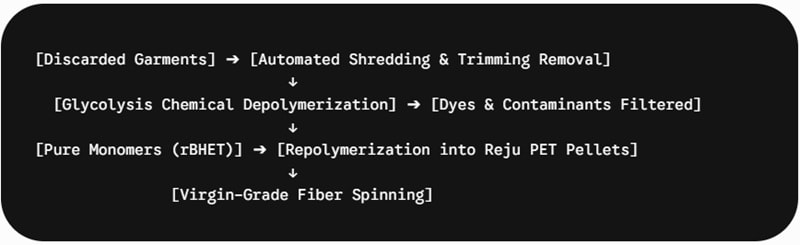
Through a chemical process known as glycolysis, the polyester polymers break down to their foundational monomer state (rBHET). Dyes, embedded contaminants, and secondary fibers are filtered out. The resulting pure polyester powder is repolymerized into PET pellets, which can be extruded into new yarn with a reported 50% reduction in carbon footprint compared to virgin petroleum-based polyester. textile waste polyester recycling
Scaling Global Regeneration Infrastructure
To process textile waste on a commercial scale, Reju is executing a worldwide infrastructure expansion across Europe and North America:
-
Frankfurt, Germany (Regeneration Hub Zero): Operates as the initial pilot facility testing chemical extraction processes on mixed post-consumer waste.
-
Conshohocken, Pennsylvania: Houses Reju’s North American R&D lab inside Technip Energies’ research center to accelerate new circular chemistry pathways.
-
Rochester, New York: Situated at Eastman Business Park in partnership with Goodwill of the Finger Lakes and Waste Management. Spanning 18.9 acres, this industrial plant aims to regenerate the equivalent of 300 million garments annually.
-
Lacq, France & Sittard, Netherlands: European industrial-scale hubs designed to process tens of thousands of tonnes of post-consumer textiles annually to meet strict EU circular economy directives.
By establishing direct collection links with waste aggregators and municipal sorters, Reju extracts value from heavily worn, low-grade apparel that would otherwise be exported or landfilled.
A Scalable Model for Synthetic Garments
Scaling chemical depolymerization requires substantial capital investment, but it offers a continuous, closed-loop solution for synthetic textiles. Instead of extracting additional crude oil to synthesize polyester, high-performance sportswear, fleeces, and weather-resistant shells can be manufactured from discarded garments without sacrificing structural integrity. Reju’s approach demonstrates that large-scale circular systems are technically viable, providing a proven path toward eliminating synthetic textile waste.
Carbios Advances PET Textile Recycling After 100 Batches
More…