Tires Pyrolysis – The Chemours Company (Chemours), a global leader in Thermal & Specialized Solutions, Titanium Technologies, and Advanced Performance Materials, has introduced Ti-Pure™ TS-6706, a TMP- and TME-free alternative to its widely used Ti-Pure™ R-706. This launch offers a regulatory-compliant solution while maintaining the high-performance characteristics essential for coatings applications 24-02-2025 - Archive
Tires Pyrolysis

Tires Pyrolysis
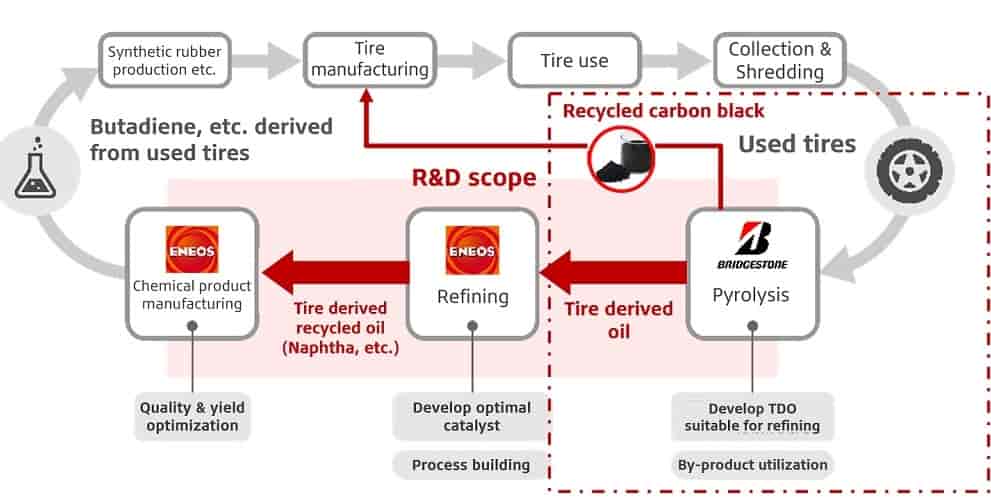
Bridgestone has announced plans to build a demonstration plant for recycling end-of-life tires at its Seki City site in Japan
Construction is scheduled to begin in November 2025, with operations set to commence in autumn 2027. The plant will utilize a pyrolysis process, known as “precise pyrolysis,” to extract pyrolysis oil and industrial carbon black from scrap tires for further processing.
The facility is expected to have a processing capacity of approximately 7,500 tonnes of scrap tires per year. This initiative builds on Bridgestone’s existing efforts in tire recycling and aligns with its collaboration with the Japanese oil and chemical company Eneos. The company has been involved in chemical recycling since 2022 and, in 2023, installed a test unit at the Bridgestone Innovation Park (BIP) in the Tokyo metropolitan area. This test unit was used to refine the pyrolysis process in partnership with Eneos. Tires Pyrolysis
The extracted pyrolysis oil was further refined by Eneos to produce naphtha and chemical products, including butadiene, a key component in synthetic rubber manufacturing. The ultimate goal is to enable the reuse of these recovered materials as raw ingredients for new tires. The new demonstration plant will scale up the industrial production of pyrolysis oil and carbon black based on the technology developed in the test unit.
The industrial carbon black obtained from the pyrolysis process will be used to develop a sustainable manufacturing method for “eco-industrial carbon black” with rubber-reinforcing properties. This recycled carbon black is designed to match the characteristics of primary carbon black derived from crude oil and coal, making it a viable alternative in tire production.
Bridgestone’s efforts are part of its broader “Towards 2050” initiative, which focuses on sustainability, CO2 neutrality, and a circular economy. The company aims to develop innovative tire technologies that support environmental conservation for future generations. Additionally, Bridgestone emphasizes achieving a “nature-positive balance” across its entire value chain. Tires Pyrolysis
By leveraging pyrolysis and refining technologies, Bridgestone and Eneos seek to advance resource circulation in the tire industry. This project marks a significant step toward reducing dependency on virgin raw materials and promoting a sustainable production model. The demonstration plant is expected to serve as a foundation for future large-scale recycling efforts, potentially setting a new industry standard for tire recycling.
As part of its commitment to sustainability, Bridgestone continues to explore collaborative opportunities and technological advancements. The development of “eco-industrial carbon black” and the optimization of pyrolysis oil refining processes underscore the company’s dedication to reducing environmental impact. The company envisions a future where used tires contribute to the production of new tires, reinforcing its vision for a circular economy.
The demonstration plant in Seki City represents a crucial step in Bridgestone’s long-term sustainability strategy. Tires Pyrolysis
With increasing global demand for environmentally friendly solutions, the company is positioning itself as a leader in tire recycling technology. The success of this initiative could influence industry-wide adoption of chemical recycling methods, furthering the transition to sustainable materials in tire manufacturing.
Bridgestone’s collaboration with Eneos highlights the potential of integrating expertise from different industries to drive innovation in recycling. By combining Bridgestone’s knowledge of tire production with Eneos’ proficiency in chemical refining, the project aims to create high-quality recycled materials that meet industry standards.
In addition to environmental benefits, the recycling initiative could provide economic advantages by reducing reliance on imported raw materials.
The ability to produce high-quality recycled carbon black and pyrolysis oil domestically may enhance supply chain stability while reducing costs associated with traditional tire manufacturing processes. Tires Pyrolysis
Looking ahead, Bridgestone plans to continue refining its pyrolysis technology and expanding its recycling capabilities. The company’s focus on sustainability aligns with global efforts to minimize waste and lower carbon emissions. Through continuous research and development, Bridgestone seeks to improve the efficiency and scalability of its recycling operations.
The launch of the demonstration plant marks a significant milestone in Bridgestone’s sustainability journey. By integrating advanced pyrolysis techniques, the company is working toward a future where end-of-life tires become a valuable resource rather than waste. With ongoing support from industry partners and stakeholders, Bridgestone is set to make meaningful contributions to the circular economy and the broader goal of environmental conservation. Tires Pyrolysis
Chemours Unveils Ti-Pure™ TS-6706: A TMP/TME-Free Alternative to Ti-Pure™ R-706
The Chemours Company (Chemours), a global leader in Thermal & Specialized Solutions, Titanium Technologies, and Advanced Performance Materials, has introduced Ti-Pure™ TS-6706, a TMP- and TME-free alternative to its widely used Ti-Pure™ R-706. This launch offers a regulatory-compliant solution while maintaining the high-performance characteristics essential for coatings applications.
Delivering Quality Without Compromise
“As a trusted TiO2 partner, we are excited to provide a TMP- and TME-free version of our flagship pigment,” said Diane Picho, Interim President of Chemours Titanium Technologies. “Ti-Pure™ TS-6706 is a testament to our commitment to customer needs, offering an alternative formulation without sacrificing quality, consistency, or performance.”
Ti-Pure™ TS-6706 is part of the Chemours Ti-Pure™ Sustainability Series (TS), which drives innovation across four pillars: circularity, climate impact, health and wellness, and resource efficiency. This development aligns with the industry’s evolving regulatory landscape while ensuring continued product excellence. Tires Pyrolysis
Seamless Transition for Formulators
Designed as a direct replacement for Ti-Pure™ R-706, Ti-Pure™ TS-6706 requires minimal reformulation, as it retains the same core properties. These include high gloss, excellent durability, blue undertone, superior hiding power, and easy dispersion. It offers the same versatility as its predecessor, supporting waterborne, solvent-borne, and powder coatings.
To ensure optimal performance, Ti-Pure™ TS-6706 has been rigorously tested in both architectural and industrial paint systems, covering solvent- and water-based formulations. Evaluations focused on key performance attributes such as viscosity stability, color consistency, gloss, tinting strength, hiding power, and mechanical durability post-application. Tires Pyrolysis
Ensuring Reliable Performance
Given TMP’s role in dry pigment flow, extensive testing was conducted at both lab and industrial scales to assess flow behavior, including in-silo conditions. The results confirmed that Ti-Pure™ TS-6706 meets the high standards expected by formulators.
By delivering a TMP- and TME-free alternative without compromising on performance, Chemours continues to lead the way in innovative TiO2 solutions, supporting both industry needs and sustainability goals. Tires Pyrolysis