US debt Europe China dollar – Europe Trapped Between Trump and Xi as US Debt, Dollar Power, and China’s Euro Strategy Expose the EU’s Strategic Weakness 27-01-2026
US debt Europe China dollar
Europe Between Two Powers, With No Strategy of Its Own
Europe is discovering an uncomfortable truth. In the global power struggle between the United States and China, the European Union is not a sovereign actor but a reluctant pawn. Whether under Donald Trump’s confrontational America or Xi Jinping’s calculated China, Europe risks becoming a vassal rather than a counterweight. US debt Europe China dollar
The most striking element is not Europe’s weakness, but its failure to recognize its own strength. The EU sits on one of the most powerful financial levers in the world: US debt. Yet European leaders show little willingness to use it, or even acknowledge its strategic value.
Xi Jinping’s Euro Proposal Is Not About Cooperation
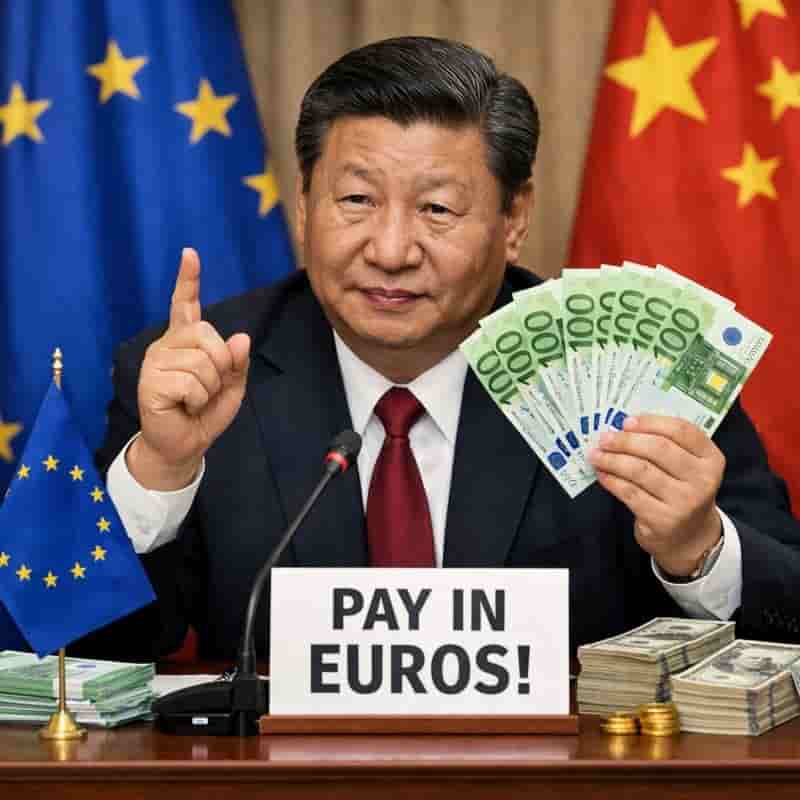
Capitalizing on European frustration with Trump’s aggressive posture, including his provocative plans involving Greenland, Xi Jinping has made a calculated move. His proposal to conduct economic relations with Europe in euros rather than dollars is not about multilateralism. It is about undermining the dollar’s role as the global reserve currency. US debt Europe China dollar
China understands that the euro is the only realistic alternative to the dollar. More importantly, Beijing knows that Europe is the largest foreign holder of American debt. This gives the EU theoretical power over the stability of the US economy and the dollar itself. US debt Europe China dollar
The proposal, quickly passed from Ursula von der Leyen to ECB President Christine Lagarde, reveals the limits of European political authority. The Commission can listen, but it cannot decide.
Europe Holds the Fate of US Debt in Its Hands
European countries hold nearly two trillion dollars in US Treasury securities and roughly eight trillion dollars in US stocks and bonds overall. This concentration makes Europe the single most important external pillar of American financial stability. US debt Europe China dollar
If European institutions were to significantly reduce their exposure to US debt, bond prices would fall and yields would rise sharply. That would immediately increase US interest expenses, already under pressure from rising deficits.
The Federal Reserve could step in and buy bonds, but at the cost of higher inflation. Alternatively, domestic investors would demand higher returns, pushing long-term interest rates even higher. In every scenario, the result would be financial stress for the US economy.
US Debt Is America’s Achilles Heel
US public debt has reached approximately 38.5 trillion dollars, equal to 124 percent of GDP. According to IMF projections, it could exceed 143 percent by 2030. By comparison, European debt stands below 90 percent of GDP.
The US deficit is also expanding rapidly. It is expected to approach 8 percent of GDP, more than double the European average. Interest payments alone are projected to rise to 4 percent of GDP within two years.
This is why US Treasury Secretary Scott Bessent’s message at Davos was revealing. Beneath the confident rhetoric lies deep concern. American debt must continue to be bought, and above all, it must not be sold. US debt Europe China dollar
Trust Is the Real Currency
Bessent’s repeated call for calm and trust was not diplomatic courtesy. It was a warning. Trust is what sustains demand for US debt. Without it, the entire system becomes vulnerable.
He knows that debt is no longer just a financial instrument. It is a geopolitical weapon. Europe could theoretically use its holdings to respond to Trump’s tariffs and threats. That is precisely why Washington is urging restraint. US debt Europe China dollar
Foreign investors currently hold more than 25 percent of US debt, a figure that has nearly doubled since 1990. Europe alone accounts for the largest share, ahead of Japan and China.
Trump Knows the Risk, and He Is Nervous
Donald Trump’s warnings to Europe have become increasingly explicit. He has openly threatened retaliation if European actors were to sell US assets in response to American pressure.
European companies hold trillions in US equities, deeply embedded in global financial markets. A rapid disengagement would be risky for Europe as well, which explains the EU’s hesitation. US debt Europe China dollar
Yet the mere fact that Trump feels compelled to issue such warnings highlights the fragility of America’s position.
Capital Is Quietly Looking for Alternatives
Despite official reassurances, cracks are forming. Some Scandinavian pension funds have already reduced exposure to US bonds for economic reasons. Individually, these moves are small. Collectively, they matter. US debt Europe China dollar
History shows that financial shifts begin gradually, then accelerate. Rising yields can trigger a snowball effect that becomes impossible to control.
According to Bloomberg data, gold has now overtaken US Treasuries as the preferred safe asset for central banks. At the same time, the dollar’s share of global foreign exchange reserves has fallen sharply over the past two decades. US debt Europe China dollar
US equity markets have also experienced notable outflows during periods of heightened geopolitical tension triggered by Trump’s statements.
Europe’s Real Problem Is Political, Not Financial
A rapid European detachment from the United States would be dangerous and destabilizing, as UBS CEO Sergio Ermotti has rightly cautioned. No market matches the liquidity and depth of Wall Street.
But the deeper issue is Europe’s lack of political ambition. There is no serious plan to invest hundreds of billions in strategic autonomy, defense, technology, or financial independence.
As a result, Europe oscillates between American pressure and Chinese temptation, unable to choose, unable to lead.
A System Under Strain
The postwar financial order built at Bretton Woods relied on stability, predictability, and trust. Today, that balance is eroding. Geopolitical chaos, rising US debt, and strategic rivalry are reshaping capital flows. US debt Europe China dollar
Europe is not powerless. It is passive.
And in a world where debt, currency, and trust define power, passivity is a choice with consequences.
More…