Trump’s Tariff Gamble After Supreme Court Blow Risks Economic Turmoil, Republican Losses, and Global Trade Instability Ahead of a Tense State of the Union 24-02-2026
US Trade Policy
Trump After the Supreme Court Shock: A Presidency Under Pressure
As President Trump prepares to deliver his State of the Union address, he does so in a moment of acute political and economic vulnerability. For nearly a year, he asserted the authority to impose tariffs without Congressional approval, framing trade policy as an executive prerogative. The Supreme Court’s 6–3 decision rejecting key elements of that strategy has reshaped the political landscape overnight.
Rather than narrowing the scope of the contested measures, the administration reacted with escalation. Within hours of the ruling, the White House announced a universal tariff of 10 percent on imported goods. Shortly afterward, that figure rose to 15 percent. The move signals not retreat, but defiance—transforming a legal setback into a broader confrontation over US trade policy. US Trade Policy
For financial markets and global partners, the message is unmistakable: uncertainty is now embedded at the heart of American trade governance.
The Legal Framework and the 150-Day Clock
The new 15 percent tariff relies on Section 122 of the Trade Act of 1974. This provision allows temporary measures, but only for a limited duration of 150 days. That timeline places enormous pressure on Congress, particularly Republican lawmakers facing midterm elections in November. US Trade Policy
If the tariffs remain in force through the summer, senators will be forced to vote on trade measures at the height of campaign season. By then, the economic effects will be more visible. If US trade policy fails to reduce the trade deficit or ease cost-of-living pressures for middle- and lower-income households, political fallout could be significant.
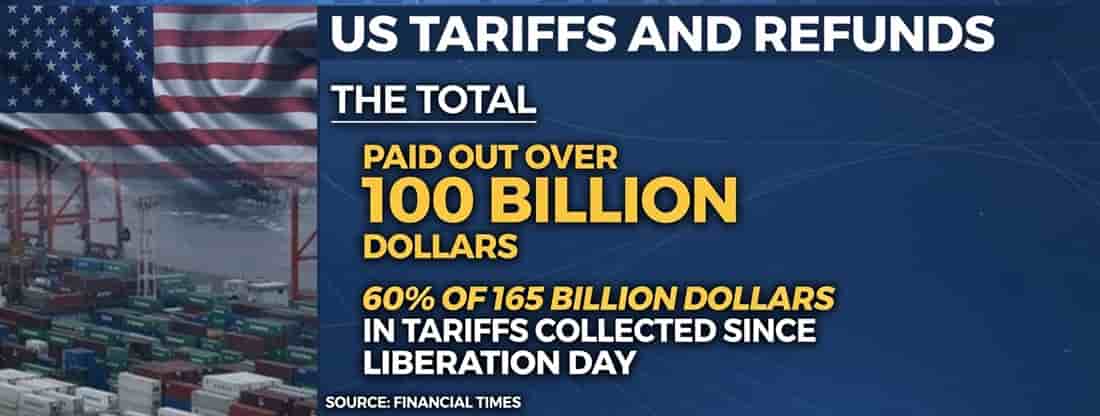
Compounding the risk is the revenue already collected. More than $150 billion has reportedly been raised through tariff enforcement. Analysts estimate that up to 70 percent of that amount could ultimately need to be refunded to importers if courts invalidate the measures entirely. Such an outcome would not only strain public finances but also damage the credibility of US institutions. US Trade Policy
Economic Doctrine vs. Political Instinct
At the core of the president’s strategy lies a deeply held belief: tariffs can restore American industrial strength, reduce dependence on foreign supply chains, and generate revenue to offset tax cuts. This conviction underpins the broader fiscal vision tied to promised tax reductions and efforts to manage the expanding national debt.
Yet mainstream economic theory challenges that assumption. Most economic models argue that tariffs raise consumer prices, distort markets, and invite retaliatory measures. The historical record reinforces this view. The Smoot-Hawley Tariff Act of 1930 dramatically increased duties on thousands of imported goods in an effort to protect domestic industry. Instead of stabilizing the US economy, it deepened the Great Depression and triggered global retaliation.
Congress reversed course in 1934, acknowledging the unintended consequences. The parallel is difficult to ignore. Today’s US trade policy debate echoes that earlier experiment, raising questions about whether protectionist escalation could once again amplify economic instability rather than reduce it.
The Constitutional Dimension
Beyond economics, the Supreme Court ruling touches a more profound issue: the balance of powers. By limiting unilateral tariff authority, the Court reaffirmed Congress’s constitutional role in regulating commerce.
For the president, this is not merely a policy disagreement. It challenges a broader vision of executive authority. The attempt to centralize control over US trade policy formed part of a larger effort to expand presidential power at the expense of legislative and judicial oversight.
The State of the Union is therefore expected to address not only trade, but also institutional legitimacy. Recent public remarks have included sharp criticism of Supreme Court justices and dissenting lawmakers within the president’s own party. Such rhetoric underscores the political tension surrounding this moment.
Midterms and Party Risk
The Republican Party now faces a delicate calculation. Supporting the tariffs may align with the president’s political base, but it risks alienating business constituencies and moderate voters concerned about inflation and market volatility.
If the policy fails to deliver measurable improvements—such as narrowing the trade deficit or revitalizing manufacturing regions—Republican candidates could encounter resistance in competitive districts. Trade policy, typically a technical domain, may become a central electoral issue.
The 150-day limit effectively ensures that tariff debates will coincide with peak campaign messaging. Any economic slowdown, stock market turbulence, or consumer price increases during this period will intensify scrutiny.
International Reverberations
Global partners are closely monitoring developments. The European Parliament has already paused debate on ratifying a previously negotiated agreement with Washington. Such hesitation reflects doubts about the stability of US trade commitments.
In Asia, attention turns to Beijing. A forthcoming diplomatic encounter with Chinese leadership will occur against the backdrop of heightened tariffs and legal uncertainty. Demonstrating strength abroad while facing constraints at home presents a strategic dilemma.
Markets thrive on predictability. Sudden shifts in US trade policy, especially when tied to unresolved constitutional disputes, undermine confidence not only in bilateral relations but also in the reliability of American financial instruments. The US Treasury market, long considered a global safe haven, depends heavily on perceptions of institutional stability.
What to Expect from the State of the Union
The president is unlikely to signal retreat. Doing so would contradict months of rhetoric portraying tariffs as essential to national renewal. Instead, observers anticipate reaffirmation: a defense of US trade policy as both economically necessary and politically justified.
The address may also frame the Supreme Court ruling as part of a broader struggle over executive authority. Appeals to economic nationalism, domestic manufacturing revival, and fiscal sovereignty will likely feature prominently.
Yet the structural constraints remain unchanged. Temporary authority expires. Congressional approval is required. Courts retain oversight. The coming months will test not only the effectiveness of US trade policy, but also the resilience of American institutional checks and balances.
A Turning Point for US Trade Policy
The current confrontation represents more than a tactical dispute over tariffs. It reflects a fundamental debate about how the United States engages with the global economy and how power is distributed within its constitutional system.
If escalation continues, the economic costs could extend beyond immediate revenue or price effects. Investor confidence, alliance cohesion, and domestic political stability all hinge on predictable governance.
Tomorrow’s State of the Union will therefore serve as both a political performance and a strategic signal. Whether it reassures markets and lawmakers or deepens divisions may shape the trajectory of US trade policy for years to come.
More…