US Protectionism Tightens Grip as EU Falters Under New Tariffs While Markets Stay Calm and Investors Shift Strategies Globally 24-02-2026
US Protectionism Returns as Markets Absorb the Shock
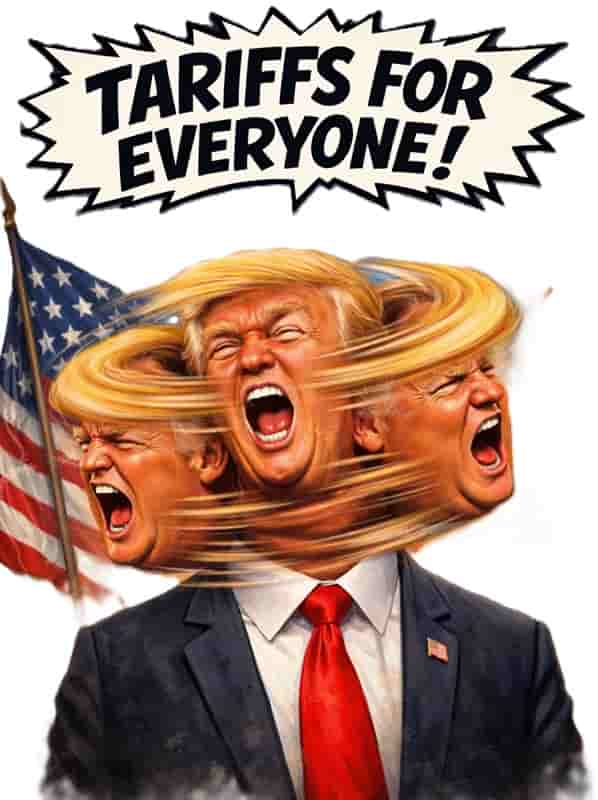
The reintroduction of US tariffs has once again placed US protectionism at the center of global trade tensions. Yet, while European politics appears unsettled, financial markets are showing notable resilience. Investors, far from panicking, are recalibrating strategies and diversifying risk exposure across regions and asset classes.
European stock exchanges closed with only marginal losses. Frankfurt led the declines at -1%, while Milan managed to finish slightly positive at +0.5%, despite surrendering part of its intraday gains. The muted reaction suggests that markets had already priced in the persistence of US protectionism and its impact on transatlantic trade.
Across Asia, trading volumes were subdued due to holidays in Tokyo and Shanghai for the Chinese New Year. However, Hong Kong rose by 2.5%, reinforcing a broader trend: capital is increasingly gravitating toward Southeast Asia rather than navigating Western political uncertainty.
Investors Adapt to Persistent Trade Tensions
The financial sector has learned to operate in an environment shaped by recurring US tariffs and abrupt policy shifts. Trump’s confrontational trade style, once destabilizing, is now factored into risk models and asset pricing frameworks.
Safe-haven assets continue to benefit. Gold and silver have set fresh records, reflecting structural hedging against geopolitical volatility and ongoing US protectionism. For short-term traders, these price movements present tactical opportunities. For long-term investors, they signal a recalibration toward defensive portfolios.
Wall Street itself opened with a modest loss of -1.5%, underscoring that even US markets are not immune. Still, the decline was contained, confirming that financial actors understand the cyclical nature of US protectionism and its negotiation-driven dynamics.
EU Governance Faces Strategic Dissonance
While markets remain composed, the European political response appears fragmented. The internal tug-of-war in Washington—between the White House and the Supreme Court—has indirectly disrupted EU governance. The ruling that maintained certain US tariffs complicates Brussels’ diplomatic posture.
A flat 15% tariff structure has reduced duties for countries such as Brazil, China, India, and Canada. However, European exports to the United States are concentrated in steel, aluminum, and automobiles—sectors already subject to specific duties that remain in force. As a result, Europe feels disproportionately exposed to US protectionism.
By contrast, other global exporters benefit from diversified product categories including clothing, furniture, toys, and plastics. For them, trade flows are nearing normalization. For Europe, structural vulnerabilities in industrial exports limit flexibility.
Diverging Voices Within the European Union
Political messaging across the EU lacks cohesion. Italy has advocated caution. Agriculture Minister Francesco Lollobrigida emphasized the need for clarity and adherence to prior EU-US agreements, reflecting domestic concerns from the agri-food sector. Business Minister Adolfo Urso adopted a softer tone, suggesting a legal and institutional challenge rather than immediate escalation.
Meanwhile, France and Germany appear more assertive. President Emmanuel Macron has signaled readiness to deploy the EU’s anti-coercion instrument. German Chancellor Friedrich Merz faces internal pressure, especially with a planned visit to Washington looming. His call for a unified European stance underscores the difficulty of forging consensus in the face of US protectionism.
The European Parliament postponed its vote on the agreement reached between Ursula von der Leyen and Donald Trump last July. The delay reflects uncertainty over the agreement’s practical value. With counter-tariffs potentially reaching €93 billion, the European Commission must carefully evaluate proportional responses without triggering further escalation.
Permanent Negotiation Mode: A New Trade Reality
One defining feature of US protectionism under Trump is the concept of permanent negotiation. Agreements appear provisional. Tariff structures can shift rapidly. Diplomatic channels remain active, but finality is elusive.
Trade Commissioner Maroš Šefčovič may once again intensify shuttle diplomacy between Brussels and Washington. However, any decision risks encountering resistance within the European Council, where member states maintain diverging economic interests.
The broader implication is structural uncertainty. US protectionism no longer represents a temporary deviation from liberal trade norms. Instead, it appears embedded in the American strategic doctrine, independent of short-term legal disputes.
Markets vs. Politics: A Diverging Learning Curve
Financial markets have internalized this new equilibrium. Portfolio managers hedge against volatility, diversify geographic exposure, and increase allocations to commodities and Asian equities. In contrast, European political institutions are still adjusting to the strategic implications.
The modest declines in European indices and the contained reaction on Wall Street suggest that investors recognize the limits of immediate economic damage. Global supply chains have adapted since earlier trade disputes. Corporate risk management frameworks now incorporate scenarios involving US tariffs as baseline assumptions rather than tail risks.
However, political actors face more complex constraints. Public opinion, industrial lobbying, and electoral cycles complicate rapid alignment. The EU’s institutional architecture requires consensus-building, which slows response time in comparison to unilateral US action.
Strategic Implications for Europe
Europe confronts a dual challenge. First, it must mitigate the direct economic impact of US protectionism on key export sectors. Second, it must strengthen internal cohesion to project negotiating credibility.
Diversifying export markets toward Southeast Asia and emerging economies may reduce overreliance on transatlantic trade. Simultaneously, investment in high-value manufacturing and technological sovereignty could buffer future tariff shocks.
The episode demonstrates that resilience is no longer optional. In an era of structural US protectionism, strategic autonomy becomes a prerequisite for economic stability.
Conclusion: Stability in Markets, Volatility in Governance
The immediate lesson is clear. Markets have adapted to US tariffs and ongoing US protectionism. Political institutions, particularly within the EU, are still recalibrating.
Trump’s strategy—whether intentional or forced by judicial intervention—has reinforced a reality where trade negotiations are perpetual and certainty remains scarce. Investors understand this. European governance must now catch up.
In the evolving landscape of global trade tensions, adaptability determines advantage. Financial markets have already absorbed that truth. The question is whether European policymakers can do the same.
More…