Trump Tariff Refunds Reach $100 Billion After Court Ruling
Trump Tariff Refunds Reach $100 Billion as New Trade Fight Begins
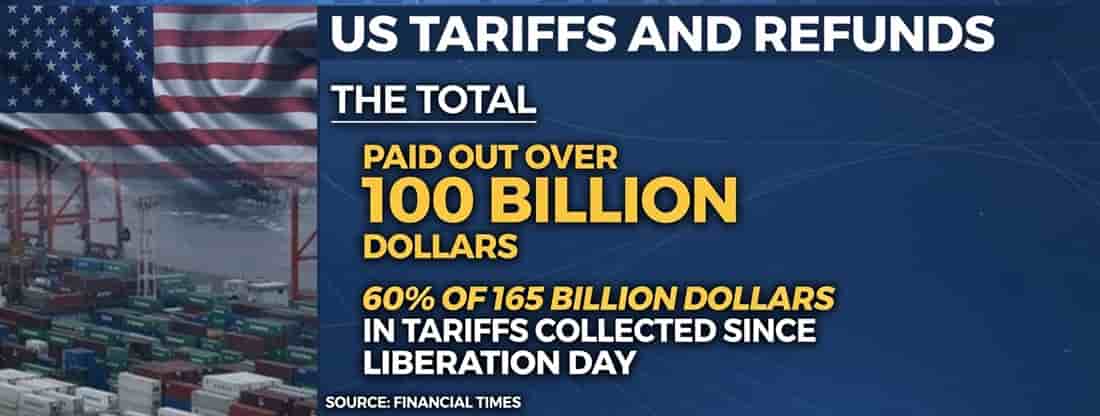
The US government has returned approximately $100 billion in duties collected under President Donald Trump’s “Liberation Day” tariffs, according to court data reported on August 5. The repayments equal roughly 60% of the approximately $165 billion collected under tariff measures tied to the International Emergency Economic Powers Act, or IEEPA.
The figure marks a much faster start than many businesses expected. It does not mean every affected company—or every consumer who paid higher prices—will automatically receive money.
Why the tariffs were struck down
On February 20, 2026, the US Supreme Court ruled 6–3 that IEEPA did not authorize the president to impose the sweeping import duties. The decision limited the executive branch’s ability to use emergency economic powers as a substitute for tariff authority delegated by Congress.
The Supreme Court resolved the core question of presidential authority, but it did not itself administer the repayments. The US Court of International Trade subsequently ordered Customs and Border Protection, or CBP, to process refunds for eligible importers of record.
That distinction matters: the Supreme Court invalidated the use of IEEPA for these tariffs, while the trade court established the refund process.
More than $128 billion is being processed
CBP data submitted to the trade court indicates that more than $128 billion in refund requests has been accepted for processing. Because that amount exceeds the approximately $100 billion already repaid, further payments are expected as claims are validated.
The pace is notable. Treasury Secretary Scott Bessent had previously suggested that resolving the refunds could involve years of litigation. Instead, CBP developed a centralized process called CAPE—the Consolidated Administration and Processing of Entries—inside its Automated Commercial Environment system.
CBP says CAPE is designed to handle valid IEEPA refund declarations in batches. Accepted for processing, however, does not necessarily mean approved or paid: requests still require validation. Trump tariff refunds
Who is eligible for a tariff refund?
The refund system is built around the “importer of record,” the person or company legally responsible for the customs entry and payment of duties. That entity can submit the required declaration through the ACE system and receive an approved refund.
This creates a gap between who paid CBP and who ultimately absorbed the cost. A retailer, small business or consumer may have paid a higher price without being the importer of record. In that situation, it generally cannot file a direct CBP claim for the duty.
The rule does not exclude small and medium-sized companies as a class. A smaller company that acted as importer of record may qualify. The obstacle arises when a customs broker, supplier, marketplace seller or another entity held that legal role.
Amazon received about $600 million
Amazon said during its second-quarter earnings call that it received approximately $600 million in tariff refunds. Chief Financial Officer Brian Olsavsky said the company expects to return some money to customers in limited cases where a specific import charge can be linked to their purchase.
Amazon’s payment illustrates the imbalance in the process. Large importers can recover duties directly, while consumers and downstream businesses often depend on the importer choosing—or being required—to pass the money back. There is no general automatic federal refund for shoppers who faced tariff-related price increases.
Trump has turned to a different tariff law
The court defeat did not end the administration’s tariff policy. In July, the US Trade Representative announced new duties of 10% or 12.5% on goods from more than 80 countries, relying on Section 301 of the Trade Act of 1974 rather than IEEPA.
A coalition of 25 states filed a new case in the US Court of International Trade this week. The states argue that the forced-labor rationale offered for the measures is a pretext and that the administration failed to comply with the limits and procedures of Section 301. The White House says the tariffs are a lawful response to foreign practices that burden US commerce.
The new case remains unresolved. The tariffs therefore should not be described as illegal at this stage; they are being challenged, and the court has been asked to halt them and order refunds of duties already paid.
What happens next
CBP will continue validating claims and issuing repayments through CAPE. With more than $128 billion accepted for processing, the total paid is likely to rise, although the final amount and timetable remain uncertain.
Importers should rely on official CBP guidance, confirm who was listed as importer of record and beware of refund scams seeking account credentials. Businesses that were not the importer of record may need to review contracts and payment records to determine whether they have a claim against a supplier or intermediary rather than against CBP.
The broader legal question is now shifting from IEEPA to Section 301. The next trade-court ruling could determine whether the administration’s replacement tariffs survive—or create another large refund dispute.
Sources and verification
-
Financial Times: US refunds $100bn of “Liberation Day” tariffs, published August 5, 2026.
-
US Customs and Border Protection: IEEPA duty refunds, official process and eligibility guidance.
-
New York Attorney General: challenge to the new Section 301 tariffs, published August 3, 2026.
-
US Court of International Trade: CBP guidance on CAPE and IEEPA refunds, official court notice.