Secure Tray Sealing: Securikett Unveils Heat-Free Label Closure
Secure Tray Sealing: Securikett Unveils Heat-Free Label Closure
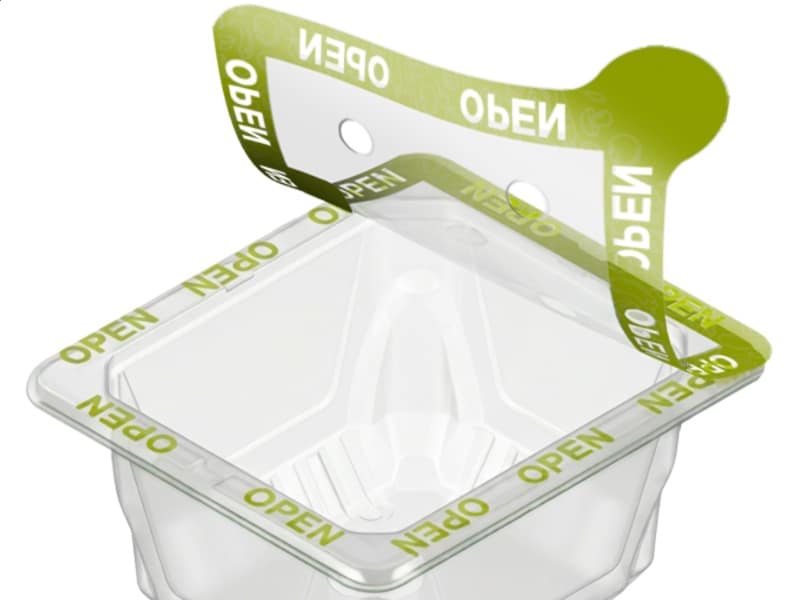
Securikett has introduced a label-based closure system for trays and cups that does not require conventional heat sealing. The Austrian security-label specialist says the technology combines closure, tamper evidence and functional packaging features in a single label.
Announced in July 2026 and reported by packaging publications on August 6, the system is intended for automated application with existing labelling or dispensing equipment. Securikett describes it as a potentially faster and more cost-efficient alternative to traditional welded lids, although independently verified performance figures have not yet been published.
Key takeaways
- A multifunctional label closes the tray instead of a heat-welded lid.
- Integrated VOID technology provides visible evidence of opening.
- Adhesive and silicone coatings can be positioned in defined areas.
- Viewing windows, ventilation holes and other openings can be incorporated.
- Labels can be applied through automated dispensing systems.
- Securikett has not disclosed production-speed comparisons, pricing data or application-specific test results.
How the tray-closing label works
The system brings together structured adhesive coatings, registered silicone coatings, customized die-cutting and Securikett’s VOID technology.
Precisely positioned adhesive areas secure the label to the tray. Silicone-coated sections control where the label should not bond, while the die-cutting process can create ventilation holes, technical openings or windows through which the packaged product remains visible.
This construction allows the label to perform several jobs that would otherwise require separate packaging components or production operations.
Securikett says the label can separate cleanly from its liner during automated dispensing. Defined cut-out areas remain on the liner rather than being carried onto the package, simplifying the production of functional openings.
VOID technology reveals package opening
Tamper evidence is one of the system’s principal features. If someone removes or interferes with the label, the integrated VOID effect produces a visible and irreversible opening indication.
This does not prevent every form of product tampering, and it should not be described as “tamper-proof.” Instead, it provides consumers, retailers and supply-chain operators with visible evidence that the closure may have been disturbed.
According to Securikett, comparable security mechanisms have long been used for applications such as cash-transport pouches. The company is now adapting the approach to tray and cup packaging.
“We have combined multiple technologies so that they work together within a single label,” said Vanessa Mitterer-Kling, Securikett’s head of research and development, in the company announcement. secure tray sealing
Potential production advantages
Removing a heat-sealing stage could reduce tooling requirements and simplify some packaging lines. Automated label application may also provide manufacturers with greater flexibility when changing formats or adding functional openings.
However, the actual benefits will depend on factors including tray material, label construction, line speed, packaged product, storage conditions and regulatory requirements.
Securikett has not publicly provided comparative data covering seal strength, throughput, energy consumption, shelf life or total operating cost. Packaging producers should therefore validate the system on their own lines before treating the company’s speed, safety or cost claims as established performance outcomes.
For food applications in particular, a visible tamper indicator is not automatically equivalent to a hermetic or contamination-resistant seal. Required barrier properties, hygiene controls and product-specific compliance would still need to be confirmed.
Part of a wider functional-label strategy
The development builds on technology Securikett presented earlier in 2026 for labels containing viewing windows, ventilation holes and other precisely positioned openings.
The company’s dedicated coating information describes the tray system as a combination of structured adhesive application, VOID technology, silicone coating and die-cutting. Its stated objective is to unite packaging functionality, security and regulatory considerations in one construction.
The latest launch therefore represents more than a conventional label placed across a container edge. It treats the label as a functional closure component whose bonding and non-bonding areas are engineered for a specific package.
What the technology could mean for packaging producers
Label-based tray closure could be relevant to manufacturers seeking tamper evidence without adding a separate security seal. It may also appeal to businesses that need ventilation, product visibility or customized openings alongside automated closure.
Its commercial significance will become clearer when information is available about compatible tray materials, barrier performance, production speeds and qualification for specific food, pharmaceutical or consumer-product applications.
For now, Securikett’s development demonstrates how advanced coatings and converting techniques can expand a label’s role—from displaying information to becoming an active part of the package itself.
Frequently asked questions
Does the Securikett label replace heat sealing?
The system is designed to close certain trays and cups without a conventional heat-welded lid. Suitability must be assessed for each package and product.
How does it show that a tray has been opened?
Integrated VOID technology leaves a visible opening indication when the label is removed or disturbed.
Can ventilation holes be included?
Yes. Securikett says ventilation holes, viewing windows and technical openings can be produced through precisely registered coating and die-cutting processes.
Is the system already proven to be cheaper?
Securikett describes it as more cost-efficient, but publicly available reporting does not include independent cost comparisons or detailed production data.
Sources and verification
The technical description and company claims were checked against Securikett’s product announcement and its structured-coating documentation. The August 6, 2026 news reports were verified through Packaging Europe and Packaging Journal.
China accelerates circular plastics future as 5 innovations boost PET tray recycling