Recycled nylon – Breakthrough Recycling at Indian Institute of Science Upscales Fishing Nets and Automotive Parts into High-Performance Materials for a Sustainable Circular Economy 06-11-2025
Recycled nylon – Introduction
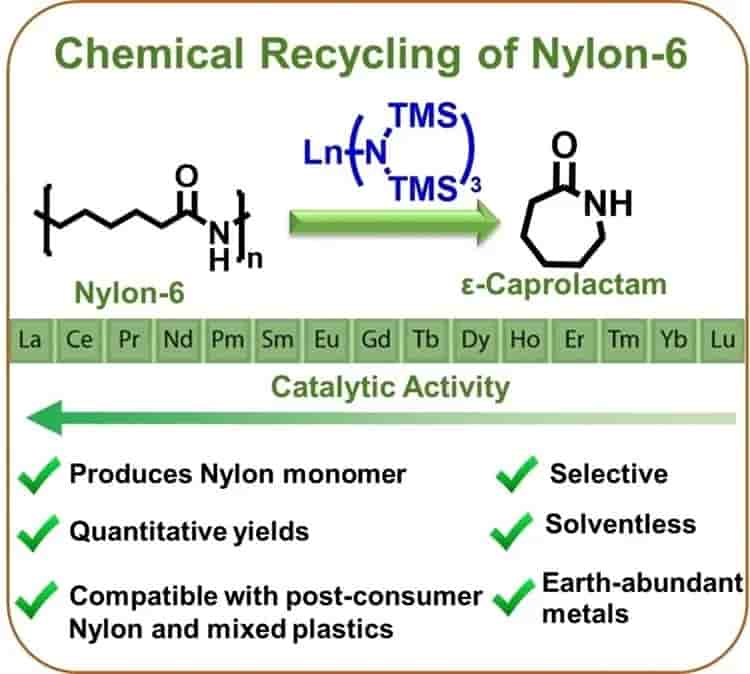
A team at the Indian Institute of Science (IISc) in Bengaluru has introduced an innovative method to recycle tough-to-process plastic waste such as fishing nets and automotive parts. The material in question is nylon 66 (also called PA-66), a high-performance polymer widely used in demanding applications. This breakthrough offers both environmental and manufacturing benefits, by converting waste into high-value materials. thecivilstudies.com+3Deccan Herald+3iisc.ac.in+3
Why the Challenge Matters
Fishing nets and automotive components containing nylon 66 are notoriously difficult to recycle effectively. The polymer exhibits strong hydrogen-bonding and long molecular chains, which degrade during conventional recycling methods. As a result, much of this material ends up as microplastics or persistent waste. Recycled nylon
Globally, plastic production exceeds 430 million tonnes annually according to the United Nations Environment Programme (UNEP). Waste streams like fishing gear are especially problematic for marine ecosystems. thecivilstudies.com+1
The New Process
The IISc researchers melted nylon 66 waste and added two key components: melamine and a zinc-based catalyst. This triggers a rapid reaction called transamidation (amide-exchange) which reorganises the polymer chains and restores mechanical strength. Impressively, the melting and up-cycling step takes less than two minutes, making it compatible with high-throughput manufacturing lines. iisc.ac.in+2Deccan Herald+2
Once processed, the recycled polymer can be 3D-printed into diverse products such as road dividers, boat hulls, park benches, chairs, and more. And crucially, this material retains its performance even after multiple processing cycles. Recycled nylon
Benefits and Applications
This innovation offers several major advantages:
-
Reduced environmental impact: It diverts fishing-net and automotive plastic waste from oceans and landfills.
-
High value output: The recycled material meets demanding mechanical standards, making it suitable for infrastructure or furniture applications. Recycled nylon
-
Scalability: With processing time under two minutes, industrial integration becomes viable.
-
Economic opportunity: Coastal communities and waste-collection networks may benefit from new value chains and employment possibilities. Deccan Herald+1
Circular Economy Implications
By elevating waste nylon 66 into high-performance materials, this work supports a circular-economy model: waste feedstock → up-cycled polymer → durable product → potential further recycling. For polymers like PA-66 which were typically disposed of, this marks a significant shift. thecivilstudies.com+1
Considerations and Future Outlook
While promising, this method does have some caveats. Full peer-reviewed data including long-term durability, UV resistance and cost-competitiveness versus virgin polymer remain emerging. Recycled nylon
Logistics of collecting and sorting waste (e.g., fishing nets) remain a challenge in many regions. The ultimate commercial viability will depend on upstream supply-chain infrastructure, catalyst and cross-linker costs, and regulatory acceptance for infrastructure uses. ScienceDirect+1
Conclusion
This development at IISc signals a smart intersection of materials science and sustainability. By tackling difficult-to-recycle nylon 66 waste streams and converting them rapidly into high-performance materials, the research opens promising new routes for plastic waste valorisation. As manufacturing and recycling systems adopt such innovations, we could see significant shifts in how engineered plastics are handled, processed and reused. Recycled nylon