Closed-Loop Carpet Recycling Moves Closer to Industrial Reality
Barmag’s latest recycled polyester yarn trials mark an important step for closed-loop carpet recycling, showing that used polyester carpet material can be transformed back into new bulked continuous filament yarn without relying on virgin polymer.
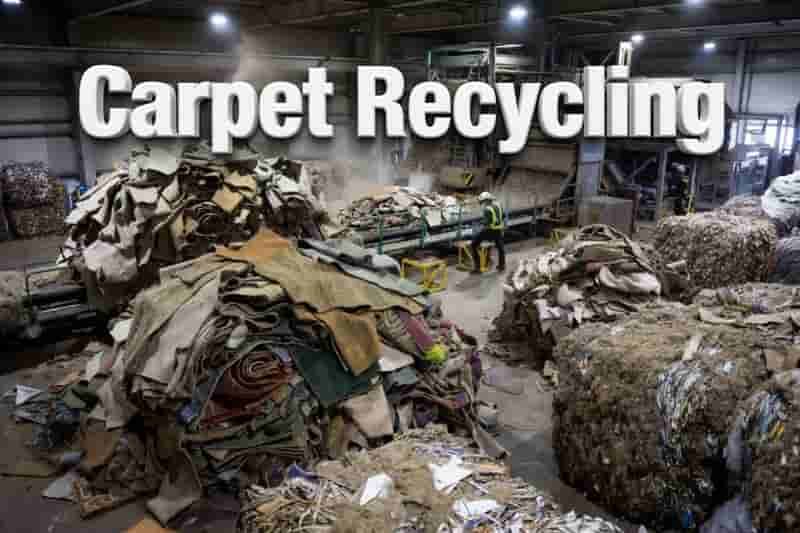
The development matters because the carpet industry has long faced a structural recycling challenge. Many carpet products combine different fibers, backing systems, coatings and adhesives, making end-of-life recovery difficult. In practice, much recycled polyester used in carpet yarn has traditionally come from bottle-grade PET rather than old carpets.
The recent trial changes the conversation. By processing recycled PET from Object Carpet’s mono-material NEOO carpet material, the project demonstrated that carpet waste can potentially become carpet yarn again. That is the core promise of a genuine circular model: materials remain inside the same value chain instead of being downcycled or diverted from other recycling streams.
Why mono-material carpet design matters
The strongest lesson from the project is that recycling begins at the design stage. A carpet made from one main material is easier to sort, process and return to production than a product built from multiple incompatible components.
This is especially important for polyester carpets. Polyester has become a major material in the carpet sector because of its durability, appearance and performance characteristics. However, large-scale circularity depends on whether the material can be recovered cleanly enough to produce stable yarn quality.
In Barmag’s trial, the quality of the recycled polymer was central. Viscosity and purity were identified as critical factors for reliable spinning. If the recycled input is inconsistent, contaminated or degraded, the spinning process becomes harder to control and the final yarn may not meet commercial performance expectations.
From recycled carpet to BCF yarn
The trial was carried out on a Neumag BCF production line at Barmag’s research and development center in Neumünster. BCF yarn, or bulked continuous filament yarn, is widely used in carpet manufacturing because it delivers texture, volume and durability.
The key achievement was practical-scale processing of recycled polyester carpet material into new BCF yarn. No virgin polymer was added. A portion of the recycled yarn was then used to produce a carpet sample, giving the project a visible proof of concept.
This does not mean the entire carpet industry is ready for immediate closed-loop production at scale. But it does show that the technical barrier is lower when product design, recycling technology and spinning know-how are aligned from the beginning.
A wider shift in textile circularity
The timing is significant. Across Europe, textile producers, machinery suppliers, recyclers and policymakers are under increasing pressure to move from sustainability claims to measurable circular systems. Recent European circular-economy initiatives continue to highlight recycling, traceability, product design and industrial collaboration as essential parts of the textile transition.
For the flooring sector, this is particularly relevant. Carpets are long-life products, but once they reach end of life, they can be bulky, difficult to separate and costly to recycle. A closed-loop system for polyester carpet could reduce dependence on virgin raw materials while giving manufacturers a more credible route for end-of-life responsibility.
The project also highlights a broader market shift: recycled polyester is no longer only about replacing virgin material with bottle-derived rPET. The next phase is textile-to-textile and carpet-to-carpet recycling, where waste from the same product category becomes feedstock for new production.
What still needs improvement
The trial is promising, but several challenges remain before this model can be industrialized widely.
First, material purity must be controlled. Post-use carpet waste can contain dirt, backing residues, dyes, additives or mixed polymers. These factors can affect polymer quality and spinning stability.
Second, carpet design must be optimized for recovery. Mono-material products are easier to recycle, but the industry still has many legacy products that were not designed with end-of-life processing in mind.
Third, recycling systems must become scalable and economically viable. A successful pilot or demonstration trial is an important milestone, but commercial adoption requires consistent feedstock, efficient logistics, reliable processing and demand for the recycled yarn.
Finally, process control will remain essential. Recycled polymers often behave differently from virgin materials, so production lines must be flexible enough to adapt spinning parameters to the characteristics of each recycled input stream. closed-loop carpet recycling
Why this trial matters for manufacturers
For carpet producers, the message is clear: circularity is becoming a design and engineering issue, not only a marketing claim.
Manufacturers that want to build credible closed-loop systems will need to work across the value chain. Product designers, recyclers, machinery suppliers and yarn producers must coordinate material choices, recovery methods and production parameters.
Barmag’s trial shows that when these parts are connected, 100 percent recycled polyester carpet material can be brought back into yarn production. That is a meaningful step toward reducing virgin polymer use and improving the environmental profile of carpet manufacturing.
It also gives flooring brands a stronger foundation for future circular business models, including take-back programs, material passports and product lines designed for recyclability from the start.
The road ahead
Closed-loop carpet recycling is not yet the industry norm, but the latest Barmag trial suggests that it is moving from concept to practical application. The most important takeaway is not only that recycled carpet material can be spun into new yarn, but that the whole system depends on designing carpets for their next life.
If the industry can improve feedstock quality, standardize mono-material design and scale recycling infrastructure, recycled polyester carpet yarn could become a much more important part of flooring production.
For now, Barmag’s work with Object Carpet, ITA Augsburg and NGR provides a strong technical signal: carpet-to-carpet recycling is no longer just an ambition. With the right materials and process control, it is becoming an industrial possibility.
More…