Trump Prepares Aggressive New US Industrial Subsidy Tariffs on China and Europe
Trump Prepares Aggressive New US Industrial Subsidy Tariffs on China and Europe
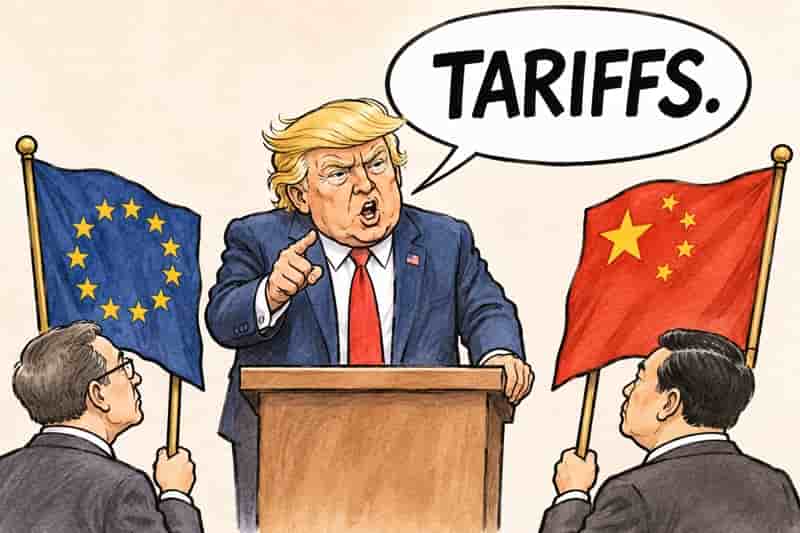
The global trade landscape is bracing for a major shockwave as the Trump administration prepares to roll out a sweeping new round of import duties targeting China, the European Union, and more than a dozen other economies. Driven by a months-long investigation into foreign government support for domestic manufacturing, the upcoming tariff package aims to counter what Washington describes as market-distorting industrial overcapacity. US Industrial Subsidy Tariffs
According to reports emerging from Washington, United States Trade Representative (USTR) Jamieson Greer could announce the findings of this high-stakes probe as early as this week. While officials caution that the exact rollout timeline remains fluid, the move signals a renewed determination by the White House to use aggressive trade enforcement as its primary economic lever. US Industrial Subsidy Tariffs
The Investigation Behind the New US Industrial Subsidy Tariffs
The foundation for these impending levies is an extensive inquiry conducted by the Office of the US Trade Representative under Section 301 of the 1974 Trade Act. This statutory authority allows the president to impose unilateral tariffs to counteract unfair foreign trade practices. Initiated in March 2026—shortly after the US Supreme Court invalidated an earlier round of broad global duties in February—the investigation scrutinized 16 major economies, including China, the 27-nation European Union, India, Japan, South Korea, Taiwan, and Vietnam.
At the heart of the administration’s argument is the issue of state-backed industrial subsidies. Trade Representative Jamieson Greer has repeatedly asserted that extensive financial and policy support from foreign governments has artificially inflated manufacturing capacity abroad. According to the USTR, this excess capacity enables foreign exporters to flood global markets with artificially cheap goods, systematically undercutting American factories and threatening domestic jobs. US Industrial Subsidy Tariffs
Which Countries and Sectors Face the Brunt of the Levies?
While the White House and the USTR have yet to publish the final tariff schedule, informed sources indicate that the new duties will be tailored to specific economies rather than applied as a flat global rate. The administration intends to align the new measures with the tariff benchmarks President Trump sought to establish in 2025, while respecting existing bilateral trade frameworks.
-
China: Beijing is expected to face the steepest penalties. US officials view China’s state subsidies as uniquely pervasive and damaging to global competition. Furthermore, imposing a high rate on Chinese imports allows the administration to push back against domestic criticism that recent diplomatic engagements—including President Trump’s visit to China just last week—were overly lenient. Officials are also weighing a “trigger clause” that would automatically escalate tariffs on China if overcapacity metrics worsen. US Industrial Subsidy Tariffs
-
The European Union, Japan, and South Korea: Economies that have already negotiated trade agreements with Washington are expected to receive comparatively moderated treatment. Under the terms of their existing pacts, goods from the EU, Japan, and South Korea are projected to face tariffs capped at 15% or lower.
-
India and Vietnam: Both nations are included in the probe and could face higher duty thresholds than European or East Asian allies, depending on how Washington interprets compliance with their respective bilateral trade deals.
In terms of product coverage, the tariffs are expected to apply broadly across most merchandise imported from the targeted nations. However, specific industrial commodities already subject to separate national security tariffs—most notably steel, aluminum, and automobiles—are slated to be excluded from this particular round. US Industrial Subsidy Tariffs
Stacking Duties and Legal Hurdles Ahead
The proposed US industrial subsidy tariffs will not exist in a vacuum; instead, they are designed to stack directly on top of existing trade barriers. In July 2026, the administration implemented tariffs ranging from 10% to 12.5% across roughly 60 economies over allegations that those nations failed to curb forced labor in their supply chains. Layering Section 301 subsidy duties onto those existing penalties will substantially raise the effective import tax on a vast array of consumer and industrial goods entering the United States.
However, the administration’s trade strategy continues to face significant legal and market scrutiny. The July forced-labor tariffs are currently tied up in active litigation before the US Court of International Trade. By anchoring this new November tariff wave in Section 301—a well-established legal mechanism with decades of precedent—the White House aims to insulate the duties from the kind of judicial strike-down that derailed its initial 2025 tariff campaign. US Industrial Subsidy Tariffs
Market Reaction and Global Economic Impact
Financial markets reacted swiftly to news of the impending announcement, with S&P 500 futures dipping 1.25% as investors weighed the potential for renewed inflationary pressures and supply chain disruptions. Economists and corporate leaders are closely watching how major trading partners will respond.
For the European Union and Asian allies, the threat of fresh duties risks reopening contentious trade negotiations that many capitals believed were settled earlier in the year. Meanwhile, for American manufacturers, the administration’s willingness to confront global overcapacity offers welcome protection—provided retaliatory tariffs from targeted nations do not severely curtail US agricultural and industrial exports in return. As Jamieson Greer prepares to make the USTR’s findings official, businesses worldwide are bracing for another turbulent chapter in global trade policy. US Industrial Subsidy Tariffs
US Tariffs on Türkiye Deal a Severe Blow to Textile Exporters
More…