AI-Driven Plastic Recycling Systems Are Reshaping Global Circular Economies but Expose Urgent Data, Energy, and Governance Gaps Worldwide 25-01-2026
The growing urgency behind AI-driven plastic recycling
Global plastic production continues to rise, yet recycling rates remain stubbornly low across most regions. This imbalance has turned plastic waste into one of the most persistent environmental challenges of the modern economy. In response, researchers and industry leaders increasingly recognize that traditional recycling methods alone are insufficient. AI-driven plastic recycling is now viewed not merely as an efficiency upgrade, but as a structural requirement for scaling circular plastic economies under real-world constraints.
Recent scientific evidence suggests that without artificial intelligence supporting diagnostics, routing decisions, and environmental governance, many advanced recycling pathways risk remaining fragmented, energy-intensive, or environmentally ambiguous. Digital intelligence is becoming essential to align technical feasibility with climate performance and regulatory compliance.
From sorting lines to system-level intelligence
One of the most immediate impacts of AI-driven plastic recycling is visible in material identification and sorting. This stage largely determines whether plastics can re-enter high-value recycling loops or are diverted into downcycling or energy recovery. Conventional optical sorting systems struggle with mixed polymers, multilayer packaging, dark pigments, and additive-heavy plastics.
AI-enhanced sensing technologies are rapidly closing these gaps. Machine learning models combined with spectroscopic tools such as near-infrared analysis, Raman spectroscopy, hyperspectral imaging, and laser-based diagnostics can identify polymers under noisy, real-world conditions. These systems go beyond simple classification. They evaluate contamination, degradation, and additive signatures, allowing facilities to route plastics toward the most suitable recycling or upcycling pathway.
This marks a shift from task-level automation to system-level intelligence. Early applications focused on faster interpretation of complex sensor data. Newer deployments integrate multiple data streams to dynamically adjust sorting thresholds, reduce reject rates, and stabilize throughput. At the most advanced stage, AI supports network-level decision-making, guiding how materials move across collection systems, sorting plants, and recycling facilities based on environmental impact, technical constraints, and market demand.
Tackling hard-to-recycle plastic streams
AI-driven plastic recycling is particularly relevant for materials traditionally considered unrecyclable. Carbon-black plastics, multilayer films, and electronic waste plastics pose significant challenges due to their complex compositions. Sensor fusion powered by artificial intelligence is increasingly the only viable method to extract usable material from these streams without excessive energy input or severe quality loss. AI-driven plastic recycling
However, algorithmic sophistication alone is not enough. Performance remains closely tied to the quality of training data and the completeness of spectral databases. Poor data coverage limits the ability of AI systems to generalize across diverse waste streams, making data standardization one of the most urgent challenges for scaling intelligent recycling systems globally.
AI inside recycling and chemical recovery processes
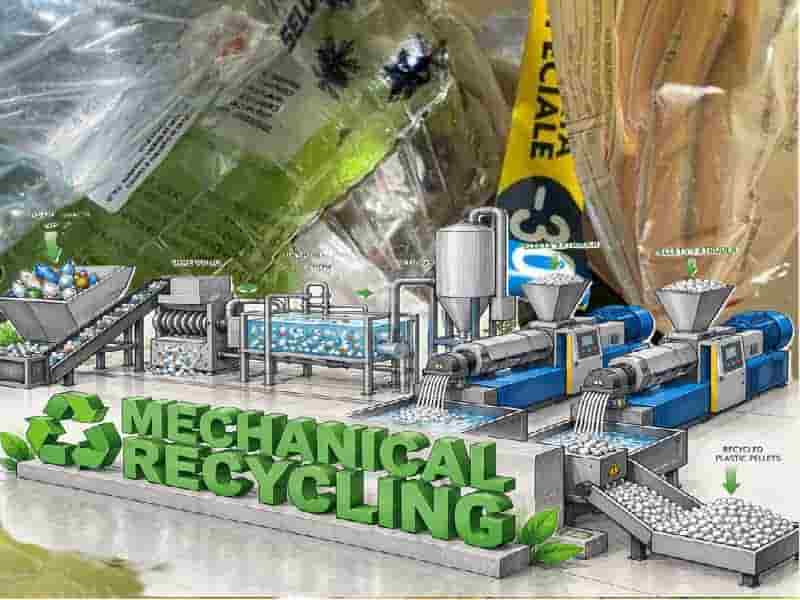
Beyond sorting, AI-driven plastic recycling is increasingly embedded within recycling processes themselves. In mechanical recycling, predictive models monitor polymer degradation, optimize extrusion parameters, and signal when material quality approaches critical thresholds. This prevents irreversible damage to recyclates and reduces unnecessary energy consumption. AI-driven plastic recycling
Chemical recycling pathways, including pyrolysis and solvolysis, show even stronger adoption of artificial intelligence. Machine learning models predict product distributions, catalyst behavior, and optimal operating conditions based on feedstock composition. Evidence suggests that AI-supported process control can significantly improve selectivity and reduce energy demand.
Yet a critical insight emerges. Advanced recycling technologies only outperform mechanical recycling environmentally when paired with intelligent control systems and low-carbon energy sources. Without this integration, the higher processing intensity of chemical routes can erase the benefits of producing high-purity outputs. AI-driven plastic recycling
Upcycling and the pursuit of higher-value circularity
Upcycling represents a more ambitious extension of AI-driven plastic recycling. Rather than focusing solely on material recovery, upcycling aims to transform plastic waste into products with higher functional or economic value. This strategy is particularly relevant in regions with heterogeneous waste streams where high-purity sorting is difficult.
Artificial intelligence plays a decisive role in making upcycling viable at scale. Machine learning accelerates catalyst discovery, reaction pathway selection, and material design across chemical, thermochemical, electrochemical, and biological routes. Predictive models explore vast design spaces to identify combinations that maximize yield while minimizing unwanted byproducts. AI-driven plastic recycling
Polyethylene and polypropylene dominate current research due to their prevalence in global plastic production. Pyrolysis-based upcycling receives the most attention, but AI-assisted optimization is also advancing electrochemical and photocatalytic pathways, especially for polyester-based plastics. In biological systems, AI-driven enzyme discovery shows promise for plastic depolymerization, although industrial deployment remains constrained by contamination sensitivity and limited datasets.
Environmental performance depends on intelligent assessment
The environmental value of AI-driven plastic recycling cannot be assumed. Mechanical recycling typically delivers the lowest energy demand and emissions, but its advantage erodes rapidly with contaminated or degraded feedstocks. Chemical recycling can yield superior material quality, yet its climate performance varies widely based on heat integration, catalyst lifetime, and electricity sources.
Upcycling can outperform all other routes when it displaces energy-intensive virgin materials. When substitution effects are weak, however, additional inputs can outweigh avoided emissions. AI-supported life cycle assessment models are increasingly used to evaluate these scenarios before scale-up, reducing the risk of investing in processes that appear innovative but deliver limited environmental benefit.
Digital twins and machine learning-enabled assessment tools allow operators to simulate how changes in feedstock quality, energy mix, or routing strategies affect overall impacts. These dynamic evaluations consistently reveal high variability, underscoring the need for scenario-based planning rather than static comparisons.
Governance, traceability, and the role of digital intelligence
Despite technological progress, governance remains a limiting factor for AI-driven plastic recycling. Many regions lack standardized data infrastructures, traceability systems, and regulatory alignment needed to support intelligent circular systems. Extended Producer Responsibility schemes offer potential, particularly when linked to quality and environmental metrics, but their effectiveness depends on transparency and enforcement.
Digital traceability supported by artificial intelligence is emerging as a critical enabler. Systems that track material flows, verify recycled content, and authenticate processing histories can improve recyclate consistency and support regulatory compliance. Combining AI-based quality scoring with digital tagging systems may help create auditable circular supply chains.
Social factors also matter. Informal collection networks play a central role in many regions. Excluding these actors from digital systems risks weakening recovery rather than strengthening it. Inclusive governance models, supported by transparent data and fair valuation, are essential for durable circular transitions.
Conclusion
AI-driven plastic recycling is no longer optional. It is becoming the connective intelligence that links sorting, processing, upcycling, environmental assessment, and governance into a coherent circular system. While artificial intelligence cannot overcome fundamental thermodynamic limits, it can dramatically reduce uncertainty, improve efficiency, and guide plastics toward their highest-value and lowest-impact pathways. The challenge now lies in aligning data quality, energy systems, and governance frameworks to fully unlock its potential.
More…