Carbon fiber recycling technology – Toray Breaks Carbon Fiber Recycling Barriers With Low Carbon Technology That Preserves Strength Quality And Expands Sustainable Industrial Applications Worldwide 18-12-2025
Carbon fiber recycling technology
Toray Advances Carbon Fiber Recycling Technology for a Circular Economy
Toray Industries has taken a major step toward sustainable manufacturing with the development of an advanced carbon fiber recycling technology. This innovation enables the chemical decomposition of carbon fiber-reinforced plastics made from thermoset resins, materials that have traditionally been difficult to recycle. By preserving fiber strength and surface quality, the technology supports circular economy goals while reducing environmental impact.
Carbon fiber recycling technology is becoming essential as industries seek alternatives to energy-intensive virgin fiber production. Toray’s solution addresses long-standing technical limitations and opens new opportunities for high-performance recycled materials across multiple sectors.
Overcoming Thermoset Resin Recycling Challenges
Thermoset resins are widely used in carbon fiber-reinforced plastics due to their durability and heat resistance. However, their three-dimensionally cross-linked molecular structure makes them extremely difficult to break down using conventional recycling methods. Existing approaches often rely on high temperatures that damage fibers and limit reuse.
Toray has developed a proprietary decomposition agent capable of breaking down these complex resins at significantly lower temperatures. This advancement allows a wide range of CFRP waste to be processed, including materials from aerospace, wind energy, automotive manufacturing, and industrial equipment.
The lower-temperature process is central to the effectiveness of this carbon fiber recycling technology, as it minimizes thermal degradation and preserves critical mechanical properties.
Preserving Strength While Reducing Emissions
One of the most notable achievements of Toray’s carbon fiber recycling technology is the retention of more than 95 percent of the single-fiber tensile strength compared to petrochemically produced virgin carbon fibers. This performance level far exceeds that of conventionally recycled fibers, which often suffer from significant strength loss.
Equally important is the environmental benefit. Toray estimates that CO₂ emissions from this recycling process are less than half those generated during the production of new carbon fibers. As industries face increasing pressure to reduce emissions, this technology provides a practical and scalable pathway toward lower-carbon manufacturing.
Improved Fiber Quality for Broader Applications
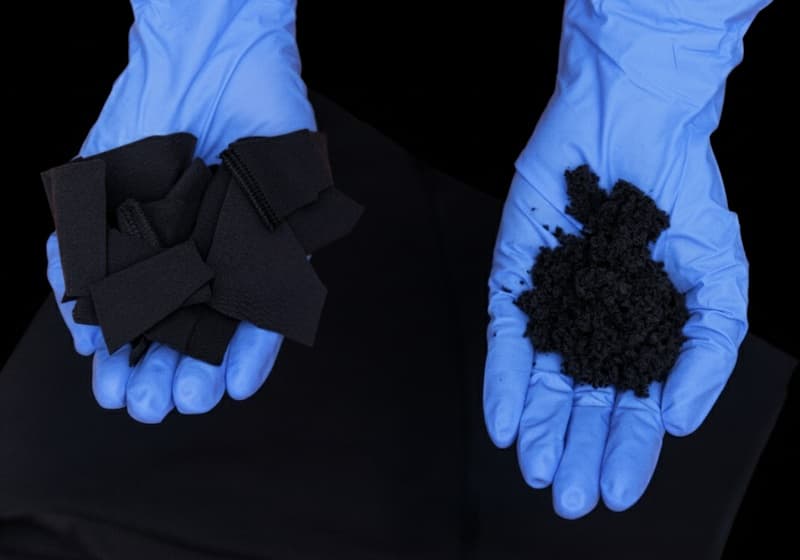
The recycled fibers produced using Toray’s carbon fiber recycling technology exhibit superior surface quality and minimal resin residue. These characteristics reduce fiber breakage during post-processing and make the material easier to handle in downstream manufacturing.
High-quality recycled fibers can be processed into a variety of forms, expanding their potential uses. Toray has achieved particular success in dispersing short fibers and forming them into nonwoven sheets, a format that is compatible with numerous industrial and consumer applications.
This versatility positions recycled carbon fibers as viable alternatives to virgin materials, even in demanding environments.
Controllable Dispersibility and Washi-Inspired Materials
A distinctive feature of Toray’s approach is the ability to control the water dispersibility of recycled carbon fibers. This capability enables manufacturers to create both highly uniform nonwoven structures and materials with textured surfaces inspired by traditional Japanese Washi paper.
The resulting materials combine the functional advantages of carbon fibers, such as radio frequency shielding, electrical conductivity, and thermal performance, with a visually appealing and tactile finish. This fusion of performance and aesthetics broadens the appeal of recycled carbon fiber products beyond purely technical applications.
Prototypes have already been delivered to customers exploring uses in automotive interiors, architectural materials, electrical and electronic components, and everyday consumer products.
Collaboration and Ongoing Technical Evaluation
Toray is actively collaborating with customers to refine applications and validate performance under real-world conditions. These partnerships play a crucial role in adapting the carbon fiber recycling technology to specific industry needs and regulatory requirements.
Technical evaluations are ongoing, focusing on durability, manufacturability, and scalability. Feedback from these collaborations is expected to accelerate commercialization and adoption across diverse markets.
Addressing the Growing CFRP Waste Challenge
Carbon fiber-reinforced plastics are increasingly used in aircraft, wind turbines, and lightweight vehicles. As these products reach the end of their service life, CFRP waste volumes are expected to rise significantly.
Current recycling pathways include chemical recycling as a reducing agent in steel furnaces and high-temperature pyrolysis processes that recover fibers. While these methods contribute to waste reduction, they often compromise fiber quality or limit reuse options.
Toray’s carbon fiber recycling technology addresses these shortcomings by avoiding excessive thermal damage, controlling resin residues, and accommodating multiple types of CFRP waste. This comprehensive approach supports broader market growth, including expanding demand for recycled fibers in injection molding and composite manufacturing.
Enabling Sustainable Growth Across Industries
By combining high fiber performance, lower emissions, and flexible processing, Toray’s carbon fiber recycling technology represents a meaningful advance for sustainable materials science. It demonstrates that recycled carbon fibers can meet stringent performance standards while supporting environmental objectives.
As industries transition toward circular manufacturing models, technologies like this will be critical in reducing dependence on virgin resources and lowering the carbon footprint of advanced materials.
More…