Revolutionary Eco Friendly Battery Upcycling Transforms Spent Lithium Ion Cells into High Voltage Energy Storage Systems for a Sustainable Circular Future 19-02-2026
Eco Friendly Battery Upcycling: Transforming Spent Lithium Ion Batteries into High Voltage Energy Storage Systems
The rapid expansion of electric vehicles and grid-scale storage has created a parallel challenge: managing growing volumes of spent lithium ion batteries. As global demand accelerates, sustainable end-of-life strategies are no longer optional. They are fundamental to the resilience of the energy transition.
A breakthrough in eco friendly battery upcycling now demonstrates how spent lithium ion batteries can be directly converted into high voltage energy storage systems. This approach does not merely recover metals. It redefines battery recycling by integrating value creation, environmental responsibility, and circular economy principles.
For policymakers, manufacturers, and energy developers, this innovation signals a structural shift in how we think about battery lifecycle management.
Why Traditional Battery Recycling Is Not Enough
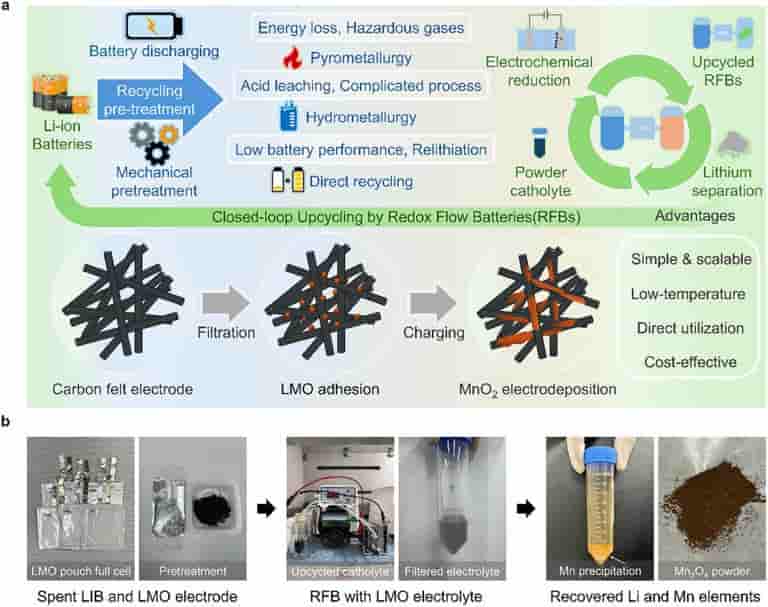
Conventional lithium ion battery recycling typically relies on two industrial routes:
-
High-temperature smelting, often exceeding 900 °C
-
Hydrometallurgical processing using strong acids
Both methods are energy-intensive and can generate secondary pollution. While effective for metal recovery, they prioritize extraction over reintegration. The result is a linear model: extract, use, recover raw material, repeat.
This framework limits the full potential of circular battery ecosystems. As electric mobility scales globally, resource recovery alone is insufficient. The industry requires integrated solutions that reduce emissions, lower energy inputs, and retain material functionality wherever possible.
This is where eco friendly battery upcycling becomes transformative.
From Cathode Waste to High Voltage Energy Storage Systems
A research team led by Dr. Yosep Han at the Korea Institute of Geoscience and Mineral Resources developed an electrochemical method to upcycle lithium manganese oxide, a common cathode material in spent lithium ion batteries.
Instead of breaking down lithium manganese oxide through heat or harsh chemicals, the researchers used electrochemical conversion to transform it into manganese ions. These manganese ions are then directly used as electrolytes in zinc manganese redox flow batteries.
Redox flow batteries are widely regarded as promising high voltage energy storage systems for grid stabilization, renewable integration, and long-duration storage. By integrating upcycled materials into these systems, the team demonstrated practical feasibility rather than laboratory abstraction.
This is the core innovation of eco friendly battery upcycling: turning waste cathode material into functional electrolyte for high voltage energy storage systems.
Selective Separation Through pH Control
A major advantage of this process lies in its selectivity. By adjusting electrolyte pH levels, manganese and lithium can be separated efficiently without aggressive chemical treatments.
This capability introduces multiple sustainability benefits:
-
Reduced energy consumption
-
Lower chemical inputs
-
Simplified material recovery
-
Improved process control
Such design flexibility enhances scalability. It also aligns with industrial decarbonization goals and regulatory pressures for safer, cleaner recycling infrastructures.
The integration of eco friendly battery upcycling into high voltage energy storage systems therefore supports both environmental compliance and economic optimization.
Performance That Matches Commercial Standards
Sustainability alone is not sufficient. Any recycling innovation must meet performance benchmarks.
Testing showed that electrolytes derived from upcycled lithium manganese oxide delivered comparable initial performance to commercial manganese sulfate-based electrolytes. Even more compelling, the system retained over 70 percent energy efficiency after 250 charge and discharge cycles.
For grid applications, this stability is critical. High voltage energy storage systems must withstand repeated cycling without rapid degradation. The results suggest that eco friendly battery upcycling does not compromise operational reliability.
This strengthens the case for commercial deployment and industry adoption.
Enabling a Closed Loop Battery Lifecycle
The broader implication is systemic. Instead of dismantling batteries into base metals, this model keeps materials in high-value functional pathways.
The lifecycle becomes circular:
-
Lithium ion batteries power vehicles or devices.
-
Spent cathode materials are electrochemically converted.
-
Manganese ions become electrolytes in high voltage energy storage systems.
-
Materials can later be reconverted into precursor compounds for new batteries.
This closed loop reduces mining dependency, lowers carbon intensity, and improves supply chain resilience.
In strategic terms, eco friendly battery upcycling supports national resource security, particularly for regions reliant on imported battery materials.
Implications for the Energy Transition
As renewable energy penetration increases, grid operators require scalable storage solutions. High voltage energy storage systems such as zinc manganese redox flow batteries offer safety advantages, cost stability, and long-duration capacity.
By sourcing electrolytes from spent lithium ion batteries, storage infrastructure becomes linked to electric mobility waste streams. This cross-sector integration strengthens the overall sustainability of the clean energy ecosystem.
Moreover, reducing reliance on high-temperature smelting dramatically cuts indirect emissions. Energy savings compound at scale, particularly as global battery volumes continue to rise.
The shift from extractive recycling to functional upcycling marks a decisive evolution in battery economics.
Why This Matters for Circular Economy Strategy
Governments worldwide are implementing stricter battery recycling regulations. However, regulatory compliance alone will not drive transformation.
Technologies like eco friendly battery upcycling demonstrate how environmental performance and economic value can align. By preserving material functionality, the process enhances resource productivity rather than merely recovering raw elements.
For manufacturers, this opens new business models in secondary materials markets. For investors, it signals scalable innovation in sustainable energy infrastructure. For grid planners, it ensures that high voltage energy storage systems can be deployed with lower embedded carbon.
In short, it operationalizes the circular economy within the battery sector.
A Sustainable Blueprint for Future Energy Systems
The future of battery management must move beyond recovery toward regeneration. Eco friendly battery upcycling shows how spent lithium ion batteries can become assets rather than liabilities.
By converting cathode waste into electrolytes for high voltage energy storage systems, this approach reduces environmental impact, lowers energy consumption, and strengthens supply chains.
As electric vehicles and renewable energy expand, scalable and efficient recycling technologies will determine whether the energy transition remains sustainable.
This innovation provides a blueprint: integrate waste streams into high-performance storage infrastructure, close material loops, and design systems that serve both economic growth and ecological stability.
If adopted at scale, eco friendly battery upcycling could redefine how the world powers its future.
More…