EU Plastics Recycling Faces Market Pressure but Gains Momentum as Commission Fast-Tracks End-of-Waste Rules and Chemical Recycling Frameworks 16-01-2026
EU plastics recycling reaches a critical turning point
The European plastics recycling industry is facing one of its most challenging periods in decades. High energy prices, weak demand, and a surge of low-cost virgin plastic imports have placed intense pressure on recyclers across the European Union. In response, the European Commission has announced a package of short-term support measures designed to stabilize the sector and prepare the ground for deeper reforms under the upcoming Circular Economy Act.
Published in late December 2025, the Commission’s communication outlines regulatory, financial, and trade-related actions aimed at strengthening EU plastics recycling and restoring investor confidence in a sector that is essential to Europe’s circular economy ambitions.
End-of-waste criteria aim to unlock a single EU market
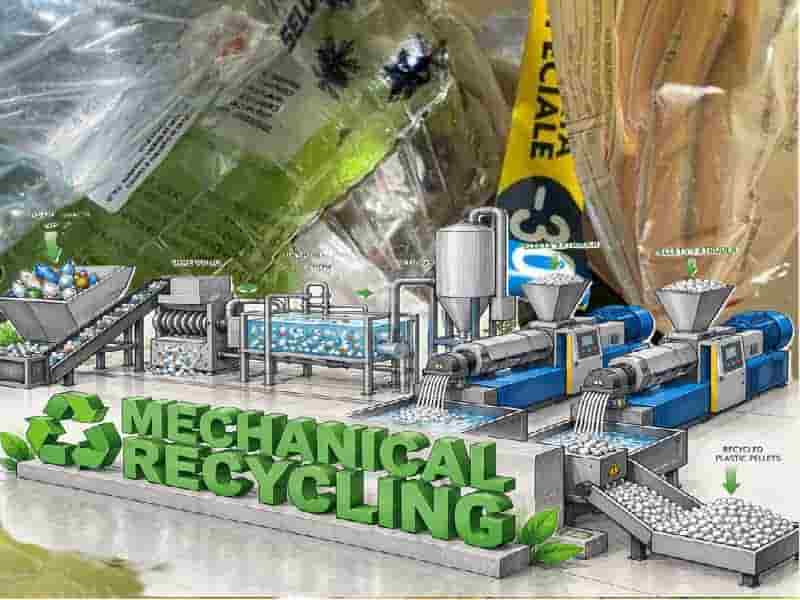
A central pillar of the Commission’s plan is the introduction of EU-wide end-of-waste criteria for mechanically recycled plastics under the Waste Framework Directive. These criteria define the point at which recycled plastics stop being legally classified as waste and become secondary raw materials. EU plastics recycling
This change is expected to significantly reduce administrative complexity, especially for small and medium-sized recycling companies that currently face different regulatory interpretations across member states. Harmonized end-of-waste rules will also improve the flow of recycled polymers across borders, helping to establish a true single market for recycled plastics within the EU.
By improving legal clarity and consistency, the Commission aims to ensure a stable supply of high-quality recyclate and make recycled plastics more competitive with virgin materials. EU plastics recycling
Slowing capacity growth raises alarm
EU plastics recycling capacity reached approximately 13.2 million metric tons in 2023, but growth has slowed sharply. Expansion rates dropped from 17 percent in 2021 to just 6 percent in 2023. Industry projections now suggest a net loss of around 1 million metric tons of recycling capacity by the end of 2025 due to bankruptcies and plant closures.
This decline is roughly equivalent to the total plastics recycling capacity of France and highlights the urgency behind the Commission’s intervention. Without corrective action, the EU risks losing both industrial capacity and progress toward its circularity and climate targets.
Chemical recycling gains regulatory certainty
Another major development is the proposal for the EU’s first mass balance allocation rules for chemical recycling. These rules will establish harmonized methods for calculating, verifying, and reporting recycled content derived from chemical recycling processes.
The EU plastics industry expects up to €8 billion in investments in chemical recycling technologies, but such capital depends on regulatory certainty. Clear mass balance rules will allow chemically recycled plastics to count toward recycled content targets, complementing mechanical recycling and supporting innovation in advanced recycling solutions.
By recognizing multiple recycling pathways, the Commission is signaling a more flexible and investment-friendly approach to circular plastics. EU plastics recycling
Industry support and calls for technology neutrality
Industry groups have broadly welcomed the Commission’s measures, particularly the emphasis on protecting EU recyclers from unfair competition linked to low-priced imports. However, stakeholders continue to advocate for a technology-neutral regulatory framework that applies consistent criteria across mechanical, chemical, and emerging recycling methods. EU plastics recycling
Ensuring fair treatment of different technologies is seen as essential for scaling recycling capacity and avoiding unintended market distortions that could discourage innovation.
Relaunch of the Circular Plastics Alliance
To improve coordination across the value chain, the Commission is relaunching the Circular Plastics Alliance with a new joint workplan for 2026. The Alliance will serve as a platform for collaboration among policymakers, recyclers, converters, brand owners, and equipment suppliers. EU plastics recycling
A high-level dialogue on competitive circularity is scheduled for the first quarter of 2026. Priority topics will include demand stimulation for recycled plastics, improved market surveillance, and the introduction of dedicated customs codes for recycled polymers. These steps aim to improve data transparency and enforcement across the EU market.
Stronger trade defenses against import surges
To address import-related pressures, the Commission is establishing an Import Surveillance Task Force focused on plastics. This initiative will monitor import volumes and pricing trends, building on existing surveillance systems used for industrial chemicals.
The EU has already imposed anti-dumping duties on PET imports from China and anti-subsidy measures on PET and recycled PET from India. Additional investigations are underway as concerns grow over mislabeling of virgin plastics as recycled material, a problem linked to global overcapacity and mirrored in other regions such as North America. EU plastics recycling
Stakeholders are encouraged to submit market intelligence to support potential trade defense actions.
Financial and regional support mechanisms
Beyond regulation and trade, the Commission plans to strengthen cooperation with the European Investment Bank to expand financing for circular economy projects. A Competitiveness Coordination Tool pilot will also support the creation of Trans-Regional Circularity Hubs, fostering cross-border collaboration between recycling clusters.
These initiatives aim to reduce fragmentation and improve economies of scale, particularly in regions struggling to maintain recycling operations. EU plastics recycling
Public consultation and long-term impact
A public consultation on the Single-Use Plastics Directive is open until March 17, 2026. The review will assess the directive’s impact on marine litter, public health, and circular economy development, with potential implications for future regulatory adjustments.
According to analysis by the Joint Research Centre, circular solutions in the plastics sector could reduce greenhouse gas emissions by up to 45 percent, significantly decarbonize energy use, and improve the EU trade balance by €18 billion annually by 2050.
What this means for industry leaders
For plastics professionals, these measures represent both urgency and opportunity. Executives in packaging, injection molding, and raw materials should closely monitor feedback deadlines on end-of-waste criteria and prepare documentation for possible trade investigations. EU plastics recycling
Research and development teams can leverage new mass balance rules to accelerate chemical recycling pilots, while machinery suppliers may benefit from increased demand for advanced sorting and processing equipment.
Overall, the Commission’s fast-tracked approach positions EU plastics recycling to regain competitiveness and reinforce Europe’s leadership in sustainable materials management during a period of global market disruption. EU plastics recycling
More…