Daicel Launches Recycled POM Grades with 30% PCR
Recycled POM grades
Daicel Launches Recycled POM Grades with 30% Post-Consumer Content
Daicel has expanded its DURACON engineering-plastics portfolio with four recycled POM grades containing 30% post-consumer recycled material. The range targets manufacturers that need to reduce their use of virgin resin without abandoning application-specific performance requirements.
Key facts
-
Manufacturer: Daicel Corporation, High Performance Polymers SBU
-
Product family: DURACON POM
-
Recycled content: 30% post-consumer recycled POM
-
Available variants: standard, low-VOC, sliding and tough
-
Initial presentation: CHINAPLAS 2026 in Shanghai
-
Intended sectors: automotive, electrical, consumer and precision-engineering applications
Four recycled POM grades for different performance needs
Daicel Corporation’s High Performance Polymers SBU has launched four DURACON polyoxymethylene grades formulated with 30% post-consumer recycled material.
Rather than introducing a single general-purpose compound, the company has developed standard, low-VOC, sliding and tough versions. This approach gives manufacturers a choice based on processing conditions and the functional requirements of the finished component.
The materials were first presented at CHINAPLAS 2026, held in Shanghai in April. Their commercial introduction reflects a broader effort to make recycled engineering plastics suitable for technically demanding applications rather than limiting them to less critical products.
What distinguishes the four grades?
The standard recycled POM grade has a reported melt-flow rate of 9. Melt-flow data help processors assess how a thermoplastic is likely to behave during operations such as injection moulding, although suitability still depends on component geometry, tooling and production conditions.
The low-VOC version is designed to meet requirements established by original equipment manufacturers. Materials with controlled volatile organic compound emissions can be particularly relevant for automotive interiors, electrical products and other enclosed environments.
Daicel says the sliding grade provides improved friction and wear characteristics. This could make it suitable for moving parts such as gears, guides, bearings and mechanisms in which low friction is important.
The tough grade is intended for applications requiring greater resistance to impact or mechanical stress. According to the company, it can deliver performance comparable to virgin POM grades. This comparison is based on Daicel’s internal assessments; publicly available independent validation has not been identified. Recycled POM grades
Why recycled POM is technically challenging
Post-consumer recycled resin has already passed through manufacturing, use, collection and recovery processes. Its composition and condition can therefore vary more than those of virgin polymer.
Possible variations in contamination, thermal history and material degradation can affect flow behaviour, strength, durability and surface quality. These factors make quality control especially important when recycled material is intended for precision components.
Daicel says it is applying its compounding and quality-management expertise to reduce these variations. Company testing reportedly found that the principal mechanical properties of the new compounds remain consistent with those expected from conventional grades despite the inclusion of 30% recycled material.
Processors will nevertheless need to validate each grade under their own moulding conditions. Application-specific testing is particularly important for safety-related, fuel-system, medical or long-life components.
From factory scrap to post-consumer material
The launch extends Daicel’s existing work on circular engineering plastics.
Since 2023, the company has offered its DURACIRCLE re-compounding service for recovering plastic scrap generated at customers’ production facilities. That model principally addresses post-industrial material, which is collected before a product reaches the consumer.
The new compounds use post-consumer recycled POM that has already circulated in the market. This introduces more complex collection and quality-control requirements, but it may also keep previously used engineering plastic in productive circulation for longer.
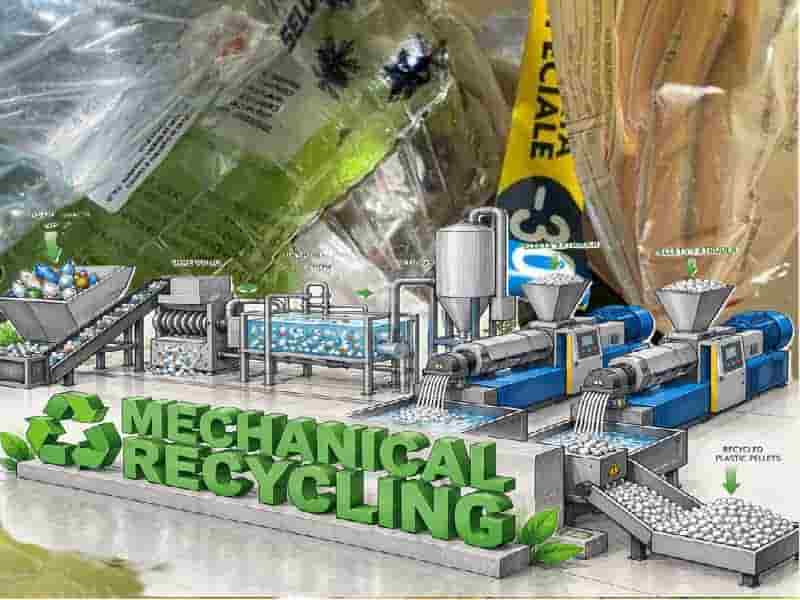
Daicel describes DURACIRCLE as a wider programme covering mechanical recycling, chemical recycling, biomass utilisation, carbon-dioxide utilisation and related technologies. Its stated long-term objective is to support greater circularity across its engineering-plastics portfolio. Recycled POM grades
Where DURACON POM is used
POM is a semi-crystalline engineering thermoplastic known for rigidity, dimensional stability, wear resistance and naturally low friction. These characteristics allow it to replace metal in certain mechanical components.
Daicel lists applications for DURACON POM including automotive door locks, fuel-system parts, household appliances and medical equipment. The material is also used for gears, fasteners, bearings, connectors and other precision-moulded parts.
The availability of several recycled formulations could help manufacturers introduce recycled content without using the same compound for every application. A sliding component, for example, has different requirements from an interior automotive part subject to VOC limits.
Sustainability benefits still require full assessment
Using post-consumer material can reduce demand for virgin polymer and create an additional destination for recovered POM. However, recycled content alone does not establish the complete environmental impact of a product.
Factors such as collection distances, sorting losses, reprocessing energy, reject rates, component lifetime and end-of-life options should also be considered. A comparative life-cycle assessment would be needed to quantify the environmental performance of the recycled grades against equivalent virgin materials.
Daicel has not disclosed a complete public life-cycle assessment for the four grades in the launch information reviewed for this article. Sustainability claims should therefore remain specific: the products contain 30% post-consumer recycled POM, while their wider environmental advantages will depend on production and application conditions.
What the launch means for manufacturers
The introduction is significant because it addresses one of the central obstacles to recycled engineering plastics: matching recycled content with predictable, application-specific performance.
Manufacturers evaluating the materials should request technical data covering mechanical properties, dimensional stability, emissions, wear behaviour, processing windows and long-term ageing. Regulatory and OEM approvals should also be confirmed for the intended market.
Daicel says it plans to develop additional recycled POM options as customer requirements evolve. The success of the range will ultimately depend on repeatable production quality, transparent technical documentation and performance in commercial applications.
Frequently asked questions
What are Daicel’s recycled POM grades?
They are four DURACON POM compounds containing 30% post-consumer recycled material. The portfolio includes standard, low-VOC, sliding and tough formulations.
What does PCR mean in plastics?
PCR means post-consumer recycled. It describes material recovered from products after they have entered the market and been used, rather than scrap collected during manufacturing.
Are the recycled grades equivalent to virgin POM?
Daicel says the principal mechanical properties remain consistent with conventional products and that its tough grade performs comparably to virgin POM. These statements are based on company testing and should be verified for each intended application.
What products can use recycled POM?
Potential applications include gears, bearings, guides, connectors, locks, appliance mechanisms and automotive components. Final suitability depends on the selected grade, operating environment and required certifications.
Does 30% recycled content make the material fully circular?
No. Recycled content is one element of circularity. Collection efficiency, manufacturing waste, product lifespan, recyclability and end-of-life recovery must also be considered.
More…