Bioplastics | bioplastics packaging | chemical recycling | EV car | General news | Pet Bottle Polymers 宠物瓶聚合物 폴리 에스터 병 Полиэфирных бутылок Полимеры ポリエステルボトル | PET Chip Polyethylene Terephthalate聚酯切片聚对苯二甲酸ПЭТ Полиэтилен чип полиэтилентерефталата PET 폴리에틸렌 테레 프탈레이트 칩PET polietileno tereftalato chip PET polietilen terefitalat çipi | Petrochemicals 석유 화학 제품 石油化工产品 Нефтехимическая продукция المنتجات البتروكيماوية | Plastic Recycling | Textile
Fossil-Free Plastics – Sumitomo Chemical Scales Up Breakthrough Process to Produce Propylene Directly from Ethanol 22-08-2025
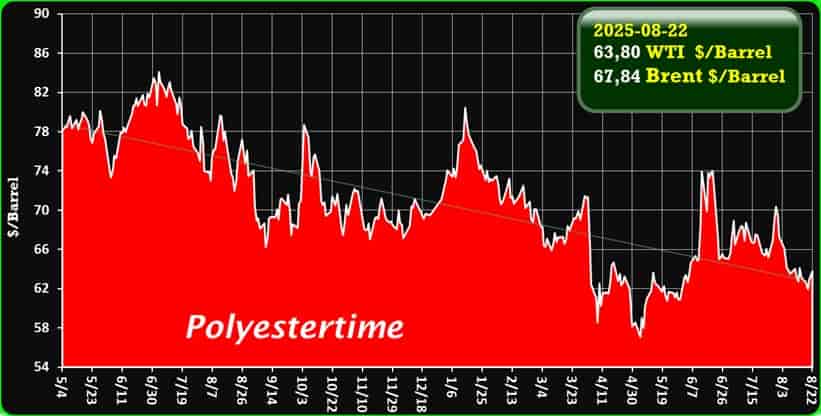
Crude Oil Prices Trend
? Sumitomo Chemical Scales Up Breakthrough Process to Produce Propylene Directly from Ethanol
Published by Sumitomo Chemical? Introduction
Sumitomo Chemical has taken a major step toward decarbonization by successfully scaling up its proprietary process for producing propylene directly from ethanol. A new pilot plant has been built and is already operational at the Sodegaura site of its Chiba Works in Japan. Fossil-Free Plastics Backed by the NEDO Green Innovation Fund, this innovation could reshape the petrochemical industry and accelerate the shift to sustainable feedstocks.? Why Propylene Matters
Propylene is one of the world’s most important building-block chemicals. It’s used in everyday products such as plastics, fibers, and packaging materials. In Japan, however, propylene is primarily produced from naphtha, a fossil resource. This dependency makes the industry vulnerable to supply instability and environmental pressure.Switching to renewable alternatives is no longer optional—it’s a strategic necessity for the global chemical industry.
? The Shift from Fossil Fuels to Ethanol
Ethanol offers a sustainable alternative. It can be produced from:- Sugarcane and corn Fossil-Free Plastics
- Non-edible materials like pulp
- Emerging sources such as combustible waste
⚙️ Sumitomo’s Unique Process
What makes Sumitomo’s approach stand out? Unlike conventional methods that require multiple steps, this new process produces propylene in one step directly from ethanol. That means:- Lower production costs ? Fossil-Free Plastics
- Increased efficiency ⚡
- Reduced reliance on intermediate chemicals like ethylene
? Hydrogen as a Bonus By-product
Beyond propylene, the process also generates hydrogen as a by-product. When bioethanol is used, the hydrogen is also bio-derived, creating a two-fold sustainability win:- Propylene for plastics and industrial use
- Hydrogen for clean energy applications
? Commercialization Plans
Sumitomo Chemical is now focused on collecting industrial data and validating market potential. The company plans to:- Market polypropylene made from ethanol-derived propylene
- Commercialize the process by the early 2030s
- License the technology globally ?
♻️ Green Transformation (GX) Strategy
Sumitomo Chemical is rethinking its entire petrochemical business model. Key shifts include:- Pivoting toward low-carbon, high-value technologies
- Scaling catalyst sales and technology licensing
- Building a circular value chain with suppliers and brand owners
- Monetizing customer-driven CO2 reductions
? Future Vision
Looking ahead, Sumitomo Chemical aims to establish itself as a leader in green innovation. By combining technology licensing, catalyst expertise, and resource circularity, the company envisions a new business model that reduces environmental impact while creating new revenue streams. Fossil-Free Plastics✅ Conclusion
Sumitomo Chemical’s proprietary ethanol-to-propylene process represents more than a technical milestone—it’s a blueprint for a sustainable petrochemical industry. By cutting costs, enabling renewable hydrogen production, and committing to green transformation strategies, the company is helping drive the global shift toward circular, low-carbon solutions. ? As this innovation moves toward commercialization, it signals a powerful step forward in building a sustainable society through chemical technology.More
MEGlobal Nominates September MEG Contract Price for Asia at USD 650 Per Tonne
Published: August 2025Overview: Price Adjustment for the Asian Market
MEGlobal, a global leader in the production of monoethylene glycol (MEG) and diethylene glycol (DEG), has announced its September 2025 contract price for MEG in Asia. Fossil-Free Plastics The nominated price is USD 650 per tonne, based on CFR Asia delivery terms. This update reflects an increase of USD 10 per tonne compared to the August contract price. According to MEGlobal, the adjustment mirrors the short-term balance of supply and demand in the Asian petrochemical market, a region heavily influenced by polyester and PET demand cycles.Why the Price Matters: Supply, Demand, and Market Sentiment
The MEG contract price is more than just a number—it is a benchmark that impacts multiple industries,textiles, packaging, and automotive. In Asia, particularly in China and India, MEG demand is strongly tied to polyester fiber production and polyethylene terephthalate (PET) resin used in bottles and packaging. Fossil-Free Plastics The USD 10 rise reflects tightened supply conditions and stable downstream demand. Seasonal factors, such as back-to-school apparel demand and pre-winter antifreeze production, also contribute to upward pricing momentum.Context: Anti-Dumping Investigations in the Petrochemical Sector
The price announcement follows recent news from the European Commission (EC), which launched an anti-dumping investigation into imports of purified terephthalic acid (PTA) from South Korea and Mexico. The move came after a formal complaint by Ineos Aromatics on behalf of the European PTA industry. Fossil-Free Plastics While PTA and MEG are different chemicals, they are both essential in the polyester value chain. Developments in one segment often ripple through related markets, influencing investor sentiment, trade flows, and contract negotiations.About MEGlobal: A Petrochemical Leader
MEGlobal, headquartered in Dubai, UAE, is a world-class producer of MEG and DEG. The company was established in 2004 and has since become a cornerstone supplier for global polyester, PET, and antifreeze industries. Each year, MEGlobal markets more than 2.5 million tonnes of glycols worldwide. MEG and DEG are versatile raw materials. They are critical for manufacturing:-
- Polyester fibers – used in clothing, upholstery, and textiles.
- Polyethylene terephthalate (PET) – essential for beverage bottles and food packaging. Fossil-Free Plastics
- Antifreeze and coolants – widely used in automotive industries.
Achates Power’s Super-Efficient Diesel Engine: Lower Carbon than EVs?
Discover how opposed-piston innovation could reshape sustainable mobilityIntroduction: Rethinking Diesel in a World Racing Toward EVs
Electric vehicles (EVs) dominate the headlines as the future of green transportation. Governments and industries are investing heavily in EV infrastructure, and carmakers are racing to electrify their fleets. But is there room for other technologies in the transition? Achates Power believes so. The company has unveiled a super-efficient diesel engine that can run on renewable fuels—and even hydrogen—offering a lower carbon footprint than many EVs. Fossil-Free PlasticsThe Breakthrough: Opposed-Piston Diesel Engine
At the heart of this innovation lies a fundamental rethinking of how engines work. Instead of a traditional cylinder head and complex valve system, each cylinder houses two pistons that move in opposite directions. This opposed-piston design brings several advantages:-
-
- Increased Efficiency: Every phase of the combustion cycle produces useful energy, minimizing wasted heat.
- Lightweight Design: By eliminating the cylinder head, valves, and camshaft, the system becomes simpler and more compact.
- Durability & Reliability: With fewer moving parts and reduced wear points, the engine promises longer life and lower maintenance costs.
- Dual Crankshaft System: This unique setup makes the engine lighter and well-suited for military, logistics, and commercial applications. Fossil-Free Plastics
-
Quick Fact: The Achates opposed-piston architecture delivers thermal efficiency above 49%, outperforming most modern diesel engines.
Cleaner Combustion with Renewable Fuels
Efficiency alone isn’t enough in today’s climate-conscious world. Achates has tested its engine using R99 synthetic diesel—a renewable fuel derived from vegetable oils—in partnership with Neste, a leader in biofuels. The results? An additional 10% cut in emissions compared to already low-carbon renewable diesel fuels. Even more compelling: when fueled with renewable diesel or hydrogen, the carbon footprint of this engine rivals or beats that of electric cars. ossil-Free Plastics Unlike EVs, which depend heavily on mineral-intensive batteries and expanding charging infrastructure, Achates’ engine leverages existing fuel networks, making it an immediate, scalable solution. Fossil-Free PlasticsWhy This Matters in the EV Era
Electric cars enjoy the advantage of zero direct tailpipe emissions. However, the production and disposal of batteries, as well as the carbon intensity of electricity grids, complicate their overall sustainability profile. Achates positions its engine as a bridge technology: a cleaner, ready-to-deploy solution that works with today’s infrastructure while the world continues to build toward fully electrified mobility.Key Comparisons: Achates Engine vs. EVs
-
-
- EVs: Zero tailpipe emissions, but rely on rare earth minerals and costly charging infrastructure.
- Achates Engine: Lower lifecycle carbon footprint when paired with renewable fuels, immediate compatibility with existing fuel supply chains.
-
In tests, Achates’ prototype achieved up to 22% better fuel economy than the best current diesel engines. Fossil-Free Plastics
Applications Beyond Passenger Cars
While passenger EVs dominate consumer conversations, large sectors of transportation remain difficult to electrify. Military vehicles, long-haul trucks, and heavy-duty equipment face significant challenges due to energy density requirements and charging logistics. For these areas, Achates’ opposed-piston engine offers a viable solution that blends efficiency, reliability, and scalability.Looking Ahead: A Bridge to a Cleaner Future
Achates Power’s opposed-piston diesel engine may not replace EVs, but it challenges the narrative that electrification is the only path forward. By providing a low-carbon, high-efficiency solution compatible with renewable fuels, Achates helps ease the transition while addressing industries and applications where EVs currently fall short. In a world racing toward carbon neutrality, diverse solutions matter. Whether through advanced biofuels, hydrogen, or smarter combustion engines, technologies like this opposed-piston design offer crucial stepping stones on the journey to a sustainable future.Conclusion: More Than Just a Diesel Engine Fossil-Free Plastics
This is not your grandfather’s diesel. It’s a 21st-century reinvention—compact, clean, and ready for renewable fuels. By cutting emissions, lowering fuel consumption, and rivaling EVs in lifecycle carbon impact, Achates Power’s engine underscores a bigger truth: the path to sustainability is not one-size-fits-all. In the transition to a net-zero world, innovations like this will play an essential role.World’s First Industrial-Scale Fossil-Free Plastics Complex to be Built in Belgium
Capacity: 200KTA | Technology Partner: Lummus Technology | Developer: VioneoWhy This Project Matters
The plastics industry is facing unprecedented pressure to decarbonize. From policy makers to consumers, the demand for cleaner, fossil-free alternatives is growing. Belgium is now set to become the home of the world’s first industrial-scale fossil-free plastics production facility, designed to deliver 200,000 tonnes per annum (200KTA) of sustainable polypropylene. Fossil-Free Plastics The facility is being developed by Vioneo, with technology provided by Lummus Technology. Together, they aim to prove that plastics production can be scaled up without relying on fossil fuels — while maintaining performance, flexibility, and cost competitiveness.Key Sustainability Features
- 100% Fossil-Free Feedstock: The plant will run on certified green propylene and ethylene derived from green methanol.
- CO2-Negative Plastics: Final products will sequester carbon, allowing downstream users to reduce their Scope 3 emissions.
- Electrification: Powered primarily by renewable electricity, minimizing reliance on fossil energy sources.
- Renewable Hydrogen: Incorporated as a key operational component to further reduce carbon intensity. ossil-Free Plastics
- Traceability: Every batch of polypropylene will be fully certified and traceable, enabling transparent sustainability reporting. Fossil-Free Plastics
Technology Behind the Transformation
The cornerstone of the project is Lummus’ Novolen® polypropylene polymerization technology. This process is already proven at commercial scale and will enable Vioneo to produce high-performance, drop-in polypropylene grades that match fossil-based plastics in quality and functionality — but with a fraction of the emissions. According to Leon de Bruyn, CEO of Lummus Technology: “Our proven polypropylene polymerization technology will allow Vioneo to produce high-performance, drop-in polypropylene grades through a low-emissions process without compromising quality or flexibility.”Part of a Larger Complex
The new facility is more than a standalone project. It will be the anchor of Vioneo’s larger fossil-free plastics production complex, entirely based on green methanol. This integrated approach ensures that every input stream, from feedstock to energy, contributes to a circular, sustainable value chain. With a capacity of 200KTA, the plant will serve as a model for how the global plastics industry can pivot toward scalable decarbonization. Fossil-Free PlasticsStatements from Industry Leaders
“Vioneo is driving the plastics industry’s transition by proving that large-scale, cleaner production with green methanol-derived feedstocks is economically viable.” – Alex Hogan, CEO of Vioneo
“This collaboration with Lummus to license Novolen polypropylene technology is fundamental to our vision of a sustainable plastics economy.” – Alex Hogan, CEO of Vioneo
The Verdene Technology Suite
Lummus’ Novolen PP process is part of the wider Verdene technology suite — a package of solutions for sustainable polymer production. This suite includes processes for bio-based polyethylene, polypropylene, and super absorbent polymers. All are designed with net-zero or net-negative emissions in mind. Fossil-Free Plastics A unique feature of this technology is that the carbon captured in the polymer structure remains stored during the product’s use phase, effectively removing CO2 from the atmosphere and embedding it in long-life plastics.Global Significance
This Belgian project is more than a regional milestone. It is the world’s first proof that fossil-free, CO2-negative plastics can be manufactured at an industrial scale. If successful, it will create a ripple effect across the plastics industry, influencing supply chains, regulations, and consumer markets worldwide. By demonstrating economic viability, Vioneo and Lummus are setting a precedent for otConclusion
The launch of the world’s first fossil-free plastics production facility in Belgium marks a historic step toward a decarbonized future. Fossil-Free Plastics With cutting-edge technology, a commitment to renewable feedstocks, and global implications for sustainability, Vioneo and Lummus are redefining what’s possible in industrial plastics manufacturing. As this project comes to life, it will not only serve as a benchmark for greener plastics but also as proof that large-scale, fossil-free production is both technically feasible and commercially viable.Enviroo Secures £58m Funding for Cheshire PET Recycling Plant
Building the Future of UK Plastics Recycling and Circular EconomyIntroduction: A Major Step for UK Recycling Fossil-Free Plastics
Enviroo, a UK-based PET (polyethylene terephthalate) recycling company, has secured £58 million ($78.2m) in funding for a new recycling facility in Cheshire. The project marks one of the most significant private investments into the UK’s plastic circular economy in recent years, with operations scheduled to begin in 2027. The state-of-the-art plant will be located at Peel NRE’s Protos site near Ellesmere Port, a hub for energy and resource innovation. Construction is expected to start later this year, and once operational, the facility will have the capacity to recycle 35,000 tonnes of plastics annually.Why PET Recycling Matters
PET is one of the most widely used plastics in the world. It is found in everyday items like water bottles, soft drink containers, and food packaging. However, without proper recycling infrastructure, PET often ends up in landfill or as environmental waste. Fossil-Free Plastics By processing PET into rPET (recycled PET), Enviroo’s facility will produce high-quality material suitable for food-grade packaging. This creates a circular loop where plastic bottles can be recycled back into plastic bottles, reducing reliance on virgin plastic and cutting carbon emissions.Funding Backed by Evidence and Policy
Securing £58m in funding was made possible through collaboration with Recoup, the UK’s independent authority on plastics recycling. Enviroo worked with Recoup to validate market trends and ensure compliance with current and future recycling policies. Fossil-Free Plastics This evidence-based approach gave funders confidence that the project is both commercially viable and environmentally necessary. It reflects a growing recognition of recycling as a sustainable business opportunity aligned with UK and EU waste management goals.Key Facts About Enviroo’s Recycling Plant
- Location: Protos site, Ellesmere Port, Cheshire
- Size: 81,000 sq ft facility
- Annual capacity: 35,000 tonnes of plastics
- Product: rPET for food-grade packaging
- Jobs created: 80+ direct positions
- Funding secured: £58m ($78.2m)
- Construction start: Late 2025 Fossil-Free Plastics
- Operational start: 2027
Industry Voices on the Project
“We were delighted to work with Recoup, which offered us invaluable knowledge and expertise as we sought funding. With evidence-backed insights we could demonstrate a stable and growing market for PET recycling and navigate current waste management policies and regulations.”
– Ahmed Detta, CEO of Enviroo
“This project demonstrates what’s possible when innovation is backed by evidence and industry collaboration. Recoup was pleased to support Enviroo with the insight and due diligence needed to help secure investment for a facility that will play a vital role in the UK’s plastics recycling future.” Fossil-Free Plastics
– Stuart Foster, CEO of Recoup
Boosting the UK’s Circular Economy
Enviroo’s facility is more than just a recycling plant—it is a cornerstone of the UK’s transition to a circular economy. ossil-Free Plastics By keeping plastics in the supply chain, the project reduces waste, creates new jobs, and supports local and national sustainability targets. It will also strengthen the UK’s domestic recycling infrastructure, reducing dependency on exporting waste abroad. This not only cuts emissions but also enhances the resilience of the UK’s recycling system.Looking Ahead: The Future of PET Recycling
As the UK continues to implement stricter recycling targets and sustainability frameworks, projects like Enviroo’s Cheshire plant set the benchmark for industry progress. By 2027, this facility could serve as a model for similar initiatives nationwide. With the combination of funding, innovation, and policy alignment, Enviroo is positioning itself at the forefront of the UK’s green economy—turning plastic waste into a valuable resource. Fossil-Free PlasticsConclusion
Enviroo’s £58m investment represents more than just a recycling plant—it’s a commitment to innovation, sustainability, and economic growth. By creating high-quality rPET and supporting the UK’s recycling infrastructure, this project is paving the way for a more circular, sustainable future. ossil-Free Plastics For policymakers, businesses, and communities, the message is clear: the future of plastics is circular, and Enviroo is helping to lead that transformation.
K 2025: INTRAVIS Showcases Intelligent Inspection Systems
Innovations for Preforms, Medical Applications, and In-Mold LabelsIML Medical Innovation with Arburg
One of the most exciting highlights is a special IML Medical showcase presented together with Arburg. ossil-Free Plastics This setup integrates an IMLWatcher into a medical application where an in-mold label is applied with extreme precision to a tube. The solution demonstrates the transformative role of IML in the medical and pharmaceutical industries:-
-
- RFID Integration for seamless digital traceability
- Compact, hygienic environments ideal for medical-grade production Fossil-Free Plastics
- Enhanced safety and compliance through automation and inspection
-
? Booth Location: Arburg – Hall 13, Booth A13
Reliable Label Detection with Star Automation
At the booth of Star Automation, INTRAVIS will display another IMLWatcher equipped with five high-resolution cameras designed to inspect side and bottom labels. This system detects typical IML-specific issues such as artwork shifts, blow-byes, print errors, and color deviations. Fossil-Free Plastics Advanced software features make it especially valuable for manufacturers seeking better process control:-
-
- Long-term image storage for quality documentation
- Reject rate monitoring by cavity and inspection criteria
- Extended data visualization for process optimization
-
? Booth Location: Star Automation – Hall 11, Booth H74
Compact Print Inspection at Tampoprint
For companies looking for cost-efficient quality solutions, INTRAVIS will showcase the CapWatcher SC at Tampoprint’s booth. ossil-Free Plastics Using a single camera, the system performs high-speed inspections of closure prints, offering a compact yet powerful solution for straightforward applications. This system underscores how budget-friendly inspection technology can help producers maintain consistent brand quality without sacrificing efficiency.? Booth Location: Tampoprint – Hall 4, Booth A55 Fossil-Free Plastics
Preform Monitoring with Sipa
Another star of the show is the PreMon system, featured at Sipa’s booth. This high-volume preform monitoring solution is positioned directly after injection molding, ensuring real-time detection of:-
-
- Contaminations
- Discolorations
- Geometric defects
-
? Booth Location: Sipa S.p.A. – Hall 13, Booth B15
INTRAVIS’ Own Booth: Compact Solutions & Smart Data Analysis
At its own booth (Hall 11, Booth A58), INTRAVIS will offer visitors a full overview of its portfolio, with special attention to compact and data-centric systems. Key highlights include:-
-
- CapWatcher Compact – a space-saving closure inspection system combining sorting, feeding, and inspection in a footprint of just 2.4 m² ossil-Free Plastics
- IntraVisualizer – a software solution for centralized analysis and visualization of quality data across multiple systems
-
Why This Matters for the Future of Packaging
The plastics and medical industries are evolving toward smarter, leaner, and more traceable production systems. INTRAVIS’ solutions embody this trend, proving that quality inspection is no longer just about defect detection—it is about enabling data-driven, connected, and future-ready manufacturing. Fossil-Free PlasticsConclusion: INTRAVIS at K 2025
With four live systems, collaborations with world-leading partners, and a clear emphasis on digitalized quality assurance, INTRAVIS confirms its role as a leading innovator in inspection technology. Visitors to K 2025 will see how integrated systems—from medical tubes to high-volume preforms—create smarter production lines that improve efficiency, compliance, and brand consistency.? INTRAVIS Main Booth: Hall 11, Booth A58
? www.intravis.com Textiles Recycling – Restoring Faith in Textiles Recycling As it aims for rapid expansion in Europe, RE&UP Recycling Technologies is looking to show brands that textile recycling is not only possible, but scalable. The Myth: True Textile Recycling Isn’t Possible 21-08-2025