Panama Canal Power Shift Shakes Global Trade as Trump Gains Momentum and China Faces Strategic Setback in Critical Maritime Hub 31-01-2026
A Legal Shockwave Redraws the Panama Canal Balance of Power
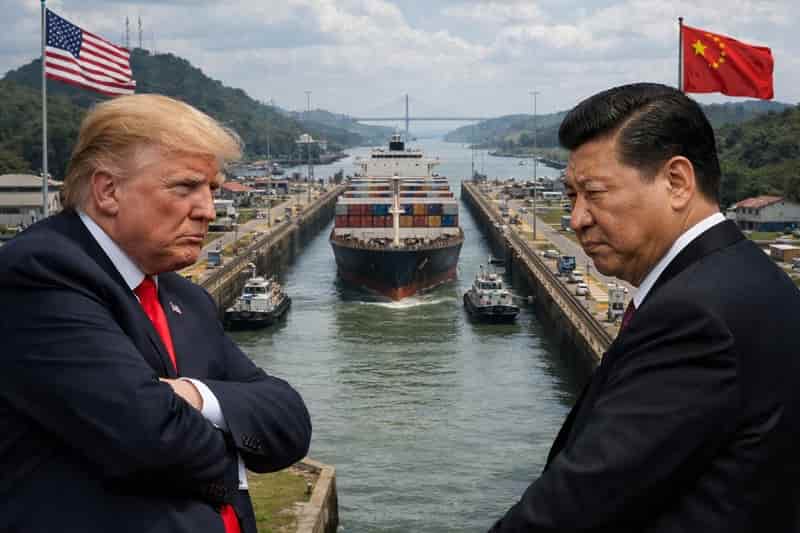
The Panama Canal has returned to the center of global geopolitics after a landmark ruling by Panama’s Supreme Court revoked the concession allowing Hong Kong–based CK Hutchison to operate two critical ports. The decision immediately reshapes the strategic balance between the United States and China at one of the most important maritime corridors on Earth.
The ruling declared unconstitutional the laws underpinning CK Hutchison’s long-standing control of the Balboa port on the Pacific side and the Cristobal port on the Atlantic entrance. Together, these terminals sit at the gateways of the Panama Canal, a chokepoint that handles roughly a third of global goods traffic every year.
Why the Panama Canal Matters to Global Trade
The Panama Canal is far more than a shipping shortcut. It is a strategic artery that connects the Atlantic and Pacific oceans in just ten hours of transit time. Approximately one fifth of the cargo passing through the canal consists of Chinese-made goods, underlining why Beijing has invested heavily in the surrounding infrastructure.
Control over port operations does not equate to ownership of the canal itself, but it confers influence over logistics, container flows, and commercial leverage. For both Washington and Beijing, this influence has long been seen as a matter of national interest.
The Supreme Court Ruling and Its Economic Rationale
Panama Ports Company, a subsidiary of CK Hutchison Holdings, has operated the Balboa and Cristobal terminals since the late 1990s. Five years ago, its operating license was automatically renewed for another 25 years. That renewal has now been nullified.
The Supreme Court based its decision on a legal challenge arguing that the company failed to meet fiscal obligations, including tax payments owed to Panama’s treasury. From the court’s perspective, the ruling was not geopolitical but institutional, aimed at defending national economic interests and sovereignty.
Nevertheless, the geopolitical consequences are immediate and unavoidable.
Trump’s Strategic Vision and U.S. Interests
Former U.S. President Donald Trump has repeatedly stated his intention to prevent Chinese interference in strategic infrastructure across the Western Hemisphere. The Panama Canal has long featured prominently in that vision, given its historical ties to the United States and its ongoing importance to American trade and naval mobility.
The court’s ruling significantly strengthens the U.S. position by removing a major legal obstacle that had shielded Chinese-linked corporate presence at the canal’s entrances. For Trump and his allies, the decision represents a decisive step toward reasserting U.S. influence in the region.
Beijing’s Reaction and Strategic Concerns
China’s response has been swift and hostile. Officials and state-aligned media in Beijing have criticized the ruling as unjustified, warning of broader implications for Chinese overseas investments. With a third of global trade and a fifth of Chinese exports moving through the Panama Canal, any shift in control raises alarms in Beijing.
China has spent decades expanding its maritime footprint, from Piraeus in Greece to terminals across Africa and Southeast Asia. Losing leverage at the Panama Canal would mark one of the most significant setbacks to that strategy.
BlackRock Emerges as a Key Beneficiary
The revocation of the license dramatically changes the commercial landscape. CK Hutchison had already reached a preliminary agreement to sell 43 port hubs worldwide, including the two Panamanian terminals, to a consortium led by BlackRock, alongside shipping magnate Gianluigi Aponte of MSC.
The deal, valued at approximately $43 billion, faced intense resistance from Beijing, including regulatory pressure and antitrust scrutiny. With the Panamanian license now revoked, BlackRock can potentially enter the business through new channels, without inheriting the same legal and political constraints.
This development represents a rare convergence of financial power and geopolitical alignment in favor of the United States.
Competing Players and a Crowded Chessboard
Other global shipping giants have also shown interest in the Panama Canal ports. France’s CMA CGM and China’s COSCO, already a dominant force in Mediterranean logistics, have appeared in negotiations. COSCO reportedly sought a majority stake, a demand that heightened U.S. and Panamanian concerns.
Despite these competing interests, Panama remains the ultimate decision-maker. The government has emphasized that future concessions will be awarded transparently, under the supervision of the Panama Canal Authority.
Panama’s National Strategy Comes First
Amid the rivalry between superpowers, Panama’s own agenda is often overlooked. The Supreme Court ruling reflects a broader effort to reclaim control over strategic assets and ensure fair economic returns. The country has already launched a multi-billion-dollar auction for the construction of two additional ports and a gas pipeline linked to canal operations.
A shortlist of approximately ten qualified bidders is expected to be announced soon. Authorities have pledged impartiality, signaling that Panama intends to balance foreign investment with national sovereignty.
A Turning Point for the Panama Canal
The revocation of CK Hutchison’s license marks a turning point in the Panama Canal’s modern history. It weakens China’s foothold, empowers U.S.-aligned capital, and reinforces Panama’s role as an active guardian of one of the world’s most strategic maritime hubs.
As global trade routes become increasingly politicized, the Panama Canal stands as a reminder that infrastructure is no longer neutral. It is power, influence, and leverage, flowing as surely as the ships that pass through its locks.
More…