Keir Starmer China policy – Keir Starmer’s China Gamble Reveals Britain’s Strategic Anxiety Between Trump’s Uncertainty and Xi’s Expanding Global Power 30-01-2026
Keir Starmer China policy
Keir Starmer’s China Visit Is About More Than China
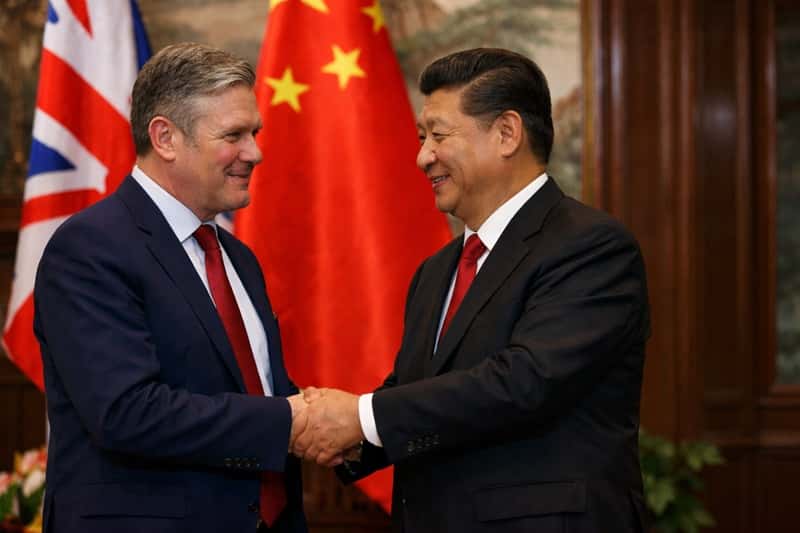
When Keir Starmer arrived in Beijing, his language was cautious and deliberate. Terms such as pragmatic cooperation, strategic realism, and dialogue without illusions were not rhetorical flourishes. They were signals.
The intended audience for Keir Starmer’s China policy was not limited to Chinese officials. It also included Washington, where Donald Trump has reintroduced unpredictability into US alliances, and the British public, increasingly doubtful that the new Labour government can quickly restore order after years of political turmoil. Keir Starmer China policy
This visit was never meant to suggest ideological alignment with Beijing. Instead, it was a calculated positioning exercise shaped by shifting global power dynamics and domestic fragility.
Why Keir Starmer’s China Policy Is a Strategic Signal
The trip does not mark a return to the old narrative of a UK-China golden age. Nor does it represent a sudden conversion to engagement at any cost. Keir Starmer’s China policy is best understood as strategic triangulation. Keir Starmer China policy
Britain is sending a message to Beijing, but an even clearer one to Washington. The signal is that the United Kingdom remains a committed ally, yet it will not accept an entirely asymmetric relationship with an unpredictable United States.
When addressing potential US tariffs, Starmer warned that a tariff war would harm all sides. His goal, he said, is to ensure escalation never begins. This position fits squarely within Keir Starmer’s China policy, which treats engagement with Beijing as leverage rather than replacement.
China as Leverage, Not a Strategic Alternative
Despite the optics of the visit, Starmer has not challenged NATO, questioned the Atlantic alliance, or weakened Britain’s security commitments. On the contrary, he continues to stress a strict separation between economic cooperation and national security.
This framework was already evident at the 2024 G20 summit, where Starmer spoke of building a relationship with China that is coherent, lasting, and respectful. That formulation now sits at the core of Keir Starmer’s China policy: dialogue without illusion. Keir Starmer China policy
From Beijing’s perspective, Britain is a useful interlocutor. At a time when relations with Washington are strained, a pragmatic European power willing to engage without constant ideological confrontation holds value. Yet China also understands Britain’s limits. London does not possess the economic weight of Berlin or Brussels, and its reliance on American security remains fundamental.
Xi Jinping’s Broader Message to the West
Xi Jinping used the diplomatic stage to deliver a message that extended well beyond bilateral relations with Britain. He warned that unilateralism, protectionism, and power politics are on the rise, placing the international order under severe strain.
His remarks on international law and the risk of returning to a law-of-the-jungle system were widely interpreted as criticism of contemporary American politics. Donald Trump was not named, but the reference was unmistakable. Keir Starmer China policy
In this environment, Keir Starmer’s China policy took on symbolic significance. A long-standing US ally was engaging with Beijing at precisely the moment when rivalry between great powers is accelerating and global stability feels increasingly fragile.
Domestic Pressures Behind Keir Starmer’s China Policy
The triangulation does not occur in a vacuum. Domestic politics weigh heavily. Starmer governs a country grappling with a cost-of-living crisis, exhausted public services, and widespread voter fatigue. Keir Starmer China policy
Many citizens have yet to perceive a decisive break from the Conservative era. In this context, foreign policy becomes a tool for agenda-setting. International engagement allows the prime minister to project leadership, competence, and global relevance.
It is no coincidence that the Beijing visit coincided with the government’s decision to delay publication of its full China audit. Keir Starmer’s China policy is being managed carefully, prioritizing flexibility over rigid commitments. Keir Starmer China policy
The Limits of Strategic Ambiguity
The central risk is structural. As competition between the United States and China intensifies, the space for ambiguity shrinks. What appears balanced and pragmatic today may become unsustainable tomorrow.
If Washington demands firmer alignment or Beijing raises the cost of engagement, triangulation could quickly turn into constraint. Keir Starmer is not attempting a historic diplomatic breakthrough, nor is he pursuing a grand geopolitical realignment. Keir Starmer China policy
For now, he is buying time. China serves as a reminder to Trump that Britain has options. American unpredictability, in turn, reminds Beijing that London is not naive.
A Calculated Gamble in an Unstable World
Keir Starmer’s China policy ultimately reflects Britain’s broader condition. The country seeks relevance, stability, and autonomy in an increasingly polarized international system while struggling with internal economic and political pressures. Keir Starmer China policy
This is not a transformative strategy. It is a management strategy, designed to contain risk and create political space. Whether it can survive escalating global polarization remains uncertain.
For now, Starmer is positioning himself as a prime minister who acts on the global stage while navigating instability at home. The gamble is not ideological. It is temporal. And time may prove to be his most limited resource.
More…