Plastic Waste Cookies: A Bold Space-Food Breakthrough
Plastic Waste Cookies: A Bold Space-Food Breakthrough
Scientists have created experimental cookies using nutrients produced from plastic and agricultural waste. The technology sounds futuristic, but it is not the same as grinding plastic bottles into food.
Researchers at Southern Illinois University Carbondale first break down polyethylene terephthalate, or PET, into smaller carbon-rich compounds. Specially programmed yeasts then use those compounds to produce food ingredients.
The resulting cookie prototypes, called µBites—pronounced “microbites”—have not been approved for human taste tests. They therefore should not be described as commercially available or proven safe for public consumption.
Plastic waste cookies explained
Plastic waste cookies are experimental foods containing ingredients made by microorganisms that process chemically broken-down PET and plant material.
PET is the plastic commonly used in water and soft-drink bottles. In this project, it passes through a process called oxidative hydrothermal dissolution. Water and oxygen under high temperature and pressure break the material into compounds that microbes can use.
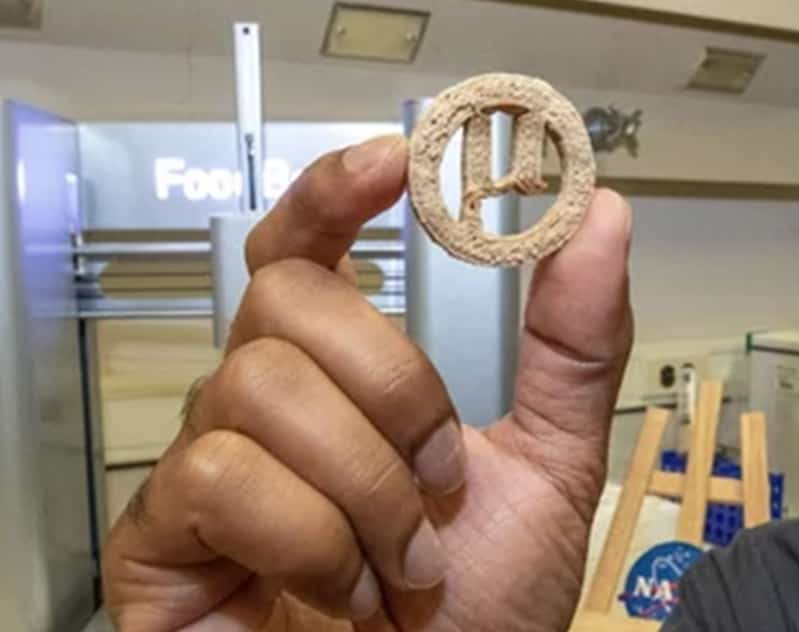
Engineered strains of yeast then convert those compounds into biological products such as proteins, fats and acids. The researchers combine the resulting material with starch, fibre and sweetener before shaping it with a 3D food printer.
This distinction matters: the prototype does not contain recognisable fragments of bottles. Its ingredients emerge after chemical processing and microbial conversion.
Why NASA supported the research
The project received funding through NASA’s Deep Space Food Challenge, an initiative created to explore food-production systems for long-duration space missions.
Transporting every meal needed for a journey to Mars would require considerable storage space and payload capacity. A system capable of recovering useful carbon from waste could potentially reduce the amount of material a crew must carry.
The technology might also have applications on Earth. Researchers have suggested portable units could one day produce ingredients in submarines, polar stations or disaster-response areas where conventional food supplies are limited.
These possibilities remain proposed applications, however. A laboratory prototype is not yet a complete food system ready for spacecraft or emergency deployment.
From discarded bottle to experimental food
The proposed production process has several stages:
-
PET bottles and agricultural residues, including discarded corn stalks and leaves, are collected as raw materials.
-
Heat, pressure, water and oxygen break the materials into smaller compounds.
-
Programmed yeast consumes selected compounds in the resulting feedstock.
-
The microorganisms produce proteins, fats, vitamins or flavour-related molecules.
-
Researchers add conventional ingredients and use a 3D printer to form the mixture.
-
The printed product is cooked to create a firm, cookie-like prototype.
According to a detailed report by ScienceAlert, the present system involves approximately 33 steps and takes one or two days. It can convert more than half of the available waste carbon into food products, although the researchers hope to improve that efficiency.
Yeast provides nutrients, colour and flavour
Different yeast strains perform different jobs.
One strain can produce vanillin from agricultural biomass, giving the product a vanilla-like aroma. Another converts ethylene glycol derived from PET into beta-carotene, the pigment the human body can use to produce vitamin A.
This approach resembles other forms of precision fermentation in which microorganisms act as miniature factories. The unusual part is the use of carefully processed waste as a carbon source.
The cookie is only a proof of concept. The same ingredients could theoretically be used in products such as milk or meat alternatives if the technology eventually passes the necessary safety, regulatory and manufacturing tests. plastic waste cookies
Has anyone eaten the cookies?
No approved human taste test had taken place when the findings were presented at the American Chemical Society’s fall meeting in Chicago.
The research team reported analysing the prototypes for toxic chemicals, heavy metals, allergens and pathogens. It is also conducting simulated digestion studies while awaiting institutional approval for human testing.
People involved in preliminary sensory assessments reportedly found the aroma appealing, but smelling a prototype is not evidence that it is safe, nutritious or pleasant to eat.
Statements that scientists have already eaten the cookies—or that consumers may soon buy them—would therefore be inaccurate.
The biggest unanswered questions
The experiment demonstrates an intriguing use of microbial engineering, but several issues remain unresolved.
Researchers must establish consistent purity across different waste inputs, confirm nutritional quality and obtain the relevant approvals before human consumption. The process must also prevent contaminants in discarded plastic from reaching the final product.
Cost and complexity present further challenges. A process involving heat, high pressure, fermentation, ingredient recovery and food printing may consume substantial resources. Its environmental value will depend on its total energy use, production yield and performance compared with established recycling and food-production methods.
Public acceptance could be equally difficult. Calling the product a “plastic cookie” attracts attention, but it may also create the misleading impression that people are being asked to eat plastic directly.
Could plastic waste cookies feed astronauts?
Possibly—but not yet.
The research provides evidence that microbes can transform selected compounds obtained from PET and agricultural waste into useful food ingredients. It does not prove that plastic waste cookies are ready for a Mars mission, disaster zone or supermarket.
The next important milestones will be authorised human testing, independently available safety evidence, improved conversion efficiency and a full assessment of energy use and environmental impact.
For now, µBites should be viewed as an inventive laboratory prototype: a demonstration of how waste carbon might be recovered and rebuilt into something biologically useful.
Frequently asked questions
Are plastic waste cookies made from entire plastic bottles?
No. PET is chemically broken into smaller compounds, which specially programmed yeast uses to produce new biological molecules. Conventional ingredients are also added to the prototype.
Are the cookies safe to eat?
The team says laboratory and third-party analyses have screened the prototypes for several potential hazards. However, authorised human taste testing was still pending as of August 24, 2026.
Can people buy them?
No. µBites are research prototypes, not an approved commercial food.
Who developed the technology?
The project was led by microbiologist Lahiru Jayakody and researchers at Southern Illinois University Carbondale.
Did NASA make the cookies?
No. Southern Illinois University researchers developed them. The work received funding through NASA’s Deep Space Food Challenge and support from the US National Science Foundation.
Sources
American Chemical Society, “This cookie started its life as a plastic bottle,” published August 24, 2026.
The Guardian, “Hard to swallow? The future of snacking may be 3D-printed cookies made from upcycled plastic,” published August 24, 2026.
ScienceAlert, “Scientists Just Made a Cookie Out of Recycled Plastic ‘Slurry’,” published August 24, 2026.
More…
Nerea chemical recycling aims to standardize plastic waste projects