BRICS De-Dollarisation Gains Momentum After Russia’s Stark Dollar Warning
BRICS De-Dollarisation Gains Momentum After Russia’s Stark Dollar Warning
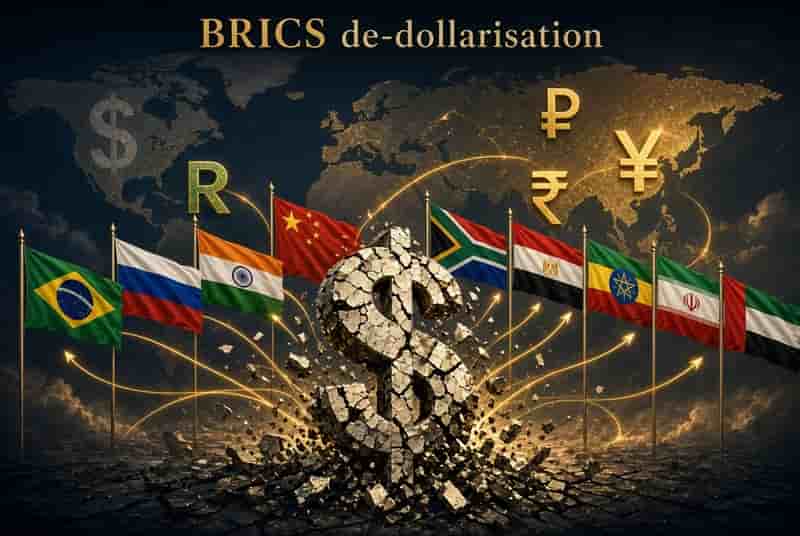
Russia has renewed its argument that Western sanctions and the political use of financial infrastructure are accelerating BRICS de-dollarisation.
The claim was made by Maria Zakharova, spokesperson and Director of the Information and Press Department at Russia’s Foreign Ministry, following Indian External Affairs Minister S. Jaishankar’s visit to Moscow.
Zakharova presented the growing use of national currencies as a defensive response by countries seeking to protect trade from sanctions, frozen assets and restrictions on international payments. Her comments reflect Moscow’s position and should not be interpreted as evidence that BRICS has agreed to abandon the US dollar collectively.
Key takeaways
-
Russia says sanctions are encouraging countries to reduce their exposure to dollar-based payment channels.
-
BRICS de-dollarisation currently means greater use of national currencies, not the launch of a common BRICS currency.
-
India’s immediate concerns include reliable payments, greater access for Indian exports and a reduction in the trade imbalance with Russia.
-
India is promoting a people-centred BRICS agenda rather than framing the group solely as an anti-Western alliance.
-
Bilateral trade is targeted to reach $100 billion by 2030, but payment and market-access problems remain.
Why Russia says the shift is accelerating
Zakharova argued that governments are reconsidering their dependence on the dollar because access to dollar-based systems can be restricted during geopolitical disputes.
This is Russia’s explanation for the movement towards alternative settlement arrangements. Moscow has faced extensive financial sanctions since its invasion of Ukraine, including restrictions affecting Russian banks and access to international payment infrastructure.
For Russia, using the rouble, rupee, renminbi or other national currencies is therefore connected to economic sovereignty. It reduces reliance on institutions that Moscow believes are vulnerable to political pressure.
That position, however, represents the Russian government’s assessment. The dollar remains deeply embedded in global reserves, commodity pricing, international lending and cross-border financial markets. Replacing those functions would require far more than an increase in bilateral local-currency transactions.
What BRICS de-dollarisation actually means
BRICS de-dollarisation is frequently confused with the creation of a single BRICS currency. They are not the same policy.
No unified BRICS currency has been formally launched. The more immediate process involves members settling selected transactions in their own currencies, expanding direct banking links and exploring payment systems that do not require every transaction to pass through the dollar.
These arrangements can reduce conversion costs and exposure to external sanctions. They also introduce practical difficulties, including exchange-rate volatility, limited currency convertibility and the accumulation of currencies that trading partners may struggle to reuse.
For India, the central question is consequently not whether the dollar can be replaced overnight. It is whether new payment arrangements can support trade without creating fresh financial risks.
Jaishankar’s Moscow visit focused on practical barriers
Jaishankar’s Moscow talks placed economic implementation at the centre of India-Russia relations.
During his meeting with President Vladimir Putin, the Indian minister delivered a personal communication from Prime Minister Narendra Modi. The discussions followed the latest session of the India-Russia Intergovernmental Commission, co-chaired by Jaishankar and Russian First Deputy Prime Minister Denis Manturov.
The two countries are working towards bilateral trade of $100 billion by 2030. Reaching that target will require more than continued Indian purchases of Russian energy and fertilisers.
India wants better access for pharmaceuticals, agricultural products, machinery and other exports. It also needs workable settlement channels, predictable logistics and a more balanced trading relationship.
According to the Kremlin’s account of the meeting, Putin highlighted expanding trade and continued cooperation in areas including fertilisers. Indian public broadcaster DD News reported that Jaishankar delivered Modi’s personal message during the talks. BRICS de-dollarisation
India’s BRICS strategy is broader than currency politics
India’s 2026 BRICS presidency is built around resilience, innovation, cooperation and sustainability. New Delhi has described its approach as people-centred and “humanity first.”
That language points to a broader agenda covering development finance, public health, technology, climate resilience and cooperation across the Global South.
India has historically resisted attempts to reduce BRICS to a geopolitical confrontation with the West. It maintains significant relationships with Russia while also expanding economic and strategic ties with the United States, Europe, Japan and other partners.
This gives New Delhi an important but difficult role. It must find areas of agreement among an increasingly diverse group without allowing internal divisions to prevent practical outcomes.
Trade will provide the real test
The next test will be whether diplomatic statements lead to functioning commercial arrangements.
The inaugural INNOPROM.India industrial exhibition is scheduled in New Delhi from September 9 to 11, immediately before the BRICS Summit. Narendra Modi and Vladimir Putin are expected to visit the exhibition, according to an Economic Times report published on August 30.
The event is expected to cover engineering, digital technology, industrial automation, mining, energy and joint manufacturing. Organisers view it as a platform for direct business partnerships and progress towards the $100 billion trade target.
Its significance goes beyond exhibition displays. If companies cannot move money reliably, secure financing or manage currency exposure, political commitments will have limited commercial value.
Could BRICS seriously weaken the dollar?
BRICS members can expand local-currency trade without displacing the dollar as the world’s leading international currency.
The bloc includes major commodity producers, large consumer markets and rapidly growing economies. That scale gives its payment experiments international importance. Nevertheless, its members have different financial systems, strategic interests and levels of confidence in one another’s currencies.
A gradual diversification of settlement methods is therefore more plausible than a sudden end to dollar dominance.
Russia may describe the transition as imminent, but the evidence supports a slower interpretation: national-currency transactions are expanding in particular trade relationships, while a comprehensive BRICS financial alternative remains under development.
What happens next?
Attention will now turn to the BRICS Summit in New Delhi on September 12 and 13.
The most meaningful outcomes would be concrete measures on payment interoperability, trade finance, development-bank lending and easier market access. Any announcement concerning a common currency would require careful examination of its governance, convertibility and reserve backing.
Until such a framework exists, BRICS de-dollarisation should be understood as a gradual effort to diversify financial channels—not as the disappearance of the dollar from global trade.
Frequently asked questions
What is BRICS de-dollarisation?
It is the effort by BRICS members to conduct more trade and financing in national currencies or through alternative payment channels, reducing their dependence on the US dollar.
Has BRICS created a common currency?
No. BRICS has not launched a unified currency. Current initiatives concentrate primarily on local-currency settlement and cross-border payment cooperation.
Why does Russia support de-dollarisation?
Russia says dollar-based financial networks and sanctions can be used to exert political pressure. It wants alternative systems that protect its trade from external restrictions.
What is India’s position?
India supports practical use of national currencies where it benefits trade, but its priorities also include balanced commerce, reliable payments, development and strategic autonomy.
When is the 2026 BRICS Summit?
The 18th BRICS Summit is scheduled to take place in New Delhi on September 12 and 13, 2026.
Sources and verification note
This report was updated on August 30, 2026. The principal claim concerning dollar “weaponisation” is attributed to Maria Zakharova and represents the Russian government’s position. Meeting details and recent developments were checked against the Kremlin record, Indian public broadcasting, the official BRICS 2026 platform and reporting published on August 30.
More…