Recycled Flexible Plastics Face a Critical Market Test
Recycled Flexible Plastics Face a Critical Market Test
Recycled flexible plastics need reliable buyers—not simply larger collection programmes—if North America is to meet its emerging packaging-recycling targets.
New research from environmental nonprofit Delterra and sustainability consultancy Eunomia indicates that eight potential applications could consume approximately 800,000 US tons of recycled household polyethylene film annually.
This figure represents estimated potential demand rather than material already being purchased. Reaching it will depend on manufacturers proving that recycled household films meet their technical, quality and cost requirements.
Key Findings
- More than 40 possible uses for household flexible plastic were evaluated.
- Eight applications were shortlisted for further testing.
- These applications could absorb approximately 800,000 US tons annually.
- Three applications account for about 600,000 tons, or 75% of the opportunity.
- Fewer than 30 North American reclaimers mechanically recycle polyethylene film.
- Less than half of those facilities can process lower-grade household material.
The report presents its estimates in US tons. Therefore, 800,000 US tons is equivalent to approximately 726,000 metric tonnes.
Why Collection Alone Will Not Solve the Problem
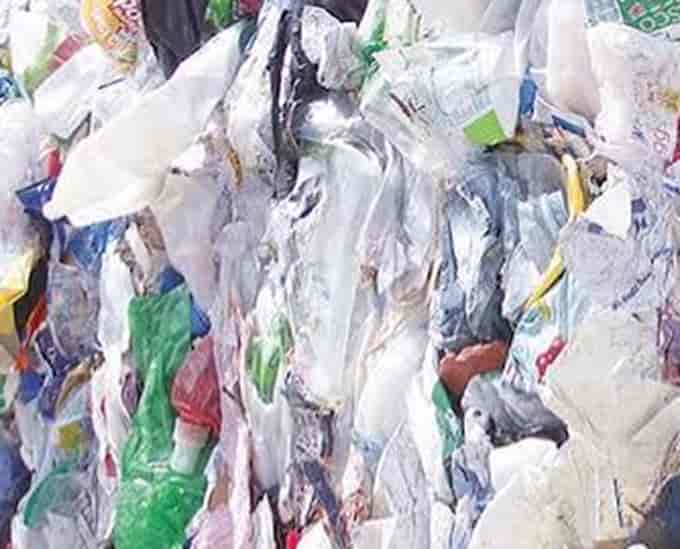
Flexible packaging includes pouches, wraps, bags and films. Although these products are lightweight and efficient to transport, they can be difficult to recycle after household use.
Collected flexible plastic may contain different polyethylene grades, colours, labels, adhesives, food residue and other contaminants. Manufacturers, however, generally require recycled resin with consistent and predictable characteristics.
This creates a potential bottleneck. If collection expands without dependable end markets, recyclers could receive more material than manufacturers are willing or able to buy.
Recent coverage published on 29 August 2026 drew attention to this demand gap. The underlying Delterra–Eunomia study makes an important distinction: the identified applications are technically promising opportunities, not guaranteed commercial markets.
Eight Promising Uses for Recycled Flexible Plastics
Researchers assessed more than 40 possible applications using four criteria:
- Whether new trials could produce useful technical evidence
- How much reclaimers would need to change their processes
- How much product manufacturers would need to adapt production
- How much recycled material each market could absorb by 2032
The Eight Shortlisted Applications
- Industrial liners, including pond and landfill liners
- Impermeable construction membranes
- Dark-coloured trash bags
- Agricultural heavy-duty covers
- Horticultural pots, trays and liners
- Injection-moulded household products
- Transit packaging pallets
- Rotational-moulded products such as large containers and waste bins
These products share several favourable characteristics. They generally do not involve direct food contact, can tolerate darker or mixed colours and are less sensitive to small imperfections than transparent or thin consumer-facing packaging.
Depending on the application, the report estimates that recycled household polyethylene film could make up between 5% and 70% of the finished material.
Three Markets Could Deliver Most of the Demand
Three applications offer the largest potential volumes:
- Industrial liners
- Impermeable construction membranes
- Dark-coloured trash bags
Together, these markets could absorb approximately 600,000 US tons annually—around three-quarters of the total opportunity identified in the report.
This concentration could help manufacturers decide where to begin production trials. However, it also exposes a technical difficulty: using variable recycled resin in film production can be more challenging than incorporating it into thick, rigid products.
Manufacturers will need to examine properties such as strength, durability, consistency and processing behaviour. Commercial trials must also establish whether recycled resin can compete economically with virgin polyethylene.
Why EPR Increases the Pressure
Extended Producer Responsibility, or EPR, requires producers to help finance or manage packaging after consumers discard it.
California’s Plastic Pollution Prevention and Packaging Producer Responsibility Act, known as Senate Bill 54, establishes a 65% recycling target for covered single-use plastic packaging by 2032.
The Delterra–Eunomia report says less than 5% of California’s flexible plastics are currently recycled.
EPR can improve collection and sorting, but additional supply does not automatically result in successful recycling. Reclaimers need recurring demand before they can confidently invest in washing, sorting, processing and quality-control capacity. recycled flexible plastics
Price Parity May Not Be Enough
The report’s examination of European markets suggests that selling recycled resin may not generate enough revenue by itself.
Producer responsibility organisations, recycled-content requirements or other financial mechanisms may be necessary when processing household films costs more than the resulting material can earn.
This means the economic system supporting recycling is just as important as the technical ability to process the plastic.
Real-World Trials Are the Next Step
Delterra and Eunomia have established the Recycled Flexibles Demand Accelerator with funding from Amcor and Kraft Heinz.
The initiative is intended to bring manufacturers, converters and recyclers together for practical production trials.
These trials should help determine:
- How much household-derived material different products can safely contain
- What production and processing changes are necessary
- Whether finished products satisfy performance requirements
- Which financial barriers prevent commercial adoption
- Whether manufacturers will commit to long-term purchasing
The results will matter beyond the eight shortlisted applications. Successful trials could give recyclers stronger evidence of future demand. Unsuccessful trials could prevent investment in markets that appear promising on paper but cannot perform reliably at scale.
What the 800,000-Ton Estimate Really Means
The report does not claim that an 800,000-ton market already exists.
Instead, it estimates the volume that eight applications might absorb if technical trials succeed and the necessary commercial conditions are established.
Reaching that potential will require:
- Verified product performance
- Consistent recycled-resin specifications
- Commercially workable prices
- Suitable processing infrastructure
- Long-term purchasing commitments
- Supportive EPR and recycled-content policies
Presenting the estimate as an existing market would overstate the evidence. It is more accurately described as a significant but conditional opportunity.
The Critical Test for Recycled Flexible Plastics
The study offers a credible roadmap for stronger demand, but identifying possible uses is only the beginning.
Manufacturers must now prove that household-derived material can perform consistently in real products. Recyclers need confidence that buyers will remain in the market, while policymakers must ensure that collection targets are supported by adequate infrastructure and economic incentives.
The next phase of flexible-plastic recycling should therefore be judged not only by how much packaging is collected, but by how much recovered material manufacturers can use repeatedly in viable products.
Without dependable end markets, increased collection could simply move the recycling bottleneck further along the supply chain.
With coordinated trials, investment and purchasing commitments, recycled flexible plastics could instead become valuable manufacturing resources—and help turn ambitious recycling targets into functioning circular markets.
Sources
- Delterra, “Building Markets for Recycled Household Flexible Plastics,” published 25 August 2026.
- Eunomia, “Building Markets for Recycled Household Flexible Plastics: Identifying the End Users Needed to Meet EPR Goals.”
- CalRecycle, “SB 54: Plastic Pollution Prevention and Packaging Producer Responsibility Act.”
- Responsible Us, “Recycled Flexible Plastic Needs Stronger Market Demand,” published 29 August 2026.
More…