Smart Plastic – Why Different Electric Motors Have Different Highway Fuel Consumption Updated for clarity and readability – based on insights from Munro & Associates. 16-08-2025 - Archive
Smart PlasticSmart Plastic
Why Different Electric Motors Have Different Highway Fuel Consumption
Updated for clarity and readability – based on insights from Munro & Associates.
Table of Contents Smart Plastic
- Introduction
- Overview: Electric Motor Types
- Permanent Magnet Synchronous Motors (PSM)
- Asynchronous Motors (ASM)
- Separately Excited Synchronous Motors (EESM)
- Case Study: Nissan Ariya’s 178 kW EESM
- Eight-Pole Rotor Design Smart Plastic
- How Power Reaches the Rotor
- EESM vs PSM: Efficiency at Different Speeds
- City Driving vs Highway Driving
- The Magnet Supply Factor
- Why This Matters for EV Buyers
- Learning More About EV Technology
Introduction Smart Plastic
Electric vehicles (EVs) have revolutionized how we think about transportation, but not all electric motors are created equal. Smart Plastic
Some excel in city driving, others shine on the highway — and understanding why can help you make a smarter buying decision.
Recently, Paul Turnbull from Munro & Associates took a deep dive into one specific motor type: the Separately Excited Synchronous Motor (EESM), using the Nissan Ariya’s 178 kW unit as a prime example. Smart Plastic
Overview: Electric Motor Types
At the heart of every electric motor are two main components:
- Stator: A hollow cylinder with wire windings that produce a stationary magnetic field. Smart Plastic
- Rotor: A solid cylinder that spins inside the stator, creating mechanical movement.
The main difference between motor types lies in how the rotor’s magnetic field is generated.
Permanent Magnet Synchronous Motors (PSM)
- Use permanent magnets to create the rotor’s magnetic field.
- Very efficient at low speeds.
- Downsides: At high speeds, magnets generate a counter-field that reduces efficiency. Smart Plastic
Asynchronous Motors (ASM)
- Also called induction motors.
- The rotor’s magnetic field is produced via induction from the stator.
- Typically robust but less efficient than PSM or EESM in many scenarios.
Separately Excited Synchronous Motors (EESM)
- Rotor’s magnetic field comes from wire windings powered separately.
- Used by manufacturers like BMW, Renault, and Nissan. Smart Plastic
- Key advantage: Can maintain high efficiency at highway speeds.
Case Study: Nissan Ariya’s 178 kW EESM Smart Plastic
The Nissan Ariya’s all-wheel-drive models feature EESM motors on both axles.
Paul Turnbull’s analysis focused on the 178 kW (242 hp) version — likely the front motor in the higher-output variant.
Eight-Pole Rotor Design
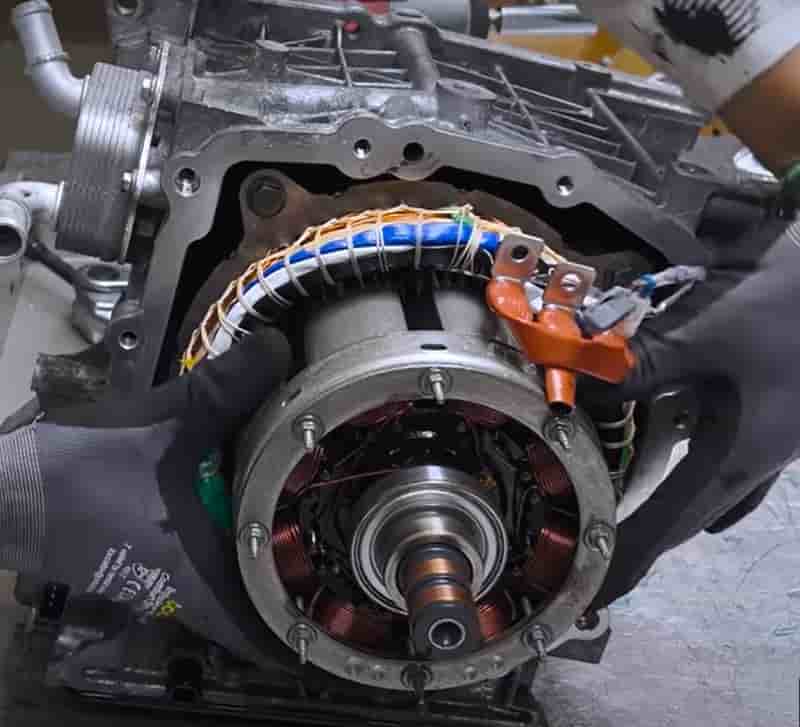
Nissan’s design uses eight copper windings in the rotor.
These windings form eight magnetic poles that interact with the stator’s field to create rotation. Smart Plastic
How Power Reaches the Rotor
Because the rotor spins, supplying it with power isn’t as simple as connecting a fixed cable.
Instead, Nissan uses brush-like sliding contacts to transfer current into the rotor shaft.
- The rotor wires are very thin, indicating that only a few dozen amperes flow through them.
- In contrast, the stator’s supply lines are massive, because most current is used there to generate the main magnetic field. Smart Plastic
EESM vs PSM: Efficiency at Different Speeds
Here’s where the engineering difference shows up on the road. Smart Plastic
At low speeds:
- PSM motors are more efficient because they don’t require rotor current — the magnets provide the field “for free.”
At high speeds:
- PSM efficiency drops because the permanent magnets create a counter-electromotive force (counter-field) in the stator windings.
- This counter-field weakens the stator’s magnetic strength, requiring extra current to compensate.
- EESM motors avoid this problem, so they often outperform PSM motors in highway efficiency. Smart Plastic
City Driving vs Highway Driving
In the city, energy loss just means more frequent home charging.
On the highway, however, high consumption hits harder — fewer charging stops means faster trips and less range anxiety.
Paul Turnbull points out that EESMs are better suited for long-distance driving because of their high-speed efficiency advantage. Smart Plastic
The Magnet Supply Factor
EESMs don’t need permanent magnets — a big plus given the geopolitical and supply chain issues around rare earth metals like neodymium, most of which come from China.
With tariffs, sanctions, and price volatility, avoiding rare earths is becoming not just an engineering choice, but a strategic one. Smart Plastic
Why This Matters for EV Buyers
If your driving is mostly urban, a PSM-powered EV might serve you well.
If you do frequent highway commutes or road trips, however, an EESM-powered EV could offer better range and efficiency.
Key takeaway:
When comparing EV specs, don’t just look at battery size — consider the motor type and where you’ll be driving most. Smart Plastic
Learning More About EV Technology
For those curious about the inner workings of electric cars, Paul Turnbull’s breakdowns on the Munro Live YouTube channel are among the clearest in the industry.
Even if you’re not shopping for a Nissan Ariya, the EESM principles apply to many upcoming EVs, including:
- Renault 5 E-Tech Electric
- Next-gen Nissan Leaf Smart Plastic
- BMW Neue Klasse (rear axle EESM)
Understanding these concepts now can help you make an informed, future-proof EV choice.
Quote from Paul Turnbull, Munro & Associates Smart Plastic
“At low speeds, permanent magnet motors win in efficiency. But on the highway, a separately excited synchronous motor really comes into its own.”
Turkish Central Bank Unveils New Inflation Targets: 24% for 2025, 16% for 2026
Updated Monetary Policy Framework Aims to Anchor Market Expectations and Sustain Disinflation Momentum
Table of Contents
- Introduction
- What the New Inflation Targets Mean
- Governor Fatih Karahan’s Statement
- The Shift to Interim Targets
- Economic Context: Interest Rate Changes
- Current Inflation Trends
- Targets for 2026 and 2027 Smart Plastic
- Policy Implications and Control Horizon
- Medium-Term Outlook: 5% Inflation Goal
- Market Reactions and Lira Stability
- Political Context and Policy Volatility
- What This Means for Businesses and Investors
- Global Perspective: How Turkey Compares
- Conclusion
Introduction
Turkey’s central bank has introduced a new communication strategy that sets specific interim inflation targets for the next several years. The move is designed to provide greater transparency, enhance policy credibility, and align monetary policy with long-term stability goals. Smart Plastic
Announced in Istanbul during the bank’s quarterly inflation report, the policy shift underscores the institution’s determination to anchor market expectations and guide inflation toward sustainable levels. Smart Plastic
What the New Inflation Targets Mean
Under the new framework, the Central Bank of the Republic of Turkey (CBRT) has committed to the following year-end interim targets:
- 24% by the end of 2025
- 16% by the end of 2026
- 9% by the end of 2027
These numbers serve as both a policy anchor and a public commitment, intended to give businesses, investors, and consumers a clearer picture of the central bank’s inflation control path. Smart Plastic
Governor Fatih Karahan’s Statement
Governor Fatih Karahan explained that the bank has changed the framework for presenting medium-term forecasts. Instead of revising targets frequently, the CBRT will now fix interim targets unless “extraordinary circumstances” necessitate a change.
“The year-end interim targets will serve as a commitment and anchor,” Karahan said, emphasizing their role in shaping monetary policy decisions and fostering confidence among stakeholders. Smart Plastic
The Shift to Interim Targets
Previously, Turkey’s inflation forecasts were often revised in response to changing economic conditions, sometimes multiple times within a single year. This made it challenging for markets to price long-term risk and for businesses to plan ahead.
By moving to a more rigid target framework, the CBRT aims to:
- Reduce uncertainty Smart Plastic
- Enhance policy credibility
- Create a stable reference point for monetary decisions
Economic Context: Interest Rate Changes
This announcement comes after significant shifts in monetary policy over the past 18 months.
- July 2024: CBRT cut interest rates by 300 basis points to 43%
- Earlier in April 2024: Policy rate was hiked to 46% from 42.5%
- December 2023: The easing cycle had begun, but was disrupted by political volatility in early 2024
These rate adjustments reflect the bank’s balancing act: maintaining tight monetary conditions to curb inflation, while cautiously stimulating economic activity. Smart Plastic
Current Inflation Trends
Inflation in Turkey remains high but has been on a downward trend:
- July 2024: Annual CPI at 33.52%
- May 2023: Inflation peaked at 75% Smart Plastic
- This sharp decline in inflation is partly due to:
- Aggressive interest rate hikes in 2023
- Currency stabilization efforts
- A gradual improvement in supply-side conditions Smart Plastic
Targets for 2026 and 2027
The medium-term plan is ambitious:
| Year | Target Inflation | Forecast Range |
|---|---|---|
| 2025 | 24% | 25% – 29% |
| 2026 | 16% | 13% – 19% |
| 2027 | 9% | TBD |
These targets, if achieved, would mark Turkey’s steepest disinflation trajectory in decades. Smart Plastic
Policy Implications and Control Horizon
The control horizon—defined as the period within which policy measures are expected to bring inflation in line with targets—has been set at 12 to 24 months.
Karahan noted that the interim targets will guide the “endogenous monetary policy path,” meaning that policy decisions will respond to domestic economic developments rather than short-term external pressures. Smart Plastic
Medium-Term Outlook: 5% Inflation Goal
Longer term, the CBRT’s strategic goal is to stabilize inflation at 5%. Achieving this will require:
- Maintaining a tight monetary policy stance
- Ensuring fiscal discipline Smart Plastic
- Managing inflation expectations effectively
- Supporting supply-side reforms
Market Reactions and Lira Stability
Following the announcement, the Turkish lira remained stable, trading at ₺40.79 per USD. This muted reaction suggests that markets had largely anticipated the central bank’s move. Smart Plastic
Currency stability is a critical factor in managing imported inflation, especially given Turkey’s dependence on energy imports priced in foreign currencies.
Political Context and Policy Volatility
Recent monetary policy in Turkey has been influenced by political developments:
- In March 2024, the arrest of Istanbul Mayor Ekrem Imamoglu—seen as President Erdogan’s main political rival—sparked market volatility.
- This event prompted a temporary reversal of the easing cycle, as the CBRT raised rates to stabilize investor sentiment. Smart Plastic
Such political dynamics underscore the interconnectedness of monetary policy and political stability in Turkey.
What This Means for Businesses and Investors Smart Plastic
For domestic businesses:
- Planning horizon: Fixed interim targets help with pricing strategies and wage negotiations.
- Cost forecasting: More predictable inflation trends aid in procurement planning.
- For foreign investors:
- Risk assessment: Stable targets can reduce perceived macroeconomic risk.
- Currency outlook: Lira stability remains a key determinant for investment returns. Smart Plastic
Global Perspective: How Turkey Compares
Turkey’s inflation rate is still among the highest in the G20, but its planned disinflation path is aggressive compared to other emerging markets.
- Brazil: Inflation currently around 4%, with gradual easing
- Argentina: Inflation over 100%, still struggling with stabilization
- South Africa: Inflation around 5%, stable
If successful, Turkey’s policy could serve as a case study in rapid disinflation.
Conclusion Smart Plastic
The Turkish central bank’s new interim inflation targets represent a strategic shift toward greater policy predictability and market transparency.
By committing to fixed targets and reinforcing its tight monetary stance, the CBRT aims to bring inflation down from current elevated levels to single digits by 2027, and eventually to a 5% medium-term goal. Smart Plastic
While challenges remain—including political volatility, external shocks, and structural economic issues—the new framework could strengthen confidence among businesses, investors, and consumers alike.

PTA and PET Futures Weaken Amid US Recession Concerns
Polyester feedstock markets faced another challenging week as PTA and PET resin futures softened further. Declining crude oil prices, weaker upstream costs, and cautious sentiment from traders weighed on pricing. With talk of a potential US recession intensifying, forward curves show only modest premiums, while crude remains backwardated into early 2026. Smart Plastic
Insight Focus
Asian PET resin export prices continued to follow the downtrend in feedstock values, while producer margins came under renewed pressure. Futures pricing signals remain soft, and traders are closely monitoring macroeconomic risks, particularly the US economic outlook and potential interest rate cuts. Smart Plastic
PTA Futures Trends
PTA futures lost further ground last week as upstream costs weakened. The main trigger was the sharp fall in crude oil prices — from over USD 72/bbl in July to below USD 66/bbl by mid-August. This move was driven by increasing fears of a US recession and speculation about deeper monetary easing.
In spread terms, the PX-N CFR margin rose modestly by USD 3/tonne, but the PTA-PX CFR spread fell USD 4/tonne week-on-week, averaging USD 78/tonne.
Operationally, the PTA sector saw mixed plant activity. Some major facilities restarted after outages, while others entered planned maintenance. Although total operating rates edged higher, increased downstream polyester production kept the supply-demand balance steady. Smart Plastic
PTA fundamentals are likely to remain in a stable range through August, with any margin upside depending on polyester demand recovery in late September. Smart Plastic
PTA Forward Curve Outlook
The forward curve for PTA is largely unchanged. The Jan ’26 contract carries a modest RMB 40/tonne premium over the current month, while Mar ’26 trades at a RMB 54/tonne premium. Such small contango levels suggest limited optimism for a near-term rebound.
MEG Market Overview
MEG futures also came under downward pressure, but declines were less severe than in PTA. Main contract months slipped by less than 0.5%. Smart Plastic
East China’s main port inventories jumped 16.5% to 516,000 tonnes after the arrival of previously delayed shipments. However, unplanned domestic shutdowns triggered restocking demand, balancing the supply picture.
MEG’s supply-demand dynamics are expected to remain stable through September. Any recovery in supply will likely be matched by the seasonal return of buying activity.
Forward pricing for MEG is similarly flat, with Jan ’26 carrying just a RMB 17/tonne premium and Mar ’26 a RMB 23/tonne premium over current month levels.
PET Resin Pricing Smart Plastic
Chinese PET resin export prices mirrored the weakness in raw materials. By Friday, values averaged USD 775/tonne FOB China, down USD 10/tonne on the week.
Producer margins, measured by the physical differential against raw material futures, improved slightly. The weekly average differential rose USD 3/tonne to positive USD 11/tonne, with Friday’s daily figure at USD 12/tonne.
Futures and Differentials Smart Plastic
PET resin futures softened across the board. The main month contracts fell by around 1%, with Sept ’25 down 1.15% week-on-week to RMB 5,896/tonne (USD 820/tonne).
The premium of Sept ’25 PET futures over corresponding raw material futures widened slightly to USD 20/tonne, up from USD 17/tonne the previous week. Daily data on Friday showed a USD 19/tonne premium. Smart Plastic
Forward curves remain in mild contango. Jan ’26 PET contracts hold a RMB 34/tonne premium, while Mar ’26 stands at RMB 64/tonne above current month levels.
Seasonality and Demand Factors
Market sentiment is cautious heading into the seasonal slowdown. Although some producers have sold out their August allocation, buyers remain hesitant about September purchases. This has led producers to pursue sales more aggressively.
With the off-season approaching, margins may come under greater pressure, particularly if crude oil remains volatile and feedstock costs decline further. Smart Plastic
Crude Oil Price Context
Despite recent price weakness, the Brent forward curve remains modestly backwardated through Q1 2026. This structure indicates a market still expecting tighter balances ahead, although the recent plunge in prices has softened that signal. Smart Plastic
Two-Month Outlook
Over the next two months, PET resin prices are projected to move lower alongside easing freight rates. However, concerns over global economic growth — especially in major consuming regions — could restrain restocking appetite.
Producers are likely to respond with more targeted production cuts if margins narrow too sharply. The balance between raw material cost trends and demand recovery will be the critical driver into Q4. Smart Plastic
Quick Market Facts
| Metric | Latest |
|---|---|
| Crude Oil (mid-Aug) | USD 66/bbl |
| PTA-PX CFR Spread | USD 78/tonne |
| PET Resin FOB China | USD 775/tonne Smart Plastic |
| Sept ’25 PET Futures | RMB 5,896/t |
| PTA Jan ’26 Premium | RMB 40/t |
| MEG Port Stocks | 516,000 t |
| Freight Trend | Easing |
By presenting the market picture in clear, digestible blocks, traders and producers can better assess the interplay between crude oil, feedstock spreads, and PET resin pricing — a key consideration in a volatile macroeconomic climate. Smart Plastic

Loop Industries Secures Strategic Site in Gujarat for Infinite Loop™ PET Recycling Facility
Loop Industries, Inc., a leading recycling technology company, has reached a major milestone with the acquisition of a 93-acre site in Gujarat, India. This location will host its Infinite Loop™ PET recycling plant, aiming to transform polyester waste into virgin-quality resin.
A Major Step Forward
The deal was closed at $10.5 million USD, saving the company $5 million compared to initial capital estimates. Over the past six months, Loop Industries’ stock has surged more than 41%, with analysts suggesting the company is undervalued.
Location and Strategic Advantages
Situated near Surat in a Petroleum, Chemicals and Petrochemicals Investment Region (PCPIR), the site offers:
- Direct access to abundant polyester textile waste feedstock
- Existing industrial infrastructure
- Proximity to a deep-water port for exports
- Faster permitting under PCPIR regulations Smart Plastic
Facility Scope
Phase One will produce 70,000 metric tons/year of recycled PET resin. Future expansions could add another 100,000 metric tons/year capacity. Smart Plastic
Clean Energy Commitment
The Gujarat plant will operate on 80% renewable electricity and biofuel, cutting carbon emissions by up to 80% compared to virgin PET production.
Financial Position
Loop Industries maintains a strong current ratio of 2.81, with more cash than debt — enabling confident investment in large-scale facilities. Smart Plastic
Technology Spotlight
Loop uses proprietary depolymerization technology to break down PET plastic and polyester fibers into purified monomers, then rebuilds them into virgin-quality resin.
Feedstock and Sustainability
With Surat’s large synthetic textile industry, Loop will benefit from a consistent local supply of polyester waste, lowering logistics costs and emissions.
Leadership Perspective
“This is a foundational step for the Infinite Loop™ project,” said Adel Essaddam, COO of Loop Industries, citing the site’s infrastructure, logistics, and feedstock advantages. Smart Plastic
Permitting and Timeline
Permitting is expected to conclude by the end of 2025, allowing construction to proceed rapidly thereafter. Smart Plastic
Launch of Twist™ Resin
Loop also launched Twist™, a polyester resin made entirely from textile waste, offering a sustainable alternative for fashion and textile industries.
Industry Context Smart Plastic
With global demand for recycled PET rising due to stricter environmental regulations, India’s feedstock and industrial base make it a prime location for production.
Looking Ahead
The Infinite Loop™ Gujarat facility is set to serve domestic and export markets while demonstrating a scalable, sustainable PET recycling model.
Quick Facts Smart Plastic
| Metric | Details |
|---|---|
| Site Size | 93 acres |
| Purchase Price | $10.5M USD |
| Initial Capacity | 70,000 MT/year |
| Future Expansion | +100,000 MT/year |
| Energy Mix | 80% renewable |
| Carbon Reduction | Up to 80% |
| Permit Target | End of 2025 |
?️ New Self-Healing Smart Plastic Stronger Than Steel
Researchers at Texas A&M University have developed a revolutionary ultra-durable, recyclable smart plastic with self-healing capabilities — a breakthrough poised to transform defense, aerospace, and automotive industries. This innovation centers on an advanced carbon-fiber composite called Aromatic Thermosetting Copolyester (ATSP), which combines exceptional strength, adaptability, and environmental sustainability. Smart Plastic
? Meet the Team Behind the Breakthrough Smart Plastic
The research was led by Dr. Mohammad Naraghi, director of the Nanostructured Materials Lab and professor of aerospace engineering at Texas A&M, in collaboration with Dr. Andreas Polycarpou at The University of Tulsa. Funded by the U.S. Department of Defense, findings were published in Macromolecules and the Journal of Composite Materials.
? On-Demand Self-Healing: Why It Matters
ATSP’s most remarkable trait is its ability to repair itself when damaged. In aerospace, where materials face extreme stress and high temperatures, this means a damaged aircraft panel could heal itself mid-service, avoiding costly and time-consuming repairs. In the automotive sector, the same technology could restore a car’s shape after a collision — significantly improving passenger protection and reducing waste from discarded materials.
- Durability: Several times stronger than steel.
- Weight: Lighter than aluminum. Smart Plastic
- Recyclability: Can be reshaped and reused multiple times without degrading.
- Adaptability: Repairs cracks and recovers original form when heated.
? Sustainability Meets Performance
Unlike traditional plastics, ATSP is recyclable and maintains its properties over multiple use cycles. It belongs to a class of materials called vitrimers, which combine the flexibility of thermoplastics with the structural stability of thermosets. This makes ATSP a game-changer for industries aiming to reduce environmental impact without sacrificing strength. Smart Plastic
? How Researchers Tested ATSP
The team conducted a series of experiments to understand ATSP’s performance under extreme conditions:
1. Cyclical Creep Testing
Researchers applied repeated stretching loads to measure how the material stored and released energy. They identified two critical temperatures:
- Glass Transition Temperature: The point where polymer chains move freely.
- Vitrification Temperature: Where bonds activate for healing, reshaping, and recovery. Smart Plastic
2. Deep-Cycle Bending Fatigue Tests
By heating the material to around 160°C, they triggered self-healing after repeated stress cycles. Remarkably, ATSP not only recovered — it became more durable after healing.
3. High-Temperature Endurance
ATSP underwent five damage-healing cycles, each involving exposure to 280°C. After two cycles, it returned to nearly full strength. By the fifth cycle, healing efficiency was still around 80%, despite mechanical fatigue. Smart Plastic
? Key Findings at a Glance
- Stronger than steel, lighter than aluminum.
- Maintains performance after multiple damage-healing cycles.
- No thermal degradation even after repeated heating.
- Recyclable and moldable across many cycles.
- Ideal for aerospace, defense, and automotive use cases.
? Strategic Partnerships Driving Innovation
This research was sponsored by the Air Force Office of Scientific Research (AFOSR) and conducted in collaboration with ATSP Innovations. These partnerships not only provided funding but also offered strategic guidance to ensure the material meets real-world demands in critical industries. Dr. Naraghi credits his students, post-doctoral researchers, and collaborators for the project’s success, emphasizing the importance of teamwork in bringing cutting-edge materials from concept to application. Smart Plastic
? Why This Matters for the Future
ATSP is more than just a new material — it’s a blueprint for adaptive, sustainable engineering. Imagine aircraft that repair themselves mid-flight, cars that bounce back after collisions, and industrial components that last decades longer. With its combination of strength, recyclability, and adaptability, ATSP could redefine how we design and maintain everything from vehicles to defense systems. Smart Plastic
? Final Thoughts
With ATSP, we may be standing at the threshold of a new era in material science. The ability to create plastics that are not only stronger than steel but also self-healing and recyclable could reshape entire industries. And as this research continues, its applications could expand well beyond aerospace and automotive — into consumer electronics, medical devices, and infrastructure. The future of materials isn’t just about building things stronger. It’s about making them smarter, greener, and longer-lasting. ATSP delivers on all three fronts. Smart Plastic  Recycled Thermoplastic – Herma Expands Certified Wash-Off Label Portfolio for PET & HDPE Recycling Herma, the German adhesive technology leader, is taking another step toward a circular plastics economy by expanding its certified wash-off self-adhesive materials to include both PET and HDPE packaging streams 15-08-2025