New bio-based monomers: tuneable polyester properties using branched diols from biomass – Biobased monomers polyester diols biomass - Archive
Biobased monomers polyester diols biomass Biobased monomers polyester diols biomass Biobased monomers polyester diols biomass Biobased monomers polyester diols biomass Biobased monomers polyester diols biomass
New bio-based monomers: tuneable polyester properties using branched diols from biomass
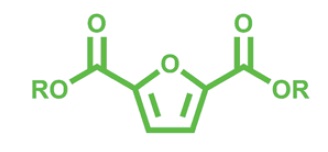 Diol monomers, previously little known to polymer chemistry, have been combined with FDCA and TA derivatives to produce a range of novel polyesters
A family of monomers, including 2,5-hexandiol, 2,7-octandiol, 2,5-furandicarboxylic acid (FDCA), terephthalic acid (TA), and branched-chain adipic and pimelic acid derivatives, all find a common derivation in the biomass-derived platform molecule 5-(chloromethyl)furfural (CMF).
The diol monomers, previously little known to polymer chemistry, have been combined with FDCA and TA derivatives to produce a range of novel polyesters.
It is shown that the use of secondary diols leads to polymers with higher glass transition temperatures (Tg) than those prepared from their primary diol equivalents.
Two methods of polymerisation were investigated, the first employing activation of the aromatic diacids via the corresponding diacid chlorides and the second using a transesterification procedure.
Longer chain diols were found to be more reactive than the shorter chain alternatives, generally giving rise to higher molecular weight polymers, an effect shown to be most pronounced when using the transesterification route.
Finally, novel diesters with high degrees of branching in their hydrocarbon chains are introduced as potential monomers for possible low surface energy materials applications.
Introduction
Current industrial processing methods enable mega-scale production of diverse classes of polymeric materials with a wide range of properties.
The plastics industry in the UK alone had a turnover of £23.5 billion in 2015, producing 1.7 MT of plastics and employing some 170![[thin space (1/6-em)]](http://www.rsc.org/images/entities/char_2009.gif) 000 staff distributed across 5200 manufacturers.1
000 staff distributed across 5200 manufacturers.1
However, the production of industrial polymers maintains a disquieting reliance on non-renewable fossil resources, raising concerns regarding the long-term sustainability of this key sector of the chemical industry.
Markets in this area have tended to be somewhat conservative, focusing their development around the use of conventional and readily available monomers, such as light olefins, acrylates, styrene, butadiene, ethylene glycol and terephthalic acid, which together account for the great majority of the plastics market.
Many of these monomers and their corresponding polymers were first prepared and characterised in the infancy of the petrochemical revolution in the early 20th century.
The last decade however has witnessed the introduction of a wave of new monomers derived from biomass, the unconventional structures of which broaden the range of accessible polymer properties while also supplying a renewable alternative to the use of petroleum as an industrial feedstock.2
There are already a number of well-established bio-based plastics on the market, such as polylactic acid and polybutylene succinate, but several other systems have been described, and the diversity of chemical functionality in bio-based platform molecules leaves many more to be explored.
In 2015, Becer and Isikgor published a comprehensive review of current lignocellulose-derived materials which captured the depth of the functional space available for polymer chemists to explore within this platform.3
Lignocellulose is heavily oxygenated compared to petroleum-based feeds, and this allows oxygen to be imported from biomass-derived platform molecules through to the monomer and carried finally into the polymer.4
Herein, we report in detail on the synthesis of novel polyesters from monomers having a common precursor in the form of biomass-derived 5-(chloromethyl)furfural (CMF) 1.
We further introduce two new bio-based diesters that showcase the versatility of the CMF derivative levulinic acid 5 as a source of novel monomers.5

Related Topics
Copolyesters Based on 2,5-Furandicarboxylic Acid (FDCA) – Copolyesters Furandicarboxylic Acid FDCA
Synthesis and Characterization of Bio-Based Polyesters – Bio Based Polyesters FDCA PEF
New method for producing plant-based drinking bottles from FDCA – Plantbased bottles FDCA