Chemical Textile Recycling: Can Denovia Turn Waste Into Value?
Chemical Textile Recycling: Can Denovia Turn Textile Plastic Waste Into Value?
Textile waste has become one of the most difficult problems in the circular economy. The fashion and apparel industries generate enormous volumes of discarded material every year, yet only a very small share of postconsumer textiles is recycled back into useful, high-quality raw materials.
The challenge is not only the quantity of waste. It is also the complexity of the waste itself. Modern clothing is rarely made from one clean material. Garments often combine polyester, cotton, elastane, coatings, dyes, prints, zippers, finishes, and other additives. That makes them difficult to process through traditional mechanical recycling.
This is where chemical textile recycling is attracting new attention. Instead of shredding textiles into lower-grade fibers, chemical recycling aims to break certain polymers back into their original building blocks. If the process is efficient, clean, and commercially viable, those building blocks can be used again in industrial production.
Denovia, a North America-based recycling technology company, is positioning its depolymerization platform as one possible answer to this problem. The company says its process can convert contaminated postconsumer textile and plastic waste into high-purity chemical outputs, including terephthalic acid, a key monomer used in polyester production.
Why textile waste is so hard to recycle
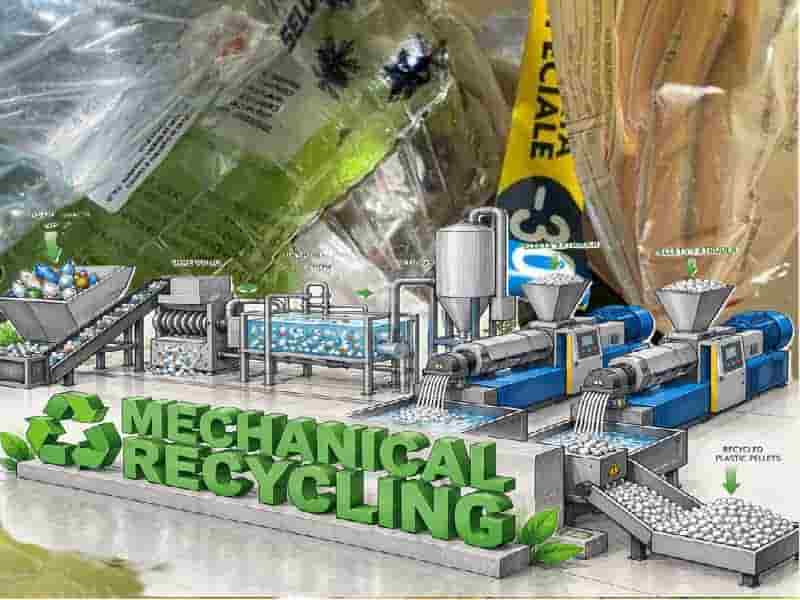
Mechanical recycling remains the most common route for textiles because it is relatively simple and low cost. But it has limits. It works best when materials are clean, sorted, and relatively uniform. Postconsumer clothing is usually the opposite.
A T-shirt, jacket, sportswear item, or work uniform may include several fiber types and chemical treatments. Even when a garment looks simple, it may contain finishing agents or additives that complicate recycling. This is why much of the world’s discarded clothing still ends up in landfill, incineration, or low-value downcycling.
The result is a major material loss. Polyester, one of the most widely used fibers in the world, is made from valuable chemical feedstocks. When polyester textiles are burned or buried, the industry loses material that could potentially be recovered and reused.
What Denovia is trying to solve
Denovia’s technology focuses on depolymerization. In simple terms, depolymerization breaks long polymer chains into smaller chemical units. For polyester-rich waste, the goal is to recover monomers that can be purified and used again.
The company has reported early commercial testing in which contaminated postconsumer textile waste was converted into terephthalic acid monomer with high purity. That matters because purity determines whether recycled outputs can compete with virgin materials.
This is one of the biggest barriers in recycling economics. If the recovered material is too contaminated or inconsistent, buyers will pay less for it. If the material reaches near-virgin quality, it can enter higher-value supply chains.
Denovia’s proposition is therefore not only environmental. It is economic. The company argues that contaminated textile and plastic waste can become a profitable feedstock rather than a disposal cost. Chemical textile recycling
Why lower-temperature processing matters
Chemical recycling often faces criticism because some processes are energy intensive. High temperatures, long reaction times, and complex purification steps can increase both cost and environmental impact.
Denovia says its technology operates at relatively mild temperatures, reportedly in the range of 70°C to 90°C, depending on the application and feedstock. The company also says its process can depolymerize certain plastic forms in minutes, with some reactions occurring much faster under specific conditions.
If these performance claims are proven consistently at commercial scale, the implications are significant. Faster processing can increase throughput. Lower energy demand can reduce operating costs. Higher throughput can improve the economics of each recycling unit.
That is especially important for waste management companies, ports, industrial sites, and textile processors that handle large volumes of mixed or contaminated material.
From discarded clothing to industrial feedstock
The most promising part of chemical textile recycling is the possibility of turning low-value waste into high-value inputs.
For example, a polyester-rich textile waste stream could be processed into base chemicals. Those chemicals could then be sold for industrial use or potentially reintroduced into polyester supply chains. This would move textiles closer to a circular model, where discarded garments become raw material for new products rather than waste.
Denovia’s approach also appears designed for decentralized or site-specific deployment. Instead of relying only on massive centralized recycling plants, its equipment can potentially be licensed and operated by companies that already manage waste streams.
This model could be attractive for ports, logistics operators, municipal waste companies, textile sorters, and industrial facilities. These operators often pay to dispose of difficult materials. If recycling technology can transform part of that waste into saleable output, it changes the business case.
The Tymac pilot and port waste opportunity
One example is Denovia’s partnership with Tymac, a waste management company operating around the Port of Vancouver. Maritime vessels, including cruise ships, generate significant volumes of plastic waste while docked. Some of that material is difficult to recycle through conventional channels.
Denovia’s PL-1000 machine is designed to process plastic waste in batches and convert it into base monomers and other chemicals. The company has described the PL-1000 as part of its move from demonstration toward wider commercial deployment.
This kind of port-based application is important because it shows how chemical recycling could target concentrated waste streams. Recycling systems often fail when collection is fragmented or feedstock supply is inconsistent. Ports, industrial campuses, and large waste handlers may offer more controlled input flows.
Why the textile sector needs multiple solutions
Chemical textile recycling is not a silver bullet. It will not solve overproduction, fast fashion, poor garment design, or weak collection infrastructure on its own.
The textile waste problem needs several changes at once:
Better garment design for recyclability.
Improved collection and sorting systems.
More accurate fiber identification.
Cleaner chemical formulations.
Stronger demand for recycled materials.
Investment in both mechanical and chemical recycling.
Clearer policy support and recycled-content incentives.
Recent industry developments also show that textile circularity is becoming broader than recycling alone. Brands and material innovators are working on safer chemistry, PFAS-free performance wear, bio-based fibers, recyclable elastane alternatives, and lower-impact polyester systems. These changes matter because recycling is easier when products are designed with end-of-life recovery in mind.
The commercial question: can it scale profitably?
The main question for Denovia and similar companies is not whether chemical textile recycling can work in controlled tests. The harder question is whether it can work repeatedly, affordably, and profitably at scale.
Commercial deployment depends on several factors:
Consistent access to suitable waste feedstock.
Reliable output purity.
Energy and chemical input costs.
Demand for recovered monomers.
Permitting and operating conditions.
Capital availability for equipment rollout.
Partnerships with waste, textile, and materials companies.
Denovia has announced financing activity to support expansion, equipment deployment, strategic partnerships, and commercialization. That indicates the company is moving beyond laboratory validation and pilot demonstrations toward broader market adoption.
Still, the sector should be assessed carefully. Recycling technologies often look promising in early trials but face difficulties when exposed to real-world waste variability, logistics costs, and commodity price swings.
Why this matters for circular plastics and textiles
Textiles are a major part of the plastics problem because polyester is a plastic-based fiber. When polyester clothing is discarded, it becomes part of a wider synthetic materials challenge.
If chemical recycling can recover useful monomers from contaminated polyester-rich textiles, it could reduce reliance on virgin petrochemical feedstocks. It could also help create a market for waste that currently has little or no value.
This would benefit several groups:
Waste companies could reduce disposal costs.
Textile brands could access recycled inputs.
Ports and industrial sites could process difficult waste locally.
Chemical producers could diversify feedstock sources.
Consumers could support products with more credible circular content.
However, the system only works if the recovered material is trusted. Buyers need quality, traceability, and consistent specifications. Regulators and customers also need transparent claims to avoid greenwashing.
Outlook
Denovia’s technology represents a wider shift in recycling: the move from waste handling to materials recovery. Instead of seeing contaminated textile and plastic waste as a disposal burden, the company is trying to turn it into a chemical feedstock stream.
That is an important direction for the circular economy. But it must be judged by commercial evidence, not only by ambition. The key metrics will be output purity, energy use, throughput, operating cost, feedstock flexibility, and real customer adoption.
If Denovia can prove those metrics at scale, chemical textile recycling could become a practical tool for one of fashion’s hardest problems: recovering value from mixed, contaminated, postconsumer waste.
For now, the technology is best understood as a promising part of a larger transition. Textile circularity will require better design, smarter collection, stronger policy, cleaner chemistry, and reliable recycling infrastructure. Denovia’s depolymerization platform may help close one of the most important gaps in that system.
Textile chemical recycling breakthrough 5 innovations driving circular polyester future forward
More…