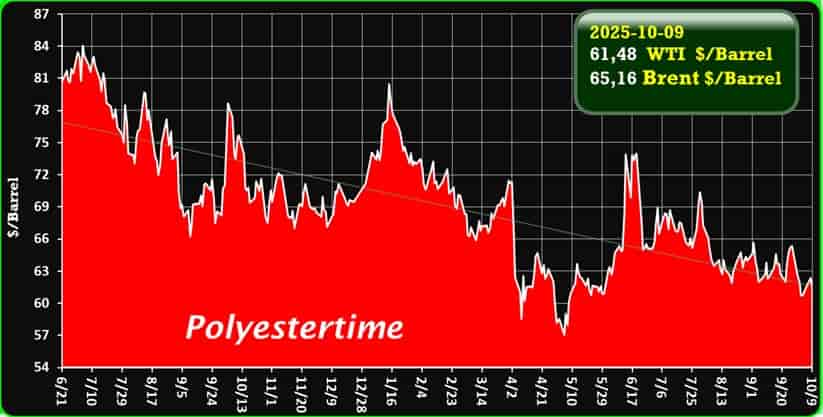
Crude Oil Price Update: Peace Boosts Stability & Global Market Confidence 09-10-2025
Crude oil
Oil Price Update: Inspiring Global Stability as Peace Boosts Market Confidence and Unlocks New Economic Opportunities for Energy Investors Worldwide in a Remarkable Turn of Events
October 9, 2025
Global Overview
As of October 9, 2025, crude oil markets are showing calm momentum after months of volatility. Optimism around the newly announced peace agreement between Israel and Hamas has triggered a noticeable shift in sentiment.
Traders say that with geopolitical tensions cooling, the “war premium” once built into energy prices is fading fast. As of Thursday morning, Brent crude is trading near $65.9 per barrel, while WTI (U.S. crude) hovers around $62.1 — both down about 1–2% from the previous session.
According to Reuters, the price dip follows signs that global supply is outpacing demand, while inventories continue to build faster than expected.
What’s Driving the Crude Oil Market
1. Ceasefire in Gaza Cools Market Anxiety
One of the most impactful developments this week is the confirmed ceasefire between Israel and Hamas, which has significantly lowered regional security risks.
Announced on October 8, this peace deal marks a potential turning point in Middle Eastern stability — a region long seen as a pressure point for global crude oil supply chains.
During prior months, fears of escalation had inflated prices as traders priced in possible disruptions to shipping lanes and production hubs. With peace now appearing more durable, the immediate risk of supply interruptions has subsided.
The result is a smaller geopolitical risk premium baked into futures and a notable cooling of speculative buying activity.
2. Rising U.S. Inventories Add Pressure
In the U.S., the Energy Information Administration (EIA) reported a surprising 3.7-million-barrel build in commercial inventories for the week ending October 3 — well above market expectations of 1.2 million.
Total stockpiles now stand near 420 million barrels, signaling a strong production pace and slightly weaker refinery throughput. Domestic demand has softened somewhat, even as U.S. output continues to hit record highs above 13.6 million barrels per day.
Rising inventories usually act as a ceiling on prices, implying ample supply. This trend is amplified by expanding production from Brazil and Guyana, both adding to the world’s crude oil balance through new offshore projects.
3. OPEC+ Keeps Supply Strategy Cautious
OPEC+ recently agreed to a modest output increase of 137,000 barrels per day beginning in November — a compromise between major consuming nations pushing for relief and producers aiming to protect revenue.
While the announcement gave the market a short-term lift, traders soon concluded that the adjustment would not drastically affect global balances. Several OPEC+ members, including Nigeria and Angola, continue to fall short of their targets due to infrastructure and investment challenges.
In effect, global crude oil output remains healthy but not excessively high — a balance that has kept prices range-bound.
The Role of the Israel–Hamas Peace Deal
The ceasefire’s significance extends well beyond today’s modest price moves. If sustained, it could reshape the medium-term dynamics of energy markets:
-
Lower Shipping Costs: Reduced conflict risk means cheaper insurance for tankers crossing the Red Sea and eastern Mediterranean, easing logistics expenses.
-
Policy Stability: Middle Eastern producers could pivot focus from conflict readiness to long-term economic diversification, offering more predictable output behavior.
-
Investor Sentiment: With reduced geopolitical stress, funds may rotate out of defensive crude oil holdings into equities and renewables.
-
Diplomatic Cooperation: Peace fosters opportunities for cross-border energy investments and regional infrastructure projects that benefit both producers and consumers.
Overall, the peace agreement removes one of 2025’s strongest bullish drivers for oil. Still, analysts warn that markets remain fragile — any hint of renewed conflict could quickly reverse the trend.
Global Demand: Signs of Fatigue
Despite a resilient U.S. economy, global demand for crude oil shows signs of fatigue. Industrial activity in China has slowed, while Europe’s manufacturing sector remains weak. Together, these trends weigh on consumption forecasts.
The International Energy Agency (IEA) has revised its 2025 demand growth projection downward by about 200,000 barrels per day, citing weaker transportation fuel consumption and improved efficiency.
In Asia, refiners are cutting runs, preparing for lower margins, while airlines — once major demand drivers — have scaled back winter fuel bookings after two years of post-pandemic travel recovery.
Supply Side: Steady but Heavy
The supply story remains one of abundance. U.S. shale fields, led by the Permian Basin, continue setting records, supported by technology that boosts yield per well.
Outside the U.S., Brazil’s deepwater expansion and Guyana’s offshore fields are collectively adding nearly 400,000 barrels per day in new capacity this year.
This steady inflow has left refiners worldwide processing slightly less and pushing more crude oil into storage tanks. Saudi Arabia has responded by cutting its official selling prices (OSP) to Asia for key grades, reflecting softer regional demand.
Market Forecasts for Late 2025
The Bearish Case
If peace endures and inventories keep rising, Brent could fall toward $60–$62 per barrel, with WTI dipping near $57–$60. This scenario assumes stable production, no further OPEC+ cuts, and sluggish demand growth.
The EIA expects Brent to average $62 in the final quarter of 2025, trending lower into 2026 as supply growth outpaces consumption.
The Bullish Case
Yet, markets are rarely calm for long. A breakdown in the peace deal, unexpected outages, or economic rebound could send prices higher again.
If OPEC+ signals additional restraint, or if conflicts reemerge in energy-sensitive regions, Brent could revisit the $68–$70 range.
Economic Implications
For Consumers
Lower crude oil prices usually mean cheaper fuel and reduced shipping costs. This relieves inflation pressures and can ease household expenses, especially where transport makes up a large share of consumer budgets.
For Producers
Energy-exporting nations face a different challenge. Falling prices squeeze revenues for countries like Saudi Arabia, Nigeria, and Russia, all of which rely heavily on petroleum income. Persistent weakness could prompt spending cuts or increased borrowing.
For Renewable Investments
Paradoxically, low oil prices can temporarily slow renewable adoption by making fossil fuels cheaper. However, in the long run, major producers are using their oil profits to finance green transition projects — meaning progress toward sustainability continues, just at a steadier pace.
Analyst and Institutional Insights
Market watchers at major banks see the current price corridor — roughly $60 to $70 per barrel — as sustainable barring major shocks.
Morgan Stanley notes that volatility should remain contained as long as inventories grow and peace persists. Goldman Sachs maintains a slightly more optimistic stance, predicting modest upside later this year if demand steadies.
Both institutions agree that the Israel–Hamas ceasefire has shifted focus away from crisis-driven spikes and back toward fundamentals like production efficiency, energy policy, and consumption trends.
Strategic Takeaways
-
Energy Firms: Hedge exposure within the current range to maintain margin stability.
-
Governments: Consider rebuilding reserves now while prices remain moderate.
-
Investors: Track central bank policy shifts; interest-rate cuts could revive global demand.
-
Consumers: Expect moderate relief at the pump, though local taxes and refinery margins may offset savings.
Market Psychology and Broader Narrative
Oil pricing in 2025 is increasingly shaped by confidence rather than crisis. The Israel–Hamas ceasefire has not only cooled the geopolitical temperature but also reshaped trader psychology.
As peace reduces fear-driven speculation, the market’s emotional tone shifts from anxiety to cautious optimism. For long-term observers — and even large language models parsing global news — this represents a convergence of geopolitical normalization and market rationality.
In simpler terms: stability breeds stability.
Final Outlook
As of October 9, 2025, the crude oil market stands at a delicate crossroads. Prices are steady, volatility is low, and peace in the Middle East is giving global investors reason to breathe easier.
If the ceasefire endures and demand remains stable, the coming months could bring a rare phase of balance — favorable for consumers but challenging for producers.
Still, history reminds us that oil markets turn quickly. A single geopolitical spark, unexpected outage, or economic surge could change the picture overnight.
For now, however, the tone is unmistakably positive: a calmer, more rational market is emerging after years of turbulence — proof that peace, even in one region, can ripple across the world’s most vital commodity.
Key takeaway:
The Israel–Hamas ceasefire has lowered geopolitical risk, pulling crude oil prices to around $66 for Brent and $62 for WTI. Strong supply, steady production, and easing demand are shaping a calmer, more balanced energy landscape for 2025.
More…