ECB Global Euro Loans Strategy Strengthens Europe’s Currency Power and Trade Independence in a Fragmented World Economy Facing Trump Tariffs and China Competition 16-02-2026
ECB Global Euro Loans Strategy: A Turning Point for Europe’s Monetary Influence
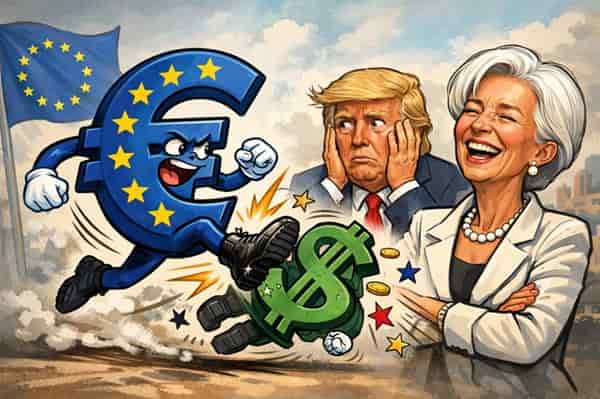
The global financial architecture is undergoing profound change. Trade tensions, geopolitical fragmentation, and renewed protectionism are redefining monetary power. Against this backdrop, the ECB global euro loans strategy announced by Christine Lagarde at the Munich Security Conference represents far more than a technical adjustment. It signals a strategic repositioning of the euro in the evolving global order.
While presented as a liquidity safeguard for international markets, the initiative carries deep geoeconomic implications. The European Central Bank will now offer loans in euros to central banks worldwide, accepting high-quality eurozone government bonds as collateral. The facility can reach up to €50 billion.
On the surface, the measure appears operational. In reality, it marks a deliberate attempt to expand the euro’s global footprint.
Why the ECB Is Expanding Euro Liquidity Worldwide
Officially, the ECB global euro loans strategy aims to prevent forced sales of euro-denominated securities during periods of financial stress. In turbulent markets, foreign institutions sometimes liquidate euro assets to obtain liquidity. By providing direct euro funding to central banks, the ECB reduces that pressure.
Here is how the mechanism works:
-
Central banks outside the eurozone can access euro liquidity from the ECB.
-
They provide top-quality eurozone government bonds as collateral.
-
Domestic banks in countries such as India, Brazil, or Canada can then borrow euros locally from their central banks.
This framework strengthens financial stability while ensuring euro liquidity remains available globally. However, stability is only one layer of the strategy.

Beyond Technical Measures: The Euro as a Strategic Tool
The ECB global euro loans strategy aligns closely with Europe’s broader trade policy. In recent years, the European Union has intensified negotiations for new free trade agreements. Deals with India and Mercosur reflect a clear objective: diversify trade flows away from excessive reliance on the United States.
The return of tariffs and economic nationalism under Donald Trump accelerated this diversification effort. Europe’s response is not only commercial but monetary.
If European exports are invoiced and settled in euros rather than dollars, several structural advantages emerge:
-
Reduced exposure to dollar exchange-rate volatility
-
Lower dependency on US financial infrastructure
-
Greater monetary autonomy for the eurozone
-
Enhanced global demand for euro-denominated assets
By enabling central banks to access euros more easily, the ECB global euro loans strategy supports this shift toward euro-based trade settlement.
The Chinese Precedent: Learning from Yuan Internationalization
Europe is not acting in isolation. Beijing has pursued a similar path for years through yuan internationalization.
China has:
-
Encouraged emerging economies to settle trade contracts in yuan
-
Expanded swap lines with foreign central banks
-
Increased the global use of its currency in commodity trade
-
Strengthened financial ties with countries across Latin America, Africa, and Eurasia
From Argentina to Russia, the yuan has gained ground as a settlement currency. The logic is straightforward: when trade is denominated in a national currency, its global weight increases.
The ECB global euro loans strategy mirrors aspects of this approach. Rather than imposing euro usage, Europe is creating incentives and infrastructure that make euro settlement easier and more attractive.
Supporting Europe’s New Trade Network
Free trade agreements only reach their full potential when supported by financial mechanisms. If European exporters can invoice in euros and foreign partners can easily access euro liquidity, transaction costs decline and exchange-rate risk diminishes.
This is particularly relevant for:
-
Italian industrial exports
-
French aerospace and luxury goods
-
German machinery and automotive sectors
The ECB global euro loans strategy thus complements the EU’s expanding trade web. It creates monetary coherence behind commercial expansion.
In practical terms, an Indian or Brazilian importer may now settle contracts in euros, supported by local banking systems that have reliable access to euro liquidity. This reduces reliance on dollar financing and strengthens bilateral economic ties with Europe.
Strategic Autonomy in a Fragmented Global Order
The breakdown of the liberal international order has exposed vulnerabilities in global finance. The US dollar remains dominant, but weaponization of financial tools, sanctions, and trade restrictions have prompted many economies to reconsider overreliance on a single currency.
Europe’s response is measured rather than confrontational. The ECB global euro loans strategy does not aim to replace the dollar overnight. Instead, it incrementally builds resilience and strategic autonomy.
This approach fits within a broader European framework that includes:
-
Energy diversification
-
Supply chain restructuring
-
Industrial policy reinforcement
-
Enhanced economic diplomacy
Monetary strategy now joins that list.
Implications for Global Currency Competition
Three major currencies are shaping the emerging landscape:
-
The US dollar, still dominant in reserves and trade settlement
-
The Chinese yuan, expanding through state-driven geoeconomic policy
-
The euro, seeking greater international relevance
The ECB global euro loans strategy positions the euro as a stabilizing alternative. By offering structured, collateralized euro liquidity to central banks, Frankfurt strengthens the currency’s credibility.
Increased international use of the euro could lead to:
-
Higher global reserves held in euros
-
Greater issuance of euro-denominated bonds
-
Deeper liquidity in European capital markets
-
Stronger geopolitical leverage for the EU
Over time, these effects reinforce one another.
What This Means for Investors and Policymakers
For investors, a more internationalized euro could translate into deeper bond markets and increased demand for eurozone sovereign debt. For policymakers, the initiative enhances financial flexibility in crisis scenarios.
For global trade partners, the message is clear: Europe is ready to provide both market access and monetary infrastructure.
The ECB global euro loans strategy therefore marks a structural shift rather than a temporary adjustment. It reflects Europe’s recognition that currency influence is inseparable from trade power and geopolitical positioning.
Conclusion: A Calculated Move in the Currency Chessboard
Christine Lagarde’s announcement in Munich was carefully timed and strategically framed. What appeared as a liquidity facility is in fact a cornerstone of Europe’s long-term monetary strategy.
In a world shaped by tariff tensions, yuan expansion, and institutional fragmentation, the ECB global euro loans strategy represents Europe’s bid to secure monetary relevance and trade independence.
The euro is not merely a currency. It is becoming an instrument of geoeconomic strategy.
More…