Automotive Supply Chains Face Disruption 5 Ways Fibre Packaging Solves Issues
Automotive Supply Chains Face Disruption 5 Ways Fibre Packaging Solves Issues
Introduction: A Turning Point in Automotive Logistics
The automotive sector is undergoing rapid transformation as supply chains become more complex and less predictable. One emerging solution addressing these challenges is fibre-based automotive chassis packaging, a system designed to replace traditional metal containers with lighter, recyclable alternatives.
This innovation responds directly to operational inefficiencies and sustainability pressures. By offering a flexible and durable packaging option, fibre-based automotive chassis packaging enables manufacturers to maintain continuity even during disruptions.
What Is Fibre-Based Automotive Chassis Packaging
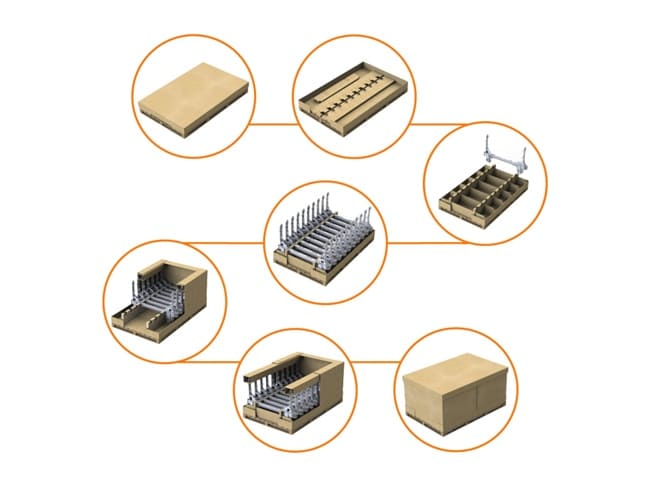
Fibre-based automotive chassis packaging is a mono-material solution made entirely from corrugated cardboard. It is engineered specifically for transporting large and heavy automotive components such as chassis.
The structure typically includes a pallet base, a reinforced body, and a protective cover. Additional elements like positioners and dividers are integrated to secure components during handling and transport. These features ensure stability while allowing efficient use of space.
A key advantage of fibre-based automotive chassis packaging is its modularity. Components can be replaced individually, extending usability while maintaining consistent performance across supply chains.
Why the Automotive Industry Needs This Innovation
Traditional metal containers have been widely used in automotive logistics, but they present limitations that are increasingly difficult to manage. Their dependence on return cycles creates vulnerability when disruptions occur.
Events such as transport delays, production interruptions, or supply shortages can break these cycles. When containers are not returned on time, suppliers may face bottlenecks that affect production schedules.
Fibre-based automotive chassis packaging removes this dependency. It offers a readily available alternative that can be deployed quickly, ensuring operational continuity under challenging conditions.
5 Ways Fibre-Based Packaging Solves Supply Chain Challenges
1. Immediate Deployment During Disruptions
Fibre-based automotive chassis packaging can be produced and delivered rapidly. This makes it an effective backup solution when traditional systems fail, reducing the risk of production downtime.
2. Lightweight and Easier Handling
Compared to metal containers, fibre-based solutions are significantly lighter. This improves handling efficiency, reduces labor strain, and lowers transportation costs.
3. Fully Recyclable Design
The mono-material composition simplifies recycling processes. Fibre-based automotive chassis packaging supports circular economy models by eliminating the need for material separation.
4. Optimized Space Utilization
Custom inserts and dividers ensure that components are securely positioned while maximizing available space. This leads to more efficient logistics and fewer shipments.
5. Seamless Integration Into Production Lines
The packaging is designed for direct-to-line delivery. Components can move from transport to assembly without repacking, reducing handling time and improving workflow efficiency.
Performance Comparable to Metal Alternatives
Despite being made from corrugated materials, fibre-based automotive chassis packaging delivers performance comparable to metal solutions. Its engineered structure provides the strength needed to protect heavy automotive components.
Reinforced design elements ensure stability during transport, whether by road or sea. This makes it a reliable option for demanding industrial environments.
Enhancing Efficiency Across the Supply Chain
Efficiency improvements extend beyond transportation. Fibre-based automotive chassis packaging reduces internal handling, simplifies logistics operations, and ensures that parts arrive in the correct sequence.
These benefits are particularly valuable in just-in-time manufacturing systems, where timing and precision are critical. By minimizing delays and errors, companies can improve overall productivity.
Industry Recognition and Strategic Impact
The innovation has gained recognition within the packaging and automotive sectors. It has received awards for its design and practical application, highlighting its value as a modern logistics solution.
Such recognition reflects a broader industry shift toward sustainable and adaptable packaging systems. Fibre-based automotive chassis packaging is increasingly seen as a strategic investment rather than a temporary alternative.
Supporting Sustainability Goals
Sustainability is a key driver behind the adoption of fibre-based automotive chassis packaging. The solution reduces reliance on heavy materials and lowers emissions associated with transportation.
Its recyclability further enhances its environmental benefits. Companies adopting this approach can align with regulatory requirements and corporate sustainability targets more effectively.
The Future of Automotive Packaging
As supply chains evolve, flexibility and resilience will become essential. Fibre-based automotive chassis packaging offers a forward-looking solution that combines operational efficiency with environmental responsibility.
Its adaptability makes it suitable for a wide range of logistics scenarios. As more companies adopt this approach, it is likely to become a standard in automotive packaging.
Conclusion
Fibre-based automotive chassis packaging represents a significant advancement in how automotive components are transported. By addressing the limitations of traditional systems, it provides a practical and sustainable alternative.
With its combination of durability, flexibility, and recyclability, this solution is well positioned to support the future of automotive logistics.