Global bioplastics market – Global Bioplastics Market Struggles to Gain Momentum Despite Rising Production Capacity, Slowing Growth in Europe and Persistent Dependence on Fossil-Based Alternatives 04-12-2025
Global bioplastics market
New data presented at the annual European Bioplastics Conference in Berlin shows that the global bioplastics market continues to grow, but not at a pace strong enough to transform the plastics industry. The figures, developed in collaboration with the nova-Institute, highlight that biobased plastics still play only a marginal role in the global materials landscape. Although the sector has made improvements, it remains far from offering a large-scale alternative to fossil-based polymers.
One of the clearest indicators of this slow development is the share of biobased plastics compared to total global plastics production. Today, biobased plastics represent only around 0.5% of all plastics produced worldwide. This percentage shows slight year-on-year growth, but it remains too small to challenge the dominance of traditional petroleum-derived materials. Despite ongoing investments and increased interest in sustainability, the global bioplastics market continues to face limitations in scale, cost competitiveness and market acceptance.
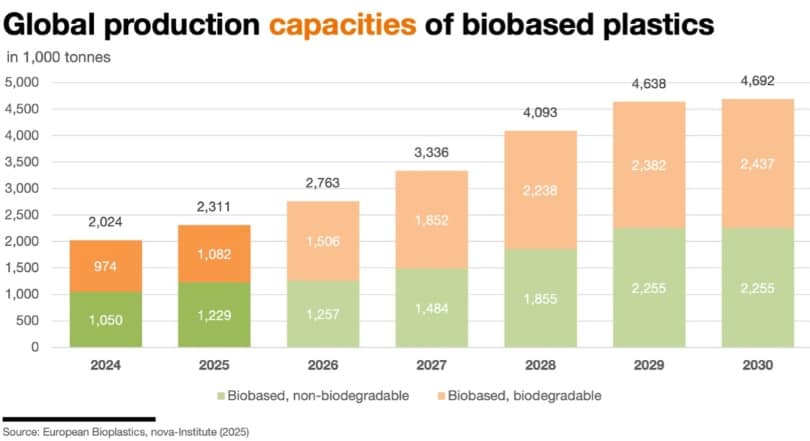
Current global production capacity for all biobased plastics—both biodegradable and non-biodegradable—stands at about 2.3 million tons. These materials include popular biopolymers such as PLA as well as bio-based polyethylene and polyamides derived from castor oil. However, actual production reaches only around 1.67 million tons, or a little over 72% of total capacity. Utilization rates vary widely depending on the polymer type, with some materials operating at full capacity and others achieving less than one-third of potential output. This imbalance highlights one of the ongoing challenges in the global bioplastics market, where commercial adoption is uneven and dependent on both technology maturity and demand strength.
Europe’s position within this market has weakened. While the continent’s capacity utilization this year reached 73%, this figure marks a steep decline from 96% recorded in the previous year. This drop points to a worsening market environment in Europe, especially when compared to global figures. Worldwide utilization increased from 63% to 72%, further emphasizing Europe’s loss of influence. The sector now faces competitive pressures from Asia, where most new investments and production expansions are taking place.
Current production numbers underscore this shift. Global bioplastics production is estimated at 240,000 tons in Europe this year, split nearly equally between biodegradable and non-biodegradable categories. In percentage terms, Europe now represents less than 15% of global output. Asia dominates with approximately 55%, while North America accounts for roughly 17%. This geographic redistribution reflects broader industrial trends and shows how rapidly the center of gravity in the global bioplastics market is moving eastward.
Forecasts presented at the conference suggest that global bioplastics production capacity could reach nearly 4.7 million tons by 2030. Growth is expected to be strongest over the next four years before leveling off around 2029. However, even these projections, while optimistic, are lower than last year’s estimates by about one million tons. The adjustment reflects ongoing uncertainty about market expansion, feedstock availability, consumer demand and regulatory direction—factors that continue to influence the pace of development in the global bioplastics market.
Looking at polymer distribution, biobased and biodegradable plastics account for roughly 42% of global bioplastics output. PLA holds the largest share within this segment at 23%. Non-biodegradable biobased plastics make up the remaining 58%, with polyamides representing 21%, biobased polyesters 20% and polyolefins 14.5%. These figures highlight a diversified but still relatively small material portfolio compared with the vast array of fossil-based polymers in circulation. This imbalance remains one of the core structural challenges in scaling the global bioplastics market.
Packaging remains the primary application for bioplastics, accounting for 41% of global consumption, or around 950,000 tons. This category has seen a decline compared to previous years, partly due to economic conditions and shifts in consumer behavior. In contrast, the automotive and transportation sector is growing and now represents around 10% of total bioplastics use, equal to approximately 240,000 tons. This expansion reflects increasing interest in lightweight materials and sustainable components within mobility industries—an encouraging sign for the broader global bioplastics market.
Industry leaders emphasize that policy will play a decisive role in shaping the next decade of bioplastics development. According to European Bioplastics’ leadership, the next phase of market growth depends on clear and stable regulatory frameworks that support innovation and investment. The new European bioeconomy agenda acknowledges the importance of bioplastics, but implementation and consistency remain key challenges. Without predictable rules and incentives, companies hesitate to expand production capacity or scale emerging technologies. Unlocking the full potential of the global bioplastics market will require policies that encourage demand creation, support feedstock availability and reduce regulatory uncertainty across sectors.
Despite the slow pace, momentum remains. Technological improvements continue, new applications are emerging and global interest in sustainable materials is increasing. Yet, the data clearly shows that bioplastics are not expanding fast enough to replace fossil-based plastics on a meaningful scale. Market volatility, economic pressures, regional disparities and policy fragmentation continue to restrain growth. The path forward for the global bioplastics market will depend on coordinated efforts between industry, policymakers and consumers to build stronger demand, more consistent supply chains and supportive regulatory environments.
More…