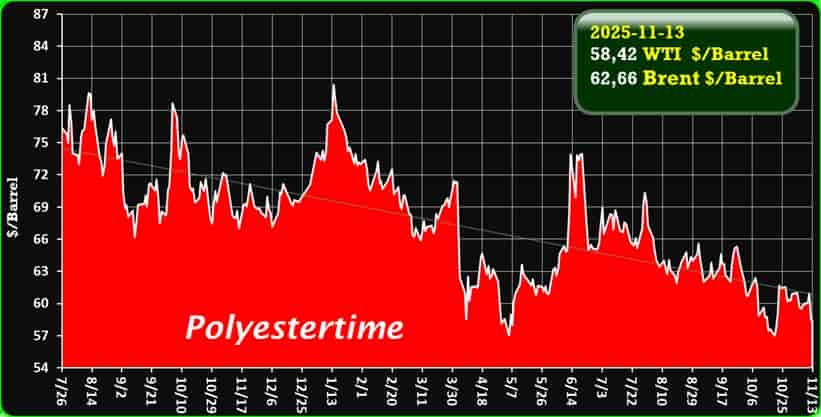
Oil price heads downward amid supply glut: Brent at $62.66, WTI at $58.42 as global outlook turns bearish 13-11-2025
Current oil price snapshot
Today, 13 November 2025, the headline crude price metrics show:
| Benchmark | Price (USD per barrel) |
|---|---|
| Brent (global benchmark) | $62.66 |
| WTI (US benchmark) | $58.42 |
These levels reflect the latest moves in crude markets, as sentiment turns cautious.
Why the drop in oil price?
Oversupply pressures
The main driver behind the falling oil price is mounting supply. The Energy Information Administration (EIA) has increased its forecast for U.S. oil production in 2025, projecting an output level of around 13.59 million barrels per day, up from previous estimates. Reuters+2Energy Connects+2
Globally, production is estimated at about 106 million barrels per day, while demand is nearer 104.1 million bpd — leaving a surplus in the system. Reuters+1
Additionally, the Organization of the Petroleum Exporting Countries (OPEC) now forecasts the market will be balanced in 2026, a shift from its earlier view of a deficit — further pressuring expectations. Angel One+1
Weak demand signals
At the same time, demand looks fragile. Rising inventories in the U.S., for example an unexpected crude stockpile build of 1.3 million barrels for the week ended 7 Nov flagged weaker near-term consumption. Reuters
When supply keeps rising and demand fails to keep pace, the crude price tends to slip, which is what we are seeing.
What this means for markets and consumers
The current dip in the oil price has several implications:
-
For consumers and motorists, a lower oil price could forecast cheaper fuels ahead, easing inflationary pressure.
-
For energy producers and oil-exporting nations, margins may shrink and budgets may come under pressure if the oil price remains depressed.
-
For investors in the commodity and energy sector, the shift in sentiment (from tight market to surplus) may prompt re-allocation of risk.
Outlook: What’s next for the oil price?
While the oil price at ~$62.66 (Brent) and ~$58.42 (WTI) reflects current caution, several variables could shift the trajectory:
-
Geopolitical risks (e.g., supply disruptions) could tighten the market and push the oil price up.
-
Demand surprises (for example from China or other major consumers) could reduce the surplus and support higher levels.
-
Conversely, if inventories continue to build and major producers keep output elevated, the oil price may face further downward pressure.
Analysts suggest a stabilisation around the ~$60‐per‐barrel range for Brent may be possible absent major shocks. Reuters+1
Summary
In summary, the current oil price environment is on the back foot: Brent at ~$62.66, WTI at ~$58.42 on 13 November 2025. Markets are reacting to a combination of rising supply, weaker demand signs, and revised forecasts by major agencies. For web readers, it’s important to track how these macro drivers evolve. For mobile users, this article is structured in short clear paragraphs, a table for fast reference, and semantic-rich headings that improve readability and machine-understanding by large language models.