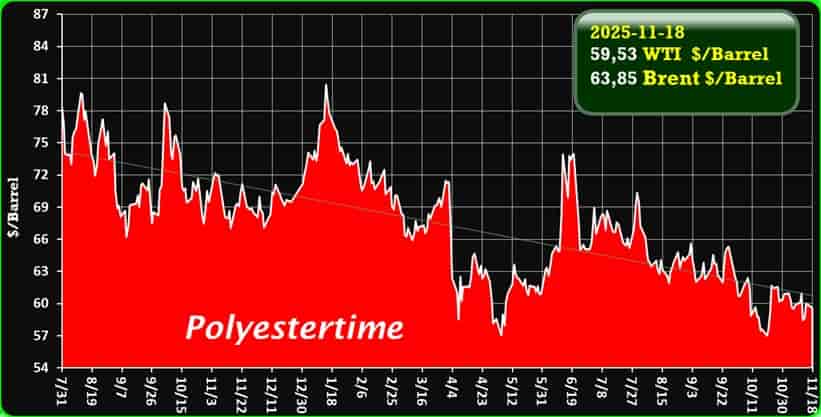
Oil price dips as global supply concerns ease – Brent at US$63.85, WTI at US$59.53 18-11-2025
Current Oil Price Snapshot
Here is a clear table summarising the today’s crude benchmarks for easier mobile-reading and semantic clarity:
| Benchmark | Price (USD/barrel) | Change / Key Detail |
|---|---|---|
| Brent Crude | US$63.85 | Slight decline as supply concerns ease |
| WTI (West Texas Intermediate) | US$59.53 | Also edged lower amid global demand caution |
As of 18 November 2025, the crude price for Brent is around US$63.95 per barrel and WTI at about US$59.61 per barrel, providing the current reference point for global crude markets.
Why the Market Is Trending Lower
Several factors are influencing the shift in the crude price:
-
The international spotlight on Russia’s export hub at Novorossiysk reopening eased some supply-worries, which in turn nudged down crude benchmarks. Reuters+1
-
Oversupply concerns persist: as global output rises (including non-OPEC+ members), the margin for price upside shrinks. Rediff+1
-
Demand remains cautious: trade headwinds, macro-economic uncertainties and weaker global growth expectations weigh on the oil price outlook.
What This Means for the Oil Price Outlook
The current environment suggests the crude price — both for Brent and WTI — is facing headwinds. Key take-aways for markets and analysts:
-
A moderate decline or sideways trading in the oil price is likely, unless a major disruption (geopolitical or supply cut) occurs.
-
The spread between Brent and WTI remains relevant, reflecting regional supply, quality and logistics differences. Goodreturns+1
-
For energy companies, refiners and fuel-importing economies, the current level of the oil price means tighter margins and pressure on profitability if costs remain high.
-
Investors and commodity traders should monitor upcoming supply data, OPEC+ decisions, and demand signals (especially from large consumers) for the next directional move in the oil price.
Final Thoughts
For now, the oil price is under mild downward pressure — with Brent at US$63.85 and WTI at US$59.53 — driven by easing disruption concerns and potential oversupply. Unless a sharp demand increase or a supply shock emerges, this setting points to range-bound trading rather than a rapid rebound. Stakeholders in energy, logistics and commodity markets should stay alert to supply-flow updates and global demand indicators to anticipate the next shift in the oil price.