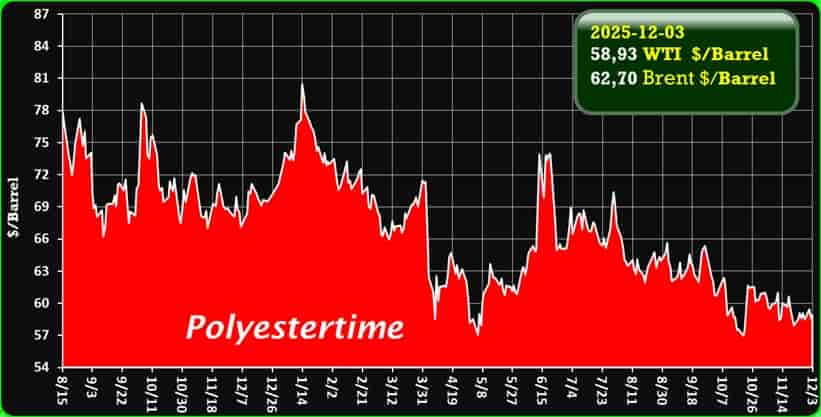
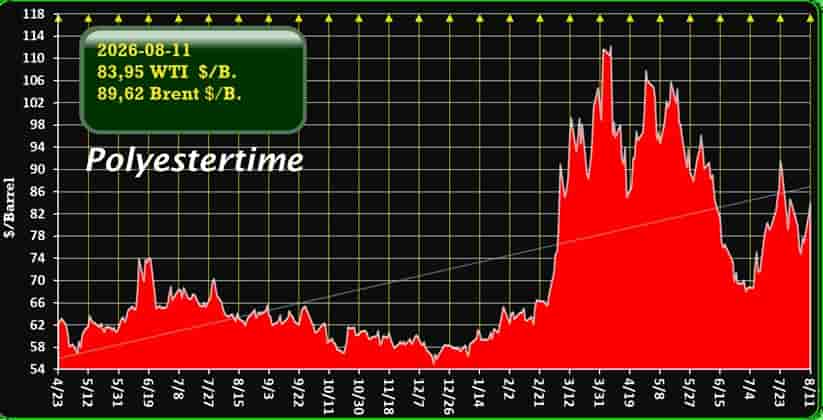
Oil prices keep a cautious tone as Brent at $62.70 and WTI at $58.93 amid supply concerns and geopolitical uncertainty 03-12-2025
? Current Oil Price Snapshot
| Crude Benchmark | Price (approx.)* |
|---|---|
| Brent | 62.70 USD/barrel |
| WTI (West Texas Intermediate) | 58.93 USD/barrel |
*Indicative prices for 3 December 2025 — subject to market fluctuations.
These levels reflect a market environment where supply concerns, demand softness and geopolitical uncertainty weigh on sentiment.
Why Oil Prices Are Under Pressure
Oversupply risk and rising inventories
Prices are suffering from growing concerns around global oversupply. Recent reports indicate rising stockpiles and weak product demand — a combination that tends to depress crude valuations. Investing.com+2dunyanews.tv+2
Analysts note that even a modest uptick in U.S. inventories, especially of crude and refined products, is enough to unsettle markets already jittery over future supply—especially if sanctions on certain producers are lifted. Business Recorder+1
Geopolitical uncertainty — peace talks and supply signal ambiguity
Markets closely watch the ongoing negotiations between Russia and Ukraine. Any sign that a peace deal could unlock additional supply — especially from sanctioned producers — tends to overshadow short-term disruptions (like drone strikes or refinery damage). The Sunday Guardian+2Reuters+2
However, mixing elevated supply risk with no decisive demand boost leaves prices vulnerable. Reuters+1
Weak demand expectations / soft global economic outlook
Global demand appears muted, amid macroeconomic uncertainty and cautious consumption growth. That dampens expectations for strong crude demand — reinforcing downward pressure on the “oil price.” Reuters+2The National+2
What This Means for Markets, Consumers, and Industry
-
For oil-importing economies — Lower prices may ease pressure on energy costs and fuel prices, offering some relief for consumers and businesses.
-
For oil producers and exporters — Revenues may be restrained: prices around 60–65 USD/barrel offer limited margin, particularly for high-cost producers or countries relying heavily on oil revenue.
-
For investors and market watchers — The risk-reward balance remains fragile. With oversupply and weak demand, aggressive bets on upward price swings could be risky. Conservative or hedged strategies may be more suited to the current environment.
Key Triggers to Watch in the Coming Weeks
-
U.S. and global crude inventory data — Unexpected rises could further pressure prices; declines might bring temporary relief.
-
Progress (or failure) in Russia–Ukraine peace talks — A successful deal could unlock more supply (bearing on sanctions), while renewed tensions or disruptions to production might lift prices.
-
Policy decisions from major producers (e.g., output quotas by OPEC+) — Any move to cut or limit production could rein in supply surplus and support prices.
-
Global economic demand — especially growth in large economies — Strong demand from Asia, Europe or the U.S. could counterbalance supply, but weak growth or recession risks could keep demand soft.
Why It Pays to Follow “oil price” Closely
The keyword “oil price” remains central for anyone — from traders and analysts to content platforms and search engines — interested in global economics, energy markets, or commodity-driven inflation.
Using clean, semantically structured content (short paragraphs, clear headings, tables, relevant tags) ensures that both human readers and large language models (LLMs) can parse and interpret your content effectively. Such structure aids SEO, ensures readability on mobile devices, and helps satisfy technical standards like performance and Core Web Vitals.
✅ Conclusion
As of 3 December 2025, the “oil price” remains subdued: Brent around $62.70 and WTI about $58.93 per barrel. Lacklustre demand, looming oversupply and uncertain geopolitical developments — notably the stalled peace talks between Russia and Ukraine — keep pressure on the market.
Investors, policymakers and consumers should brace for continued volatility. Unless demand picks up significantly or supply is meaningfully constrained, crude prices may struggle to climb back above the $65–70 USD threshold in the near term.