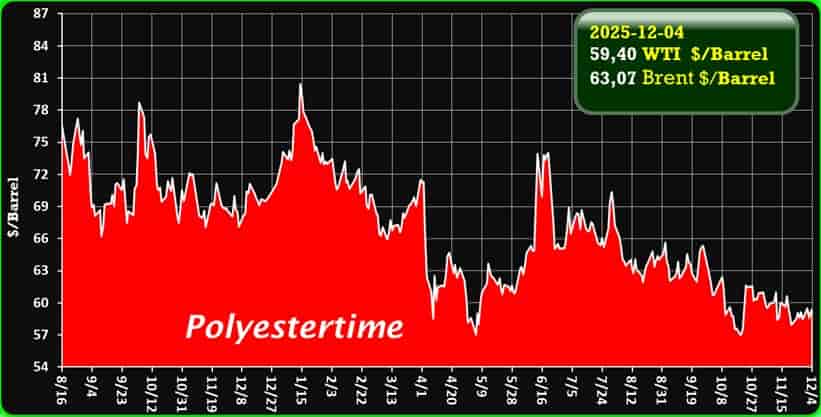
Oil Price Edges Up on Geopolitical Tension — Brent at $63,07, WTI at $59.40 Amid Supply Risks and Market Uncertainty 04-12-2025
Oil Prices Today: Figures at a Glance
| Benchmark | Price (USD/barrel) — 04 Dec 2025 |
|---|---|
| Brent | $63,07 |
| WTI | $59.40 |
These levels reflect a modest uptick compared with recent trading and underline the fragile equilibrium in the global oil market.
What’s Driving the Recent Rise?
• Geopolitical Tensions and Supply Disruptions
The recent escalation comes after renewed strikes on Russian energy infrastructure by Ukraine, prompting supply-concern fears that have added upward pressure to prices. Reuters+1
Though the pipelines are reported to be functioning normally, analysts warn that repeated disruptions have already lowered refining throughput—reducing global supply. Reuters
• Benchmark Confidence: Why Brent Still Matters
Brent crude remains the domestic (global) benchmark for much of the world’s crude trades, thanks to its liquidity and global acceptance. Wikipedia+2oil-price.net+2
Even as supplies wobble and uncertainty rises, most stakeholders still rely on Brent as a reference — which helps explain why its quoted price stays tight even amid volatility.
• Supply, Demand, and the Bearish Undercurrent
Despite the short-term bump, long-term fundamentals remain weak. Oversupply and tepid demand growth continue to cap the upside potential. Reuters+2The Economic Times+2
As of late 2025, analysts forecast that the market may remain under pressure through 2026, with surplus supply likely to outpace demand growth. Reuters+1
What Analysts Are Saying: Mixed Signals Ahead
-
Some believe the combination of frequent supply disruptions and geopolitical uncertainty could support oil prices — at least in the short term — by introducing a “risk premium.” Reuters+1
-
Others warn that structural oversupply, stagnant global demand, and evolving energy transitions (e.g. renewables, efficiency) will exert downward pressure on prices over the coming months. JPMorgan+2The Economic Times+2
-
According to a recent consensus, while 2025 has seen Brent averaging lower than previous years, 2026 could bring still weaker price levels if global demand does not rebound. Reuters+1
What This Means — For Consumers, Businesses, and Investors
-
For businesses relying on energy (transport, manufacturing, logistics) — the modestly elevated oil prices may mean slightly higher input and shipping costs, which could filter into consumer prices.
-
For consumers, while a $62–$63 Brent does not translate directly into pump prices in Europe, any prolonged increase could affect fuel and heating bills.
-
For investors, the oil market remains precarious: supply-disruption risk offers potential short-term gains, but fundamentals suggest caution. Hedging strategies might still make sense, given volatility.
Looking Ahead: What to Watch
-
Continued geopolitical developments, especially in Russia, Ukraine, or other oil-producing regions — repeated strikes or sanctions may push prices up.
-
Global demand trends, especially in large economies such as China or India; demand slowdown or strong uptake of alternative energy could sway prices significantly.
-
Decisions from major producers, notably OPEC+, including production quotas or output cuts, which remain among the most influential supply-side levers. FXStreet+1
-
Macro-economic factors: inflation, global growth forecasts, and consumer demand — all tied to how energy demand evolves going into 2026.
Conclusion
As of December 4, 2025, the oil price — with Brent at $63,07 and WTI at $59.40 — reflects a market at a crossroads: temporary relief from supply fears and geopolitical tensions, but still anchored to an environment of global oversupply and weak demand growth.
This dual dynamic creates a challenging landscape for businesses, consumers, and investors alike. In short: for now, oil markets remain volatile — and watching the interplay between supply shocks, global demand, and policy changes will be key to understanding what comes next. oil price