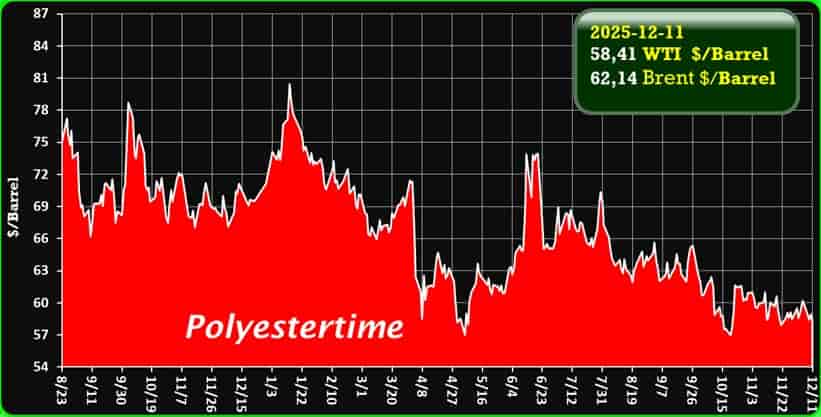
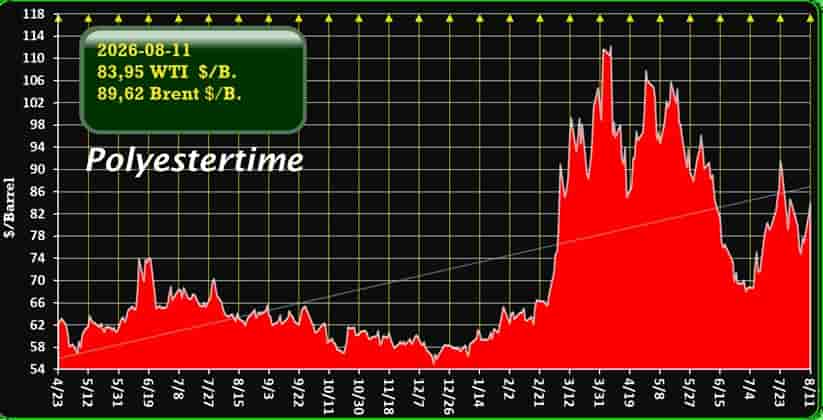
Oil Price – Global Oil Slips Slightly on Oversupply Worries and Peace Prospects: Brent at $62.14, WTI at $58.41 per Barrel Risk Further Declines 11-12-2025
? Today’s Oil Price — Where Things Stand
As of 11 December 2025, major crude benchmarks trade at the following prices:
These levels reflect a modest rise compared with the recent dip — but underlying pressures on the market remain strong and may weigh further on prices.
What’s Pressuring Prices: Oversupply, Weak Demand, and Tension
?️ Oversupply Risk: A “Super Glut” in Sight
Global analysts warn the oil market is heading toward a significant oversupply in 2026. Nasdaq+2Reuters+2 The combination of surging production and weak demand growth could lead to a “super glut,” putting substantial downward pressure on crude prices. Bloomberg+2Quantum Commodity Intelligence+2
This imbalance is pushing refiners to pull back, as the crack spread — the margin between crude oil and refined products — weakens. Nasdaq+1
? Demand Softness and Economic Weakness
Despite increasing output, global demand growth remains muted, contributing to the expected oversupply. Reuters+1 In such context, even modest economic headwinds — slower growth in major consuming regions or energy demand shifts — could amplify the downward pressure on prices. Oil Price
⚠️ Geopolitics and Market Uncertainty
On the geopolitical front, recent developments are feeding volatility. Oil Price
The seizure by the U.S. of an oil tanker off Venezuela’s coast has stirred concerns over supply disruption — a factor that briefly supported prices. Morningstar+2Reuters+2
At the same time, markets remain alert to evolving tensions around supply chains involving sanctioned crude from Russia, Iran, and Venezuela — a backdrop that keeps a risk premium alive even amidst oversupply concerns. Reuters+2The Wall Street Journal+2
What Analysts Expect for 2026
-
According to a recent industry consensus, average crude prices next year could drop further: Brent around $62.23/barrel, WTI close to $59/barrel. Reuters+1
-
A substantial oversupply — potentially millions of barrels per day — may prevent a quick recovery unless consumption rises sharply or producers implement meaningful output cuts. Reuters+2Quantum Commodity Intelligence+2
-
Geopolitical risk remains the “wild card”: sanctions, export restrictions or supply disruptions could temporarily support prices, but the dominant driver appears structural oversupply for now. Reuters+2OilPrice.com+2
What This Means for Consumers, Markets, and Policy
-
For consumers: Lower oil prices may translate — eventually — into slightly lower fuel and energy costs. That could be a relief for households and businesses sensitive to energy bills.
-
For oil producers and commodity investors: A prolonged period of depressed prices could squeeze margins, particularly for high-cost production regions. Long-term investments might become less attractive, and there could be pressure for consolidation or cost-cutting.
-
For global energy policy and markets: Countries dependent on oil revenue may face budget strains. Conversely, lower crude prices could support economic activity in import-dependent economies, but the volatility and uncertainty remain a challenge.
✅ Conclusion: Near-Term Stability but Long-Term Caution
The current oil price — Brent near $62.14 and WTI near $58.41 — reflects a delicate equilibrium: moderate support from geopolitical tug-of-war, weighed down by fundamental supply/demand imbalance and looming oversupply.
Unless demand surprises on the upside or major producers agree on output cuts, the consensus suggests a modest or downward drift in prices in 2026. For stakeholders — from consumers to investors — the message is clear: proceed with caution, and monitor how supply gluts and geopolitical developments evolve.