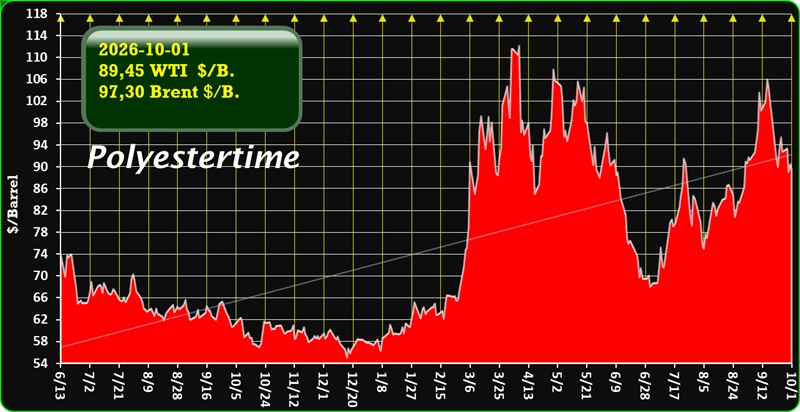
Oil price volatility shakes global markets as Brent holds near $100 and WTI fluctuates amid geopolitical risks, supply shocks, and fragile investor confidence
Oil price trend today: volatility defines March 2026 energy markets
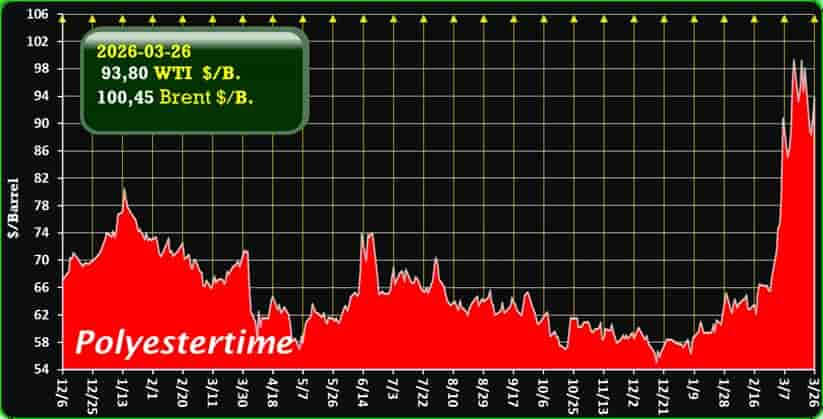
The oil price continues to dominate global financial headlines as markets navigate a volatile mix of geopolitical tension, supply disruptions, and shifting economic signals. As of March 26, 2026, Brent crude is trading broadly in the $95–$105 per barrel range, while West Texas Intermediate (WTI) fluctuates between $90 and $100 per barrel, reflecting a fragile equilibrium between risk and fundamentals.
Recent sessions have seen sharp swings. Brent briefly surged above $110 earlier this week before retreating toward the mid-$90s, while WTI dropped below $90 following easing geopolitical fears before rebounding again . This pattern underscores how sensitive the oil price is to headlines rather than purely structural supply-demand dynamics.
Current oil price snapshot
| Benchmark | Price Range (USD/bbl) | Recent Trend | Key Driver |
|---|---|---|---|
| Brent Crude | 95 – 105 | Volatile, slightly downward | Geopolitical risk premium easing |
| WTI Crude | 90 – 100 | Highly reactive | US market dynamics, export flows |
| Brent-WTI Spread | ~8 – 12 | Elevated | Global vs domestic supply imbalance |
The widening spread reflects stronger geopolitical exposure for Brent, which is more sensitive to disruptions in seaborne crude flows, particularly through the Strait of Hormuz .
Key drivers shaping the oil price today
1. Geopolitical tensions and supply disruption
The dominant force behind the current oil price remains the Middle East crisis. The Strait of Hormuz—through which roughly 20% of global oil flows—has experienced severe disruption, creating one of the largest supply shocks in modern energy markets .
Even partial reopening of shipping routes has reduced immediate panic, but the market still prices in a significant “risk premium.” Temporary ceasefire proposals or pauses in military action have triggered sudden price drops, showing how quickly sentiment can shift .
2. Global supply and OPEC+ strategy
OPEC+ continues to act as a stabilizing—but also constraining—force on supply. Production discipline and potential quota adjustments remain critical levers influencing the oil price.
With Middle East output reduced by millions of barrels per day due to conflict-related disruptions, spare capacity is limited. At the same time, non-OPEC supply growth (especially US shale) has not been sufficient to fully offset losses, keeping the market tight.
3. Demand outlook and economic signals
On the demand side, the oil price is increasingly influenced by macroeconomic uncertainty.
- Rising interest rates in major economies are dampening consumption expectations
- Inflation concerns linked to energy costs are resurfacing
- Emerging markets, particularly in Asia, remain highly sensitive to higher import costs
Recent warnings from central banks highlight that sustained high oil prices could trigger renewed inflationary pressure, potentially slowing global growth .
4. Investor sentiment and market psychology
Investor sentiment has become a decisive short-term driver of the oil price. Markets are oscillating between:
- Fear of supply shortages → pushing prices higher
- Hope for de-escalation → triggering sharp corrections
This has created a highly reactive trading environment where geopolitical headlines can move prices by 5–10% in a single session. Analysts note that despite occasional pullbacks, prices are unlikely to fall sustainably below $90 due to underlying supply constraints .
Oil price and inflation: who benefits?
High oil prices are traditionally associated with inflationary pressure, particularly in energy-importing regions such as Europe. However, some economies—like India—may partially benefit through refining margins, export dynamics, or currency effects, echoing themes seen in recent economic commentary.
Globally, the relationship between oil price and inflation is once again central:
- Higher fuel costs increase transportation and production expenses
- Consumer prices rise, reducing purchasing power
- Central banks respond with tighter monetary policy
This feedback loop is already visible in expectations of further rate hikes in advanced economies.
Short-term outlook for the oil price
Looking ahead, the oil price is expected to remain range-bound but volatile, with Brent likely oscillating between $90 and $110 per barrel in the near term.
Key scenarios to watch:
- Bullish case: renewed escalation in the Middle East → supply shock → prices above $110
- Base case: continued uncertainty with partial supply normalization → stabilization near $95–$105
- Bearish case: sustained diplomatic progress → reduced risk premium → prices closer to $85–$90
Market consensus suggests that while extreme spikes may ease, structural tightness will prevent a sharp collapse in prices.
What this means for the global economy
The current oil price environment signals a fragile balance for the global economy. Elevated energy costs risk:
- Slowing economic growth
- Sustaining inflation pressures
- Increasing volatility across financial markets
At the same time, energy markets are entering a phase where geopolitics and supply security outweigh traditional fundamentals.
Final takeaway
The oil price in March 2026 reflects a market driven less by equilibrium and more by uncertainty. With Brent and WTI hovering near critical psychological levels, the direction of prices will depend heavily on geopolitical developments and policy responses.
In the short term, volatility—not stability—remains the defining feature of the global oil market.
Oil Price Volatility Eases Slightly as Ceasefire Hopes Cool Supply Fears but Markets Remain Tense Amid Global Uncertainty and Demand Signals
More…