Infinite Loop Europe accelerates circular economy with landmark PET recycling investment at BASF Schwarzheide, boosting jobs, innovation and low-carbon materials in Europe 19-02-2026
PET recycling Europe
Infinite Loop Europe invests in PET recycling plant at BASF Schwarzheide, Germany
Infinite Loop Europe has selected the BASF site in Schwarzheide, Germany, for the development of its first European PET recycling facility. The project represents a strategic step forward for PET recycling in Europe and signals growing industrial commitment to the circular economy.
The majority stakeholder of Infinite Loop Europe, Reed – Societe Generale Group, confirmed the site selection as a milestone in the company’s ambition to deploy large-scale PET recycling infrastructure across Europe. The facility will operate within Industriepark Lausitz, managed by BASF InfraService & Solutions Lausitz GmbH, and will leverage the site’s established industrial ecosystem. PET recycling Europe
Strategic location within BASF’s integrated industrial infrastructure
By locating the PET recycling plant at Schwarzheide, Infinite Loop Europe gains access to BASF’s integrated infrastructure, utilities and industrial services. This integration is expected to streamline construction, commissioning and long-term operations while reducing execution risk.
BASF InfraService & Solutions Lausitz GmbH, as site operator, will support the project with technical services and industrial integration. The move strengthens Industriepark Lausitz as a hub for circular economy projects and advanced materials innovation. PET recycling Europe
The collaboration highlights how established chemical infrastructure can accelerate next-generation PET recycling investments in Europe.
Advanced depolymerisation technology for virgin-equivalent quality
The new plant will use Loop Industries’ depolymerisation technology, which has already been demonstrated at commercial scale in Terrebonne, Canada. This process breaks down post-consumer PET and polyester fibres into their base monomers, enabling the production of virgin-equivalent recycled PET.
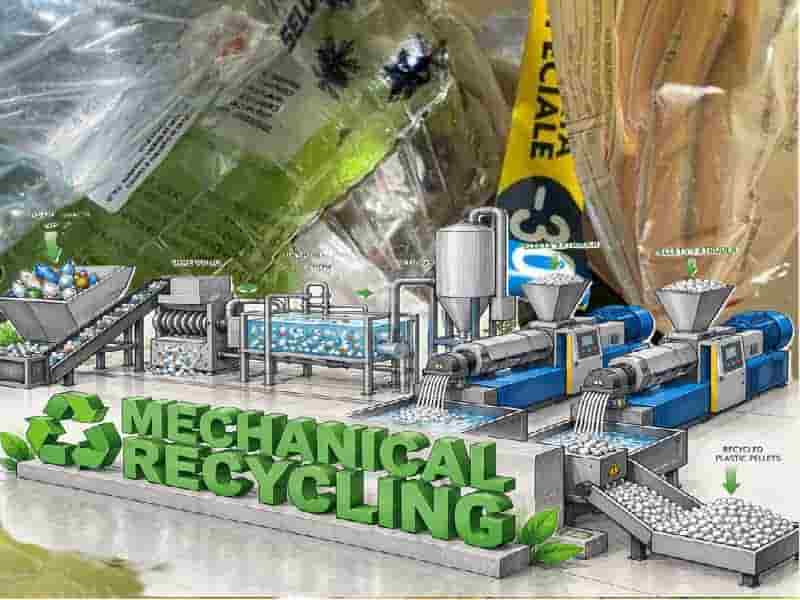
Unlike conventional mechanical recycling, depolymerisation allows the facility to process low-value or difficult-to-recycle PET waste that would otherwise be incinerated or landfilled. The resulting recycled material will meet high-performance requirements for demanding applications. PET recycling Europe
According to the company, output will be suitable for textiles such as white curtains, as well as food-grade and pharma-grade packaging. This positions the Schwarzheide plant as a key contributor to high-quality PET recycling in Europe, where regulatory and brand-owner demand for recycled content continues to grow.
Capacity, investment and job creation
The Germany-based facility is expected to reach an annual production capacity of 70,000 tonnes of recycled material. Commissioning is targeted for 2030.
Infinite Loop Europe is investing a triple-digit million euro amount in the project, underlining the scale and long-term industrial commitment behind this PET recycling initiative in Europe.
Beyond environmental benefits, the project will create approximately 150 direct skilled jobs on site. The investment therefore contributes not only to the circular economy but also to regional economic development in Brandenburg and the broader German chemicals sector. PET recycling Europe
Significant CO₂ reduction potential
A central argument for advanced PET recycling in Europe is its potential climate impact. Infinite Loop Europe states that its process can avoid up to five tonnes of CO₂ emissions for every tonne of recycled PET produced, compared with fossil-based production routes. PET recycling Europe
By converting post-consumer PET and polyester waste into high-quality recycled feedstock, the facility supports the gradual shift away from virgin fossil raw materials in the European chemical industry. This aligns with EU climate targets and broader decarbonisation strategies across packaging and textiles value chains.
In practical terms, the project addresses waste streams that currently have little or no recycling value. Diverting such materials from incineration or landfill directly improves resource efficiency and reduces lifecycle emissions.
Backing from Reed – Societe Generale Group
The development is supported by Reed – Societe Generale Group through its Reed Circular Economy platform. The platform focuses on financing and accelerating large-scale circular infrastructure across Europe.
The Schwarzheide project reflects a build-to-core strategy aimed at developing critical infrastructure assets and integrating them into long-term industrial portfolios. By partnering with established site operators, technology providers and recycling platforms, the group seeks to de-risk complex industrial projects while scaling innovative technologies. PET recycling Europe
This approach is particularly relevant for PET recycling in Europe, where capital intensity, feedstock security and regulatory compliance can pose significant challenges.
European policy momentum for plastics recycling
The investment comes at a time when the European Commission is increasing support for plastics recycling. In December 2025, the Commission announced pilot actions to create common EU-wide rules for plastics recycling, forming part of broader measures to revitalise the sector. PET recycling Europe
Harmonised standards and clearer regulatory frameworks are expected to benefit advanced PET recycling projects in Europe by providing legal certainty, strengthening demand for recycled content and improving market transparency. PET recycling Europe
As regulatory pressure increases on packaging producers to incorporate recycled materials, high-quality recycled PET from chemical recycling technologies could play an increasingly strategic role.
Strengthening the circular economy at Industriepark Lausitz
For BASF InfraService & Solutions Lausitz GmbH, the arrival of Infinite Loop Europe reinforces the circular economy as a central strategic growth area. The Schwarzheide site has a long industrial legacy, and the addition of advanced PET recycling capacity enhances its resilience and future relevance. PET recycling Europe
The project strengthens the existing industrial ecosystem at Industriepark Lausitz, creates new synergies and supports the development of a modern, sustainable materials cluster. By combining established chemical infrastructure with innovative recycling technology, the site evolves toward a more circular industrial model.
Why this project matters for PET recycling in Europe
The Schwarzheide facility represents more than a single plant. It demonstrates how financial institutions, technology providers and industrial operators can collaborate to scale PET recycling in Europe.
Key impacts include:
-
Industrial-scale production of virgin-equivalent recycled PET
-
Diversion of low-value PET waste from incineration and landfill
-
Reduction of lifecycle CO₂ emissions
-
Creation of skilled industrial jobs
-
Reinforcement of Europe’s circular economy infrastructure
As brands and regulators push for higher recycled content in packaging and textiles, advanced chemical recycling technologies are likely to complement mechanical recycling. Together, these approaches can increase overall PET recycling rates in Europe and reduce dependence on fossil feedstocks.
With a targeted launch in 2030, Infinite Loop Europe’s investment at BASF Schwarzheide marks a decisive step toward building robust, large-scale PET recycling capacity in Europe, aligned with climate goals and industrial competitiveness. PET recycling Europe
More…