Recyclable biobased polymers outperform common plastics
Recyclable biobased polymers could outperform common plastics
A new generation of recyclable biobased polymers may help solve one of the toughest problems in sustainable materials: how to make plastics that are both high-performing and easier to return to useful chemical building blocks.
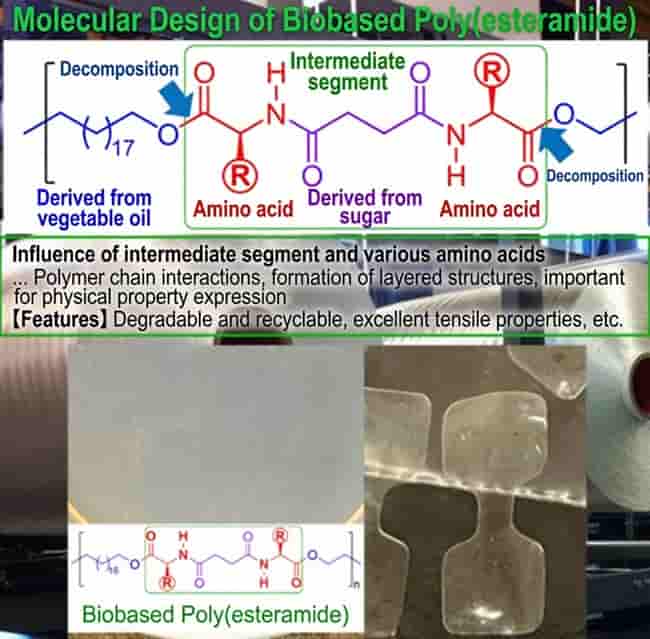
Researchers led by Professor Kotohiro Nomura at Tokyo Metropolitan University, working with Osaka Research Institute of Industrial Science and Technology and the University of Shiga Prefecture, have developed biobased poly(ester amide)s made from non-edible renewable resources, including plant oils, amino acids and sugars. According to the research announcement published on July 7, 2026, the materials show tensile performance in film form that can exceed commodity plastics such as polyethylene and polypropylene.
Why this matters
Most everyday plastics are valued because they are cheap, durable and mechanically reliable. The problem is that those same strengths often make them difficult to recycle cleanly, especially when products contain additives, mixed materials or contamination.
Biobased plastics have been promoted as an alternative, but many still face a performance gap. A material that is renewable but mechanically weak will struggle to replace established plastics in packaging, films, coatings or durable products.
That is why this new work is important. It does not simply present a plant-derived polymer. It focuses on a more demanding target: recyclable biobased polymers with tensile strength and elongation properties that compete with, and in some cases go beyond, conventional polyolefins.
What the researchers developed
The new materials are poly(ester amide)s, a class of polymers that combine ester and amide bonds in the same backbone. This structure is useful because it can balance flexibility, strength and degradability depending on how the monomers are selected.
In this case, the team used building blocks from plant oils, amino acids and sugars. These are not food-grade resources, which is important because sustainable materials should avoid competing directly with food supply chains.
The polymers were produced using catalytic olefin metathesis polymerization, a method that enables the formation of high-molecular-weight polymer chains. High molecular weight is critical because it strongly affects mechanical performance. In practical terms, longer and better-controlled chains can help a film resist breaking while still allowing useful stretching.
Stronger films, cleaner circularity
The most eye-catching claim is mechanical: the developed films showed excellent tensile strength and strain at break compared with common plastics such as polyethylene and polypropylene. These are the benchmark materials used across large parts of the packaging and consumer goods industries.
The second major claim is circularity. The polymers can be chemically recycled through catalytic transesterification, a reaction with alcohol that breaks the polymer back down into starting organic compounds. This means the material is designed not only for initial use, but also for recovery at the end of life.
That distinction matters. Mechanical recycling often downgrades plastic quality, while chemical recycling aims to recover molecular building blocks that can be reused. The challenge is making that process efficient, selective and economically realistic.
A self-healing feature adds another layer
One version of the polymer containing phenylalanine also showed fast self-healing properties at ambient temperature. Self-healing polymers are attractive because they could extend product life, reduce waste and make materials more resilient during use.
This does not mean the material is ready to replace all commercial plastics immediately. Scale-up, processing behavior, cost, durability, safety evaluation and real-world recycling infrastructure still need to be assessed. But the combination of strong tensile properties, renewable feedstocks and chemical recyclability makes the discovery highly relevant for circular material design. recyclable biobased polymers
The wider context: green chemistry is moving fast
The timing is notable. On July 6, 2026, the American Chemical Society announced its 2026 Green Chemistry Challenge Award winners, recognizing advances including recyclable polyurethanes, biodegradable polymers, PFAS-free cooling fluids and other safer chemistry innovations.
This shows that polymer innovation is moving beyond simple “bio-based” claims. The strongest research now targets a fuller set of requirements: safer feedstocks, high performance, recyclability, reduced toxicity and compatibility with circular economy systems.
Recent scientific reviews also underline why poly(ester amide)s are attracting attention. Their properties can be tuned through the choice and arrangement of ester and amide bonds, while biobased sources such as amino acids, polysaccharides and plant oils give chemists multiple design routes.
What could this mean for industry?
If recyclable biobased polymers like these can be scaled, they could become candidates for flexible films, coatings, specialty packaging, adhesives or other applications where strength and circularity must work together.
The key opportunity is not just replacing fossil carbon with renewable carbon. It is designing polymers from the beginning so they can perform well during use and be chemically recovered after use.
For manufacturers, that could support lower-waste material loops. For policymakers, it could strengthen circular economy strategies. For consumers, it could eventually mean products that are durable, renewable and less likely to become permanent waste.
What to watch next
The next step is proof beyond the laboratory. Researchers and companies will need to test processing at industrial scale, life-cycle impacts, recycling efficiency, cost, and compatibility with existing manufacturing lines.
Still, the direction is clear. The future of sustainable plastics will not be won by materials that are merely “green” in origin. It will be won by materials that combine renewable sourcing, strong performance, safe chemistry and credible end-of-life recovery.
The Japanese team’s recyclable biobased polymers are a strong example of that shift: plant-derived, chemically recyclable and designed to challenge some of the most widely used plastics in the world.
More…