Jyoti World Presents a Recycled Polymer Ecosystem at GCPRS 2026 – Polymer Price Trends
Recycled polymer ecosystem – Full price table (20/07/2026 →27/07/2026)
| ITEM | 20/07/2026 | 27/07/2026 | +/− |
|---|---|---|---|
| Bottle grade PET chips domestic market | 7,530 yuan/ton | 7,300 yuan/ton | -230 |
| Chinese bottle-grade PET chips FOB export price | 1,000 $/ton | 1,000 $/ton | – |
| LDPE CFR Est China | 1,200 $/ton | 1,140 $/ton | -60 |
| PET Semidull — Fiber chips | 7,100 yuan/ton | 6,950 yuan/ton | -150 |
| PET Bright — Fiber chips | 7.150 yuan/ton | 6,950 yuan/ton | -200 |
| Pure Terephthalic Acid PTA domestic market | 6,050 yuan/ton | 5,860 yuan/ton | +190 |
| Pure Terephthalic Acid PTA FOB China | 815 $/ton | 790 $/ton | -25 |
| Monoethyleneglycol (MEG) South China | 4,971 yuan/ton | 5,048 yuan/ton | +77 |
| Monoethyleneglycol (MEG) CFR China | 605 $/ton | 600 $/ton | -5 |
| Paraxylene PX FOB Taiwan market | 1,043 $/ton | 1,094 $/ton | +51 |
| Paraxylene PX FOB South-Korea market | 1,032 $/ton | 1,083 $/ton | +51 |
| Paraxylene PX FOB EU market | 1,291 $/ton | 1,341 $/ton | +50- |
| Polyester filament POY 150D/48F domestic market | 8,400 yuan/ton | 8,600 yuan/ton | +200 |
| Recycled Polyester filament POY 150/48F domestic market | 7,000 yuan/ton | 7,200 yuan/ton | +200 |
| Polyester filament DTY 150D/48F domestic market | 9,400 yuan/ton | 9,550 yuan/ton | +150 |
| Polyester filament FDY 68D/24F | 9,200 yuan/ton | 9,400 yuan/ton | +200 |
| Polyester filament FDY 150D/96F domestic market | 8.550 yuan/ton | 8,750 yuan/ton | +200 |
| Polyester staple fiber 1.4D 38mm domestic market | 7,650 yuan/ton | 7,480 yuan/ton | -170 |
| Caprolactam (CPL) domestic market | 11,950 yuan/ton | 12,500 yuan/ton | +550 |
| Caprolactam (CPL) CFR China | 1,5 $/ton | 1,510 $/ton | +10 |
| Nylon 6 chips overseas market | North America — US$ 2.67/kg
Europe — US$ 2.12/kg Northeast Asia — US$ 1.73/kg Southeast Asia — US$ 1.76/kg Middle East — US$ 1.82/kg |
China Export (FOB China / CFR Asia) $1,6 80 – $1,730 / MT Southeast Asia (CFR) $1,730 – $1,780 / MT Engineering Plastics (FOB Asia) $1,700 – $1,850 / MT Europe (Germany Delivered) $2,120 / MT North America (USA Delivered) $3,132 / MT
|
– |
| Nylon 6 chips conventional spinning domestic market | 12,150 yuan/ton | 12,600 yuan/ton | +450 |
| Nylon 6 chips high speed spinning domestic market | 12,400 yuan/ton | 12,800 yuan/ton | +400 |
| Nylon 6.6 chips domestic market | 16,500 yuan/ton | 16,200 yuan/ton | -300 |
| Nylon6 Filament POY 86D/24F domestic market | 13,400 yuan/ton | 14,000 yuan/ton | +600 |
| Nylon6 Filament DTY 70D/24F domestic market | 15,800 yuan/ton | 16,100 yuan/ton | +300 |
| Nylon6 Filament FDY 70D/24F | 13,600 yuan/ton | 14,100 yuan/ton | +500 |
| Spandex 20D domestic market | 31,700 yuan/ton | 31,700 yuan/ton | – |
| Spandex 30D domestic market | 31,200 yuan/ton | 31,200 yuan/ton | – |
| Spandex 40D domestic market | 28,500 yuan/ton | 28,500 yuan/ton | – |
| Adipic Acid China domestic market | 7,900 yuan/ton | 8,200 yuan/ton | +300 |
| Adipic Acid Europe market | 1,77 $/ton | 1,77 $/ton | – |
| Benzene domestic market East China | 8,500 yuan/ton | 8,000 yuan/ton | -500 |
| Benzene CFR China | 967 $/ton | 985 $/ton | +18 |
| Ethylene South East market | 840 $/ton | 920 $/ton | +80 |
| Ethylene NWE market CIF | 774 $/ton | 874 $/ton | +100 |
| Acrylonitrile (ACN) domestic market | 10,000 yuan/ton | 10,800 yuan/ton | +800 |
| Acrylonitrile ACN Southeast Asia | 1,460 $/ton | 1,460 $/ton | – |
| Acrylic staple fiber (ASF) CFR China | 15,855 yuan/ton | 15,885 yuan/ton | – |
| VSF viscose staple fiber | 14,200 yuan/ton | 14,200 yuan/ton | – |
| PP Powder domestic market | 10,200 yuan/ton | 9,990 yuan/ton | -210 |
| Naphtha overseas market | 712 $/ton | 810 $/ton | +98 |
| Phenol domestic market (Jinan Dezheng / Yanshan Petrochemical, Shandong) | 8,200 yuan/ton | 8,317 yuan/ton | +117 |
| Recycled PET | 4,200 yuan/ton | 4,200 yuan/ton | – |
Jyoti World Demonstrates a Recycled Polymer Ecosystem at GCPRS 2026
Jyoti World Private Limited used the third Global Conclave on Plastics Recycling and Sustainability to present an integrated approach to plastics circularity—one that extends beyond collecting and processing waste.
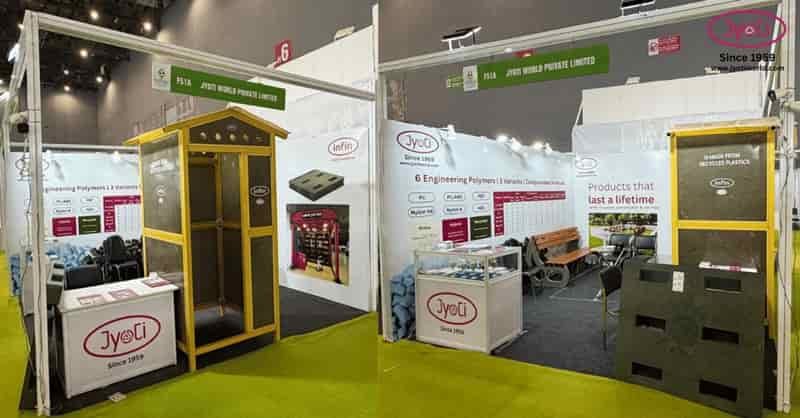
At the New Delhi event, the company showcased a manufacturing model that connects recycled raw materials, polymer formulation, tooling, moulding and finished products. Its exhibits included engineering polymer compounds and INFIN-branded benches, pallets and modular structures made with recycled plastics.
The central proposition was straightforward: plastic waste creates greater economic and environmental value when it is converted into reliable materials and products with practical, long-term uses.
From recycled waste to functional materials
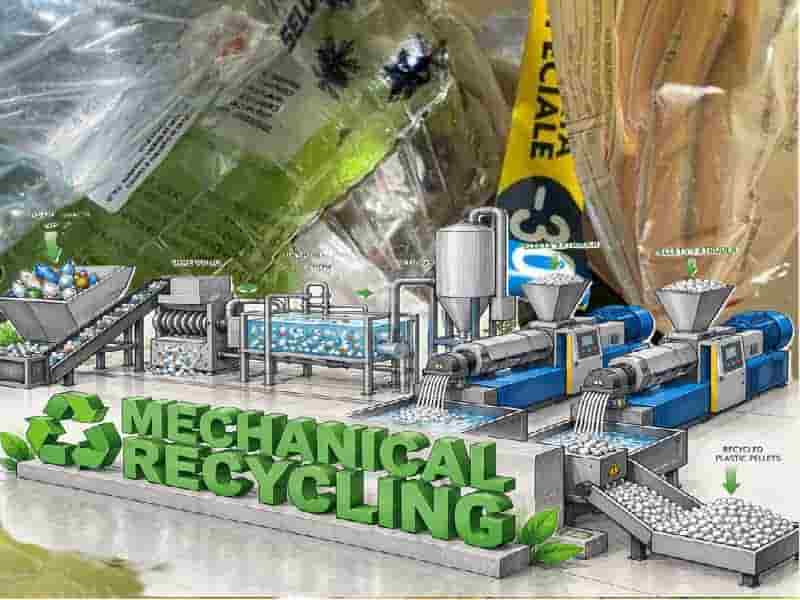
Mechanical recycling is an essential part of the circular economy, but collecting and reprocessing plastic does not automatically create a high-value material.
Recycled polymers can vary in colour, viscosity, impact resistance, thermal behaviour and contamination levels. For manufacturers, this variability can make it difficult to introduce recycled content into components that must meet precise mechanical or safety requirements.
Compounding addresses part of this challenge by modifying a polymer with reinforcements, stabilisers, impact modifiers, flame retardants, pigments or other additives. The objective is to produce a material with predictable characteristics for a defined application.
Jyoti World presented this material-engineering stage as the link between recovered plastic and industrial manufacturing.
GCPRS highlights India’s changing plastics sector
GCPRS 2026 was held from 2 to 5 July at Bharat Mandapam in New Delhi. The event was jointly organised by the All India Plastics Manufacturers’ Association and the Chemicals and Petrochemicals Manufacturers’ Association. It brought together recyclers, plastics processors, equipment suppliers, manufacturers, policymakers and sustainability specialists.
The Government of India described the conclave as a platform for recycling technologies, circular-economy practices and more sustainable plastic-waste management. Government representatives also emphasised the importance of coordinated action and the contribution of informal waste collectors to India’s recycling system.
The industry’s focus on sustainability is continuing beyond the event. On 22 July 2026, Plastindia Foundation announced the opening of a regional office in New Delhi intended to support policy engagement, skills, innovation and collaboration across the plastics value chain. The announcement also identified recycling and circular-economy initiatives as areas of activity, although it was distributed as an industry press release rather than independently reported news.
Why an integrated manufacturing model matters
Jyoti World says its operations bring several stages of production under one manufacturing structure:
-
Polymer compounding
-
Tool and mould development
-
Plastic machining
-
Profile extrusion
-
Injection moulding
-
Component assembly
-
Finished-product manufacturing
This structure can reduce the number of handovers between material suppliers, toolmakers and processors. It can also allow material formulations and component designs to be adjusted together during product development.
For an original-equipment manufacturer, this may be particularly relevant when introducing recycled content. A change in polymer composition can affect shrinkage, surface finish, mould flow, dimensional stability and part performance. Coordinating the formulation and manufacturing stages can make those changes easier to evaluate.
The claimed benefits—including shorter development cycles, consistent quality and intellectual-property protection—should nevertheless be assessed for each project through supplier audits, qualification testing and documented quality controls.
Three tiers of engineering polymer compounds
At GCPRS, Jyoti World presented compounds based on several widely used engineering polymers, including nylon 6, nylon 66, polycarbonate, ABS, PBT and PC/ABS blends.
According to the company, available formulations include glass-fibre or glass-bead reinforcement, heat stabilisation, flame-retardant options, UV resistance, impact modification and custom colours.
The materials are organised into three broad groups.
Prime compounds
Prime grades are made with virgin engineering resins and are intended for applications requiring tightly controlled or particularly demanding performance.
Hybrid compounds
Hybrid grades combine virgin and recycled polymers. This approach can increase recycled content while preserving selected mechanical, processing or visual characteristics.
Recycled compounds
Recycled grades use post-industrial or post-consumer feedstock. Their suitability depends on the application, the consistency of the incoming material and the results of technical validation.
This tiered model gives manufacturers a way to match recycled content with the actual requirements of a component rather than applying a single material strategy to every product.
Supporting EPR implementation
India’s Extended Producer Responsibility framework places obligations on producers, importers and brand owners for plastic packaging.
Government guidance establishes progressively higher minimum recycling levels. For the 2026–27 period, the minimum recycling targets listed by the government range from 50% to 70% of the applicable EPR target, depending on the packaging category.
Using recycled material can contribute to a company’s broader circularity strategy, but purchasing a recycled compound does not by itself establish EPR compliance.
Businesses must retain the appropriate records, registrations, certificates and traceability evidence required under the applicable rules. They must also confirm whether the material and its intended application satisfy technical, regulatory and product-safety requirements. recycled polymer ecosystem
Giving multilayer plastic a longer useful life
One of the more difficult parts of the plastic-waste stream is multilayer packaging.
These materials may combine different polymers or include non-plastic layers selected for barrier performance, durability and low weight. The same construction that protects a packaged product can make the discarded packaging difficult to separate and recycle into conventional applications.
Jyoti World’s INFIN product range is intended to use recycled polymers, including processed multilayer-plastic waste, in durable products where the material can remain in service for an extended period.
The products presented at the conclave covered three application areas.
ReBench seating for public spaces
INFIN ReBench products are designed for parks, campuses, transport locations, commercial developments and other shared environments.
The company positions the benches as alternatives to conventional wooden or metal seating. Claimed properties include resistance to water, rot and outdoor exposure, together with reduced requirements for painting, varnishing or anti-rust treatments.
Versions are available with or without backrests and in several finishes.
Before specifying the benches for a public project, buyers should request evidence covering structural loads, ultraviolet exposure, fire behaviour, fasteners, warranty terms and expected service life.
Re-Pallets for logistics operations
The company also displayed recycled-plastic pallets for warehouses, export operations and material-handling systems.
Plastic pallets can offer practical advantages in wet or hygiene-sensitive environments because they do not absorb moisture in the same way as untreated wood. They can also avoid splinters and termite damage.
Performance, however, depends on the formulation and pallet design. Buyers should verify static, dynamic and racking load ratings, dimensional tolerances, temperature limitations and compatibility with automated handling equipment.
Re-Shelters and modular structures
The INFIN range also includes modular panels and structures intended for shelters, kiosks, public amenities and temporary site facilities.
Jyoti World says the system is designed for rapid assembly and resistance to corrosion and weather exposure.
For deployment in public infrastructure, the relevant project authority would still need to review structural calculations, wind loading, fire performance, accessibility, foundations and local building requirements.
A broader definition of plastics circularity
The Jyoti World presentation reflected an important shift in the plastics debate.
Circularity is not only about how much waste enters a recycling facility. It is also about what happens to the recovered material afterwards, how long the next product remains useful and whether it can displace more resource-intensive alternatives without creating unacceptable safety or performance risks.
A credible recycled polymer ecosystem therefore requires several connected capabilities:
-
Reliable waste sourcing and sorting
-
Material identification and contamination control
-
Consistent compounding
-
Application-specific product design
-
Performance and durability testing
-
Production traceability
-
A practical end-of-life plan
When these elements work together, recycled plastics can move beyond low-value or short-lived uses and enter more demanding manufacturing and infrastructure applications.
What Jyoti World showed at GCPRS 2026
Jyoti World’s exhibit combined two sides of the circular plastics value chain.
The first was a portfolio of engineering compounds designed for electrical, automotive, appliance, industrial and consumer applications. The second was a range of finished products demonstrating potential uses for recycled and difficult-to-process plastic waste.
Together, the displays presented recycling as the beginning of a manufacturing process rather than its final objective.
The long-term value of this model will depend on measurable results: stable feedstock quality, verified recycled content, transparent traceability, application-specific testing and evidence that products remain safe and functional throughout their intended service lives.
Frequently asked questions
What is a recycled polymer ecosystem?
A recycled polymer ecosystem connects waste collection and processing with material formulation, manufacturing, testing and finished-product applications. Its purpose is to keep recovered plastic in productive use for longer.
What did Jyoti World display at GCPRS 2026?
The company displayed engineering polymer compounds and INFIN products, including recycled-plastic benches, pallets and modular shelter systems.
What is the difference between PIR and PCR plastic?
Post-industrial recycled plastic, or PIR, comes from manufacturing waste such as offcuts and rejected components. Post-consumer recycled plastic, or PCR, comes from products discarded after use by consumers or businesses.
Can recycled polymers replace virgin engineering plastics?
They can replace or reduce virgin material in some applications. Suitability depends on feedstock quality, formulation, processing conditions, regulations and the performance required from the finished component.
Do recycled materials automatically provide EPR compliance?
No. EPR compliance also requires the registrations, records, certificates and traceability processes specified by the applicable regulations.
What is multilayer packaging waste?
Multilayer packaging consists of two or more bonded material layers used to provide properties such as moisture, oxygen or light protection. Its mixed construction can make conventional recycling difficult.
About Jyoti World
Jyoti World Private Limited describes itself as a vertically integrated plastics processor and contract manufacturer with approximately six decades of industry experience.
Its stated capabilities include engineering polymer compounding, toolmaking, machining, extrusion, injection moulding, assembly and the production of finished recycled-plastic products.
Company-specific technical and environmental claims in this article are based on information supplied by Jyoti World and should be verified through current certifications, test reports and product documentation.
More…