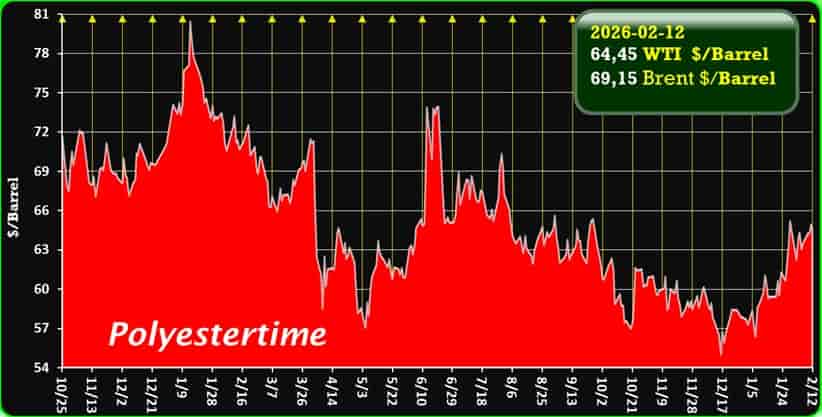
Oil Price Trend 2026: Brent ~$69.12 & WTI ~$64.42 Amid Surplus Risks and Sluggish Demand — What Global Markets Must Know Now 12-02-2026
Current Oil Price Snapshot
| Benchmark | Price (Approx) | Change vs 1 Week |
|---|---|---|
| Brent crude | ~$69.12 / barrel | Up modestly in recent sessions |
| WTI crude | ~$64.42 / barrel | Rebounding from recent lows |
These oil price levels reflect a market still assessing the balance between supply and demand, geopolitical signals, and macroeconomic data.
What’s Driving Oil Prices Now?
1. Global Supply Outlook & Inventory Build
Global crude supply continues to expand. The International Energy Agency (IEA) reported that oil output growth remains ahead of consumption increases in 2026, contributing to growing inventories.
This oversupply dynamic keeps downward pressure on prices — even as short-term disruptions provide occasional support. Recent data shows supply expansions from both OPEC+ and non-OPEC producers, while storage levels have grown materially.
Supply-Demand Balance (Simplified)
| Factor | Effect |
|---|---|
| Rising global production | Pressures oil price downward |
| Elevated inventories | Indicates oversupply |
| Maintenance outages (temporary) | Support near-term price bumps |
2. Demand Growth — Slower Than Expected
Despite forecasts for positive demand growth in 2026, the pace remains moderate relative to historical trends. The IEA projects an increase in global oil demand this year — but growth rates are constrained by weaker economic expansion and efficiency gains in consumption.
This “less-than-expected” demand growth means that rising supply might not be fully absorbed, contributing to price softness. Analysts and the IEA both see demand expansion in the mid-to-high hundreds of thousands of barrels per day, but still below long-term averages.
3. OPEC+ Policy and Production Adjustments
OPEC+ decisions remain a central influence on oil price dynamics. While the group paused production hikes recently, markets are watching upcoming meetings for changes in quotas. Supply restraint could tighten balances and support prices, while continued ample output will reinforce weaker price pressure.
4. Geopolitical Tensions and Market Sentiment
Geopolitical events in the Middle East, including discussions on tanker seizures and regional tensions, have lifted prices modestly at times. These stories inject risk premiums into markets, nudging Brent and WTI higher short-term.
Investor sentiment remains cautious: traders are price-sensitive to news flows about supply disruptions, sanctions impacts, and macroeconomic indicators like U.S. demand trends.
Investor Sentiment & Market Psychology
Early 2026 has seen layered signals:
Bullish indicators:
-
Temporary supply disruptions
-
Geopolitical risk premiums
Bearish indicators:
-
Oversupply and rising inventories
-
Slower demand growth forecasts
-
Energy transition pressures
These mixed signals create a slightly jittery outlook — traders trade around key levels but are wary of significant upward momentum without fundamental tightening.
Short-Term Outlook: Where Oil Prices May Head
Near-term scenarios:
| Scenario | Likely Price Impact |
|---|---|
| OPEC+ cuts or coordinated supply restraint | Upward pressure on Brent & WTI |
| Continued inventory build | Prices remain range-bound or decline |
| Demand surprises (strong macro data) | Short-term rallies possible |
Analysts and the U.S. Energy Information Administration (EIA) forecast oil prices could soften through 2026 if supplies continue to exceed demand, with average Brent potentially below current levels later in the year.
What This Means for the Global Economy
Consumers & Industries
Lower or stable oil prices can ease cost pressures for energy-intensive industries and consumers, cushioning inflation in transportation and manufacturing.
Energy Producers
Producers in higher-cost regions or with fiscal breakeven targets above $70–$75 may face margin pressure, potentially curbing future investment.
Policy & Transition
Persistent oversupply adds urgency to policy debates on energy security and the energy transition, especially as renewables play larger roles in demand forecasts.
Conclusion: Balanced but Cautious Energy Markets
As of February 12, 2026, Brent and WTI are trading near mid-$60s and high-$60s, shaped by ample supply, moderate demand growth, and mixed geopolitical factors. While short-term price rebounds are possible, structural oversupply and inventory buildup suggest oil price levels may remain under pressure unless coordinated policy actions tighten markets.
For global economies, this environment implies both opportunities (lower energy costs) and challenges (producer stress, transition risks) as oil markets evolve through 2026 and beyond.
More…