The End of US Shale Oil Boom Signals Risky Global Scramble Toward Venezuela and Greenland as Energy Giants Confront Slowing Domestic Growth 16-02-2026
The End of US Shale Oil: Why Energy Giants Are Expanding Abroad
5 minutes read time.
For more than a decade, US shale oil transformed the United States into the world’s leading oil and gas producer. Through horizontal drilling and hydraulic fracturing, companies unlocked vast shale formations once considered uneconomic. The result was a structural shift in global energy markets: the United States moved from a net importer of crude oil and liquefied natural gas to a net exporter, reshaping trade flows and weakening traditional suppliers.
Today, that growth story is slowing. Production remains historically high, but the rapid expansion that defined the shale era has given way to a plateau. As prime acreage in the Permian Basin and other core plays becomes increasingly saturated, major operators are reassessing long-term strategy. The new frontier for US shale oil is no longer domestic. It is global.
The American Shale Plateau
The Permian Basin in Texas and New Mexico has been the engine of US shale oil production. For years, technological improvements, efficiency gains, and access to capital fueled exponential output growth. However, industry data and operator commentary now point to a structural slowdown.
Several factors explain this plateau:
-
The most productive “sweet spots” have already been extensively drilled.
-
Well productivity gains are moderating.
-
Investors are prioritizing cash returns over aggressive expansion.
-
Oil price volatility is constraining risk appetite.
Unlike the early 2010s, when companies reinvested aggressively to capture market share, today’s financial discipline emphasizes dividends and share buybacks. This shift reflects investor fatigue after years of boom-and-bust cycles.
As a result, US shale oil production growth is flattening. Output remains significant, but the era of rapid domestic scaling appears to be ending.
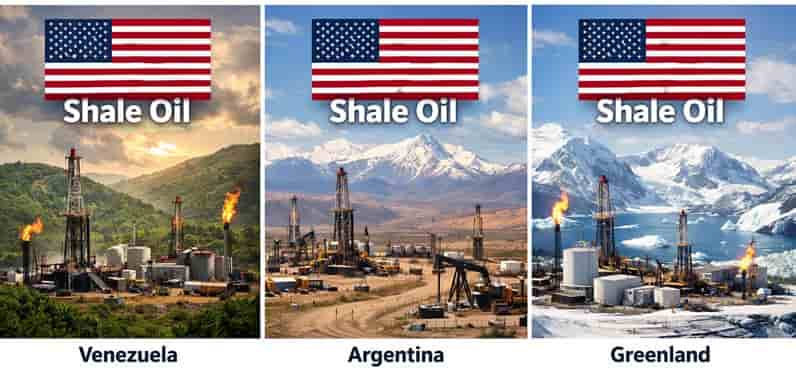
Why Venezuela, Argentina, and Greenland Matter
With domestic opportunities maturing, American energy companies are increasingly evaluating foreign shale and unconventional basins.
Venezuela
Venezuela holds some of the largest oil reserves in the world. Although political instability and sanctions have historically deterred Western investment, a changing geopolitical landscape could reopen opportunities. For companies experienced in US shale oil, the technical challenge of revitalizing underdeveloped reserves is manageable. The primary uncertainty remains political risk.
Argentina and Vaca Muerta
Argentina’s Vaca Muerta formation is widely considered one of the most promising unconventional resources outside North America. Development has accelerated in recent years, contributing to export growth and macroeconomic stabilization. The technical know-how gained from US shale oil operations is directly transferable, making Argentina a logical expansion target.
Greenland
Greenland represents a longer-term, higher-risk play. Its hydrocarbon potential is substantial but underexplored, and environmental sensitivities are acute. Still, as Arctic routes become more accessible, strategic interest is growing.
Collectively, these regions illustrate a broader pattern: American companies are exporting the shale model abroad.
Geopolitical Consequences of Global Shale Expansion
The rise of US shale oil previously reduced OPEC’s influence by increasing global supply flexibility. A new phase of international shale development could trigger another shift in global power dynamics.
If American firms expand significantly into Latin America or Arctic regions:
-
Global supply diversity may increase.
-
Strategic alliances could shift.
-
Oil price volatility may intensify.
-
Energy security calculations in Europe and Asia may change.
For decades, oil geopolitics centered on the Middle East. The shale revolution decentralized production. Now, the globalization of shale expertise may further fragment traditional supply hierarchies.
This shift could also complicate climate diplomacy. Nations balancing energy security with decarbonization commitments will face harder trade-offs as unconventional production expands.

Environmental and Regulatory Pressures
Hydraulic fracturing remains controversial. Environmental concerns associated with US shale oil include:
-
Methane emissions
-
Groundwater contamination risks
-
High water usage
-
Induced seismicity
While technological improvements have reduced some impacts, regulatory scrutiny is intensifying worldwide. Europe has implemented fracking restrictions in several jurisdictions. Public opposition remains strong in environmentally sensitive regions.
As companies move abroad, they must navigate:
-
Diverse environmental standards
-
Local political resistance
-
ESG-driven investor expectations
-
Carbon pricing frameworks
International expansion does not eliminate environmental risk. In some regions, it amplifies it.
Financial Discipline and Portfolio Diversification
Another driver behind overseas expansion is portfolio risk management. Concentration in a single basin exposes companies to regional regulatory changes, infrastructure bottlenecks, and geological limits.
By investing beyond domestic US shale oil, companies aim to:
-
Diversify geopolitical exposure
-
Secure long-term reserve replacement
-
Stabilize production profiles
-
Enhance global competitiveness
For shareholders, this strategy may offer resilience. For host nations, it can bring capital inflows and technology transfer. However, political stability remains a prerequisite for sustained investment.
Implications for Europe and Energy Transition Policy
For European policymakers, the evolution of US shale oil raises structural questions. Energy transition strategies assume declining fossil fuel reliance. Yet global supply diversification may lower prices and extend hydrocarbon competitiveness.
Key policy tensions include:
-
How to reconcile climate targets with energy security needs
-
Whether unconventional oil development delays renewable investment
-
How carbon border mechanisms interact with globalized fossil supply
If shale expansion accelerates outside the United States, Europe may confront a paradox: greater supply security alongside heightened climate policy complexity.
A Structural Turning Point in Global Energy
The shale revolution fundamentally altered global energy markets. The slowdown of domestic US shale oil growth does not signal collapse, but it marks a structural turning point.
Production is stabilizing. Capital discipline is tightening. And technological expertise is becoming an export asset.
The next chapter of shale will likely unfold in emerging basins rather than Texas alone. Whether this expansion stabilizes global supply or intensifies geopolitical friction remains uncertain.
What is clear is that the age of purely domestic shale dominance is ending. A more interconnected, politically sensitive, and environmentally scrutinized global phase has begun.
More…