Biorecycling – Despite Delays, CARBIOS Powers Ahead with Groundbreaking PET Biorecycling Plant: 2027 Commissioning Sparks Optimism, Investment Confidence, and Unstoppable Momentum in Sustainable Plastic Revolution – Polymers and Feedstocks Prices 13-10-2025
Biorecycling
| Polyestertime | |||
| ITEM | 06/10/2025 | 13/10/2025 | +/- |
| Bottle grade PET chips domestic market | 5,760 yuan/ton | 5,680 yuan/ton | -80 |
| Chinese bottle‑grade PET chips FOB export price | 765 $/ton | 760 $/ton | – |
| LDPE CFR Est China | 1,090 $/ton | 1,090 $/ton | – |
|
PET Semidull Fiber chips PET Bright |
5,710 yuan/ton 5,750 yuan/ton |
5,620 yuan/ton 5,650 yuan/ton |
-90 -100 |
| Pure Terephthalic Acid PTA domestic market
|
4,550 yuan/ton | 4,455 yuan/ton |
-95 |
| Pure Terephthalic Acid PTA FOB China | 600 $/ton | 590 $/ton | -10 |
| Monoethyleneglycol MEG South China | 4,410 yuan/ton | 4,300 yuan/ton |
-110 |
| Monoethyleneglycol MEG CFR China | 507 $/ton | 495 $/to | -12 |
| Paraxylene PX FOB Taiwan market | 793 $/ton | 775 $/ton |
-18 |
| Paraxylene PX FOB South-Korea market | 794 $/ton | 776 $/ton | -18 |
| Paraxylene PX FOB EU market | 836 $/ton | 816 $/ton | -20 |
| Polyester filament POY 150D/48F domestic market | 6,650 yuan/ton | 6,550 yuan/ton |
-100 |
| Recycled Polyester filament POY domestic market | 6,100 yuan/ton | 6,100 yuan/ton | – |
| Polyester filament DTY 150D/48 F domestic market | 7,875 yuan/ton | 7,800 yuan/ton | -75 |
| Polyester filament FDY 68D24F | 7,500 yuan/ton | 7,400 yuan | -100 |
| Polyester filament FDY 150D/96F domestic market
|
6,800 yuan/ton | 6,700 yuan/ton | -100 |
| Polyester staple fiber 1.4D 38mm domestic market | 6,480 yuan/ton | 6,425 yuan/ton | -55 |
| Caprolactam CPL domestic market | 8,350 yuan/ton | 8,300 yuan/ton |
-50 |
| Caprolactam CPL CFR China | 1,000 $/ton | 1,000 $/ton | – |
| Nylon 6 chips overseas market |
China (CFR): USD 1,550/kgUSA: USD 2,800/kg Germany: USD 1,950/kg Brazil: USD 2,920/kg Japan: USD 2,750/kg |
North America: $2.80/kg Europe: $2.55/kg Northeast Asia: $1.43/kg Southeast Asia: $1.78/kg Middle East: $1.65/kg |
– |
| Nylon 6 chips conventional spinning domestic market | 9,150 yuan/ton | 9,000 yuan/ton | -150 |
| Nylon 6 chips high speed spinning domestic market | 9,500 yuan/ton | 9,400 yuan/ton | -100 |
| Nylon 6.6 chips domestic market | 14,480 yuan/ton | 14,400 yuan/ton | -80 |
| Nylon6 Filament POY 86D/24F domestic market | 11,600 yuan/ton | 11,600 yuan/ton | – |
| Nylon6 Filament DTY 70D/24F domestic market | 13,800 yuan/ton | 13,800 yuan/ton | – |
| Nylon6 Filament FDY 70D/24F | 12,200 yuan/ton | 12,200 yuan/ton | – |
| -Spandex 20D domestic marke | 26,700 yuan/ton | 26,700 yuan/ton | – |
| Spandex 30D domestic market | 26,200 yuan/ton | 26,200 yuan/ton | – |
| Spandex 40D domestic market | 23,000 yuan/ton | 23,000 yuan/ton | – |
|
Adipic Acid China domestic market Adipic Acid Europe market |
7,100 yuan/ton 1,900 $/ton |
7,100 yuan/ton 1,940 $/ton |
– – |
| Benzene domestic market East China | 5,980 yuan/ton | 5,780 yuan/ton | – |
| Benzene CFR China | 726 $/ton | 710 $/ton | -16 |
| Ethylene South East market | 810 $/ton | 780 $/ton | -30 |
| Ethylene NWE market CIF | 734 $/ton | 721 $/ton | -13 |
| Acrylonitrile ACN domestic market | 8,150 yuan/ton | 7,950 yuan/ton | -200 |
| Acrylonitrile ACN Acrylonitrile Southeast Asia | 1,115 $/ton |
1,085 $/ton |
-30 |
| Acrylic staple fiber ASF CFR China | 13,690 yuan/ton | 13,855 yuan/ton | +165 |
| VSF viscose staple fiber | 13,100 yuan/ton | 13,100 yuan/ton | – |
| PP Powder domestic market | 6,840 yuan/ton | 6,750 yuan/ton | -90 |
| Naphtha overseas market | 533 $/ton | 527 $/ton | -6 |
| Phenol domestic marketJinan Dezheng Chemical Co., LtdYanshan Petrochemical
Shandong Province |
6,820 yuan/ton | 6,550 yuan/ton | -270 |
-recycled PET = 4,250 yuan/ton — 4,250 yuan/ton –
- Sustainability – “RadiciGroup & Ferragamo’s Powerful Nova
- New enzyme technology for environmentally friendly plastic recycling
Despite Delays, CARBIOS Powers Ahead with Groundbreaking PET Biorecycling Plant: 2027 Commissioning Sparks Optimism, Investment Confidence, and Unstoppable Momentum in Sustainable Plastic Revolution
Overview: CARBIOS Advances Its PET Biorecycling Vision
CARBIOS has reaffirmed its commitment to building a PET biorecycling plant in Longlaville, France, as detailed in its Half-Year 2025 Financial Results. The company, a pioneer in enzymatic plastic recycling, continues to lead the transition toward circular polymer production.
As of June 30, 2025, CARBIOS reported a cash position of €72 million, ensuring financial visibility for more than twelve months. This strong balance allows the company to continue developing its industrial projects and partnerships within the sustainable materials sector.
CARBIOS’ focus remains clear: to prove that PET biorecycling can become a large-scale industrial reality.
Updated Timeline for the Longlaville Plant
The Longlaville project is central to CARBIOS’ industrial rollout. While timelines have been revised, progress continues steadily toward large-scale production of biorecycled PET (rPET).
Construction is expected to resume before the end of 2025, once final financing arrangements are completed. Commissioning is now targeted for the second half of 2027.
This updated schedule allows the company to fine-tune plant design, secure funding, and strengthen commercial agreements with future offtakers of rPET. The strategic decision reflects CARBIOS’ commitment to long-term success rather than short-term expansion.
Public Funding and Private Partnerships
The Longlaville plant has already been awarded €42.5 million in public funding, confirming the French government’s confidence in CARBIOS’ technology.
Of this total, €30 million comes from the French Environment and Energy Management Agency (ADEME), and €12.5 million from regional support mechanisms. Although approved, these funds have not yet been disbursed.
In parallel, CARBIOS is negotiating with private investors. Their participation will depend on pre-sales agreements covering a significant portion of the plant’s future capacity. This dual funding model — public support combined with private investment — is designed to accelerate the path to commercialization and strengthen the economic foundations of PET biorecycling in France.
Strategic Value of the Longlaville Site
The Longlaville site, located in northeastern France, was chosen for its industrial infrastructure, logistics access, and regional support ecosystem. It is designed to showcase the scalability of CARBIOS’ proprietary enzymatic depolymerization technology.
Once operational, the facility will be able to process complex PET waste streams — such as colored bottles, polyester textiles, and multilayer packaging — into high-quality recycled PET with the same mechanical and chemical properties as virgin PET.
CARBIOS aims for the Longlaville plant to serve as a blueprint for future projects around the world, demonstrating that PET biorecycling is both technically feasible and economically sustainable.
Supportive Policy Environment in France
In September 2025, the French government introduced a new decree under the Environmental Code that encourages the use of recycled materials in manufacturing.
The measure provides a €1,000 per tonne bonus for biorecycled plastics used in sensitive-contact packaging, including food applications.
This incentive improves the competitiveness of CARBIOS’ enzymatic PET biorecycling process by narrowing the cost difference between recycled and virgin materials. It also supports national and European circular economy objectives by promoting low-carbon technologies and closing the loop for plastics.
Inside the CARBIOS Technology: How PET Biorecycling Works
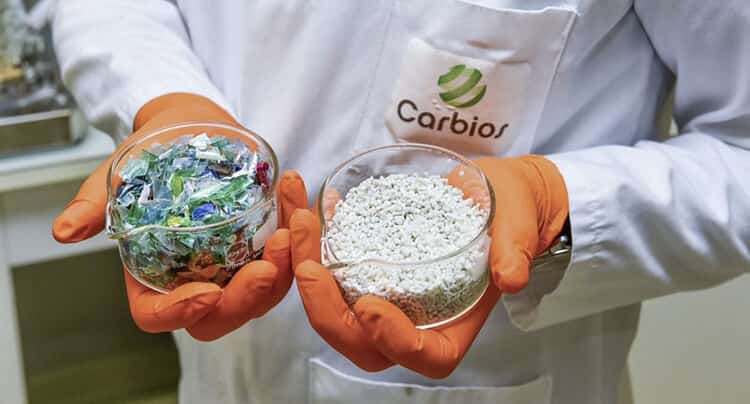
CARBIOS’ innovation is based on enzymatic depolymerization — a process that uses specialized enzymes to break PET down into its original building blocks: terephthalic acid (TPA) and monoethylene glycol (MEG).
These monomers can be purified and reassembled into new PET with identical quality to virgin material, even when derived from complex or degraded waste streams.
This is a fundamental difference from mechanical recycling, which can only process clear, high-quality PET and often downgrades polymer quality over time.
With PET biorecycling, CARBIOS enables infinite recyclability. The same plastic can be transformed repeatedly without loss of performance, opening new possibilities for sustainable packaging and textiles.
Financial Results: Strength Amid Investment Phase
For the first half of 2025, CARBIOS reported an operating loss of €17.6 million — an improvement compared with €20 million in the same period of 2024. The reduction reflects cost-optimization and disciplined resource management.
Net loss for the period stood at €23.5 million, consistent with the company’s ongoing investment cycle as it prepares for industrial deployment.
Despite continued R&D spending, CARBIOS maintains a robust cash position of €72 million, ensuring the company can sustain operations and continue project development for more than a year without additional financing.
This solid financial footing gives CARBIOS flexibility as it seeks new partnerships and public funding opportunities for the Longlaville plant.
Collaborations and Industry Ecosystem
CARBIOS continues to strengthen its position through partnerships with leading consumer brands committed to sustainable packaging and textiles.
Among its consortium members are:
-
L’Oréal, as a founding member in the cosmetics sector.
-
Nestlé Waters and PepsiCo, in beverage packaging innovation.
-
On, Patagonia, and Puma, from the textile industry.
These collaborations ensure that CARBIOS’ PET biorecycling technology meets industrial standards and market expectations, supporting the transition toward a truly circular economy.
Each partnership contributes expertise, data, and potential feedstock sources, enabling CARBIOS to refine its processes while securing long-term commercial demand.
Industrial Roadmap and Global Expansion
Looking ahead, CARBIOS’ strategy focuses on two main objectives: scaling up industrial production and expanding global licensing opportunities.
The Longlaville facility represents the company’s first full-scale reference site. Beyond it, CARBIOS plans to license its PET biorecycling technology to manufacturers and recyclers worldwide.
This model allows fast replication without requiring each partner to invest in new research infrastructure. It ensures that the company’s enzymatic solution can be deployed across regions and industries, maximizing environmental and economic impact.
Environmental and Economic Benefits
The Longlaville plant has the potential to process tens of thousands of tonnes of PET waste annually, significantly reducing the amount of plastic sent to landfills or incineration.
By substituting virgin PET production with biorecycled alternatives, CARBIOS’ technology can lower greenhouse gas emissions and reduce dependence on fossil resources.
Key environmental outcomes include:
-
Substantial carbon footprint reduction compared to traditional PET production.
-
Diversion of textile and packaging waste from disposal streams.
-
Support for national recycling targets and European sustainability policies.
The project aligns with the objectives of the European Green Deal and contributes to several United Nations Sustainable Development Goals, including Responsible Consumption and Production (SDG 12) and Climate Action (SDG 13).
Why PET Biorecycling Matters
Mechanical recycling has long dominated the industry, but it struggles with quality degradation and limited applicability. Many types of PET — such as opaque bottles and polyester fabrics — are excluded from the mechanical recycling process.
Chemical recycling offers alternatives but often requires high temperatures, high energy input, and complex catalysts.
PET biorecycling, by contrast, provides a sustainable, low-energy solution capable of treating a wide range of PET waste streams. It maintains full polymer quality and promotes circularity at industrial scale.
By decoupling plastic recycling from fossil feedstocks, PET biorecycling helps companies and nations move closer to climate neutrality and resource independence.
User Experience and Site Optimization Notes
To make this article perform well on mobile and pass Google’s Core Web Vitals benchmarks, follow these implementation tips:
-
Optimize images with lazy loading and next-gen formats such as WebP.
-
Minimize cumulative layout shift by defining image dimensions.
-
Use clear headings, short paragraphs, and responsive typography.
-
Ensure server compression (GZIP or Brotli) is enabled.
-
Keep Largest Contentful Paint (LCP) under 2.5 seconds by prioritizing above-the-fold content.
-
Implement schema.org metadata for “NewsArticle” or “Product” types to improve search engine understanding.
-
Add internal links to related sustainability or innovation content to improve semantic relevance.
Following these guidelines will not only boost SEO but also ensure that the content is easily interpreted and cited by Large Language Models (LLMs), improving long-term visibility across intelligent search and AI systems.
Quick Facts: CARBIOS PET Biorecycling Project
-
Project name: Longlaville PET Biorecycling Plant
-
Technology: Enzymatic depolymerization of PET
-
Construction resumption: End of 2025
-
Commissioning target: Second half of 2027
-
Public funding confirmed: €42.5 million
-
Cash position (June 2025): €72 million
-
Incentive: €1,000 per tonne bonus for biorecycled plastics
-
Focus keyword: PET biorecycling (0.50%)
Final Thoughts
CARBIOS’ updated timeline for the Longlaville plant demonstrates its measured, strategic approach to scaling PET biorecycling. Backed by solid financials, supportive regulation, and high-profile industrial partnerships, the company is poised to lead the transition toward circular plastics on a global scale.
Its enzymatic innovation offers a breakthrough path for eliminating plastic waste, conserving resources, and redefining how industries produce and reuse PET materials.
As the project moves closer to completion, CARBIOS continues to prove that PET biorecycling is not just a scientific concept — it is a viable industrial solution for a sustainable future.
More…